
The Oxford-Cambridge Supercluster publish their list of requirements for new ministers
“I thought the people voted in a majority of MP-candidates that were on the Labour Party’s ticket?”
You’d think so, wouldn’t you?
But for the Oxford-Cambridge Supercluster it feels like business as usual – and you can see their members here. They published their list of policy proposals summarised as:
- Make the Oxford-Cambridge region the ‘crown jewel’ of European science and innovation.
- Accelerate the delivery of [laboratory] space through the introduction of an ‘innovation’ use class.
- Allocate each regionally and nationally significant infrastructure project its own independently supervised taskforce.
- Improve R&D [Research and Development] incentives and permit permanent top-up tax relief for new-to-market R&D.
- Broaden training in R&D-intensive industries through the early introduction of a Growth and Skills Levy.
- Work with universities to support spinouts, and with industry to ensure start-ups have access to the finance they need to grow.
Above – from https://www.supercluster.org.uk/news
I first picked up on the Ox-Cam-Supercluster back in December 2023 in this blogpost, noting that some members of the Supercluster were also ‘members of members’ of the supercluster – eg Cambridge Ahead – a supercluster member of which, some of whose members are also members of the same supercluster.
“This is an example of an organisational diseconomy of scale. With so many people and firms being members of each others institutions and organisations, it makes it harder for anyone to work out where power and influence actually resides. For a start, there’s the inevitable risk of duplicating meetings. Do you go to a meeting of Cambridge Ahead to debate what their corporate position should be, or do you go along to the supercluster meeting as a member in your own right? Or do you go to both?”
A regional spatial plan for the Ox-Cam Region?
Looking into the detail of their proposals, the phrase ‘Oxford-Cambridge Region’ is particularly jarring. The reason being its creation has not come from a grassroots movement to improve how we are governed and how decision-makers are held accountable democratically (and not just by the ballot box), but rather this feels like the creation of a small group of powerful and influential institutions seeking to extract as much wealth as they can from the people and land between the two ancient universities.
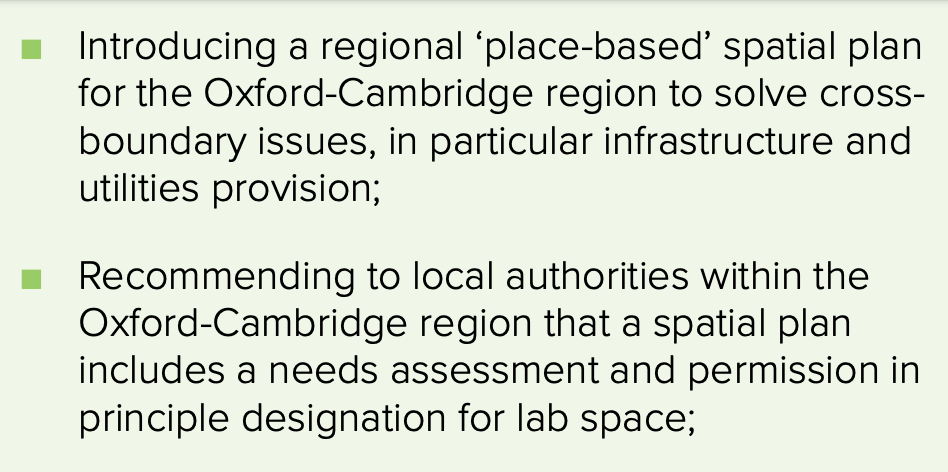
Above – Supercluster briefing July 2024 p3
The briefing cites the Radical Capital Report from Bidwells and Blackstock in aid.

Above – Radical Capital (Bidwells/Blackstock) 2021
That report was published to help make the case for the OxCamArc – a policy which angry Conservative backbenchers forced Michael Gove to water down, and then abandon. It remains to be seen what the new generation of MPs do should they be re-presented with it in the face of the ecological and water crises – on top of the news that Thames Water (which supplies Oxford) is now in breach of its operating licence because some of its bonds have been downgraded to ‘junk’ status.
Is the sci-tech sector demonstrating an ignorance of democracy and political legitimacy of decisions that affect people’s lives?
In their call for 1) – making the ‘Ox-Cam Region’ the ‘crown jewel…’ their document concludes at the end of that section:
“Doing all of this will require addressing the fragmented nature of local government in the region and installing effective and competent leadership to deliver a pan-regional strategy.”
***Do they know how difficult it is to reorganise local and regional government?!?***
Possibly not given that this incredibly difficult piece of policy and politics is dropped in almost as a throwaway remark. What would it be like if those that were pushing strongest for this were the ones that also had to face the public day-after-day-after-day? It’s as if they were completely oblivious to the political catastrophe of the Greater Cambridge Partnership’s road user charging proposals – where the business sector was conspicuous by its relative silence in the debate. That said, the business sector didn’t have a very good time in the EU Referendum Campaign – as the chair of the Remain Campaign, former M&S chief Stuart Rose conceded.
“Asked if the country’s captains of industry could have done more to convince voters to back the status quo, he pointed to disaffection between the “man in the street and big business
““There has been a loss of trust and we need to think about how to rebuild that,” Rose said. “It has happened over time, since the last recession, whether it’s the banks or the crisis in the eurozone or a business being run in a way people don’t like.”“
What makes the sci-tech sector think that the general public trusts them?
That lack of trust was on display again at a recent public consultation for a sci-tech development in my neighbourhood – the consultants representing the developers conceding that their timetable for getting the planning application through was ‘ambitious’ and that trying to rush the application through during the school summer holidays was not a good look. (There’s still time to have your say on whether this site allocated for housing in the Cambridge Local Plan 2018 should be turned into a sci-tech site. After all, what’s the point on having a ‘Regional Place-based Spatial Plan if your sectors are willing to ignore existing local development plans signed off by ministers?)
The sci-tech sector (and the big financiers behind it) do not understand Politics, just as too many politicians and too much of the general public (myself included) do not understand what’s happening in the sci-tech world. (How do we bridge those gaps?)
Which comes back to Stuart Rose’s point in the article above about ‘Business’ and ‘Politics’ speaking different languages. Furthermore, the Grenfell Inquiry exposed appalling practices across the construction industry that led to a collapse in trust.
“UK Construction Sector is ‘a Building Site’ for Fraud and Corruption”
“A new report developed by Crowe in conjunction with the University, shows that construction has a corruption problem on a scale that outstrips many other sectors“
Above – University of Portsmouth 22 Oct 2021
Why should local residents trust the sci-tech sector with its demands when it is going to be commissioning firms in a construction sector that is “A Building Site for Fraud and Corruption”?
Furthermore, there remains a chronic skills shortage in the construction industry – reflecting a strategic public policy failure from ministers and also from construction firms in their collective failures to invest in their own workforces as well as incentivising more people to switch careers from other industries that have an over-supply of people.
Above – little mention in public policy circles of *paying people to learn new skills in sectors that have chronic skilled labour shortages*
The sci-tech sector risks alienating communities by ignoring their multiple needs
The Grafton Centre in Cambridge is a classic case. The site was allocated for retail amongst other things but catastrophic management by the previous owners combined with the collapse of the high street retail chains due to asset stripping and the growth of internet shopping meant that this vision below from the Supplementary Planning Document for The Grafton was…ambitious.
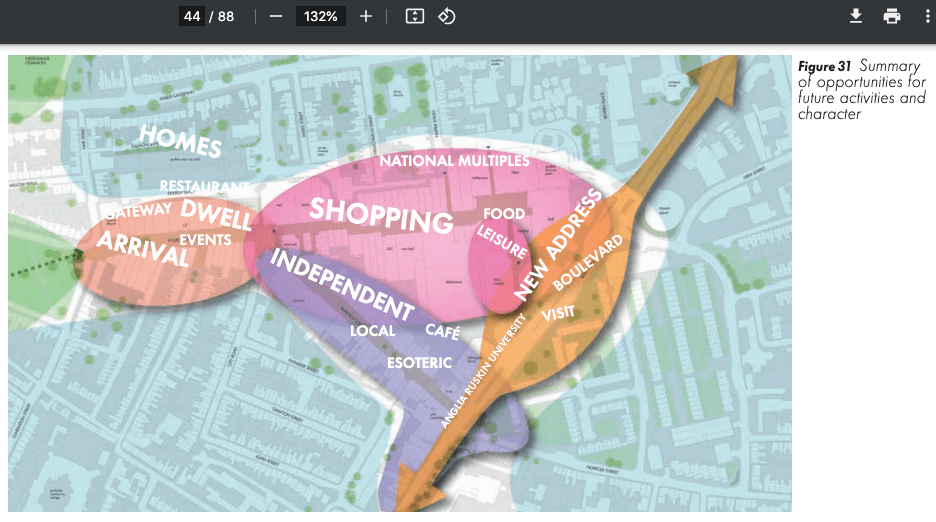
Above – Grafton Centre SPD 2018
The loss of both The Grafton Centre and The Beehive Centre as retail centres serving mainly communities on low incomes both within and outside Cambridge has been a bitter blow to those affected. Furthermore, the minimal attempts at engagement from the developers to meet their needs – in particular with The Grafton site, has been woeful.
The risk of over-dependence on very few industries
Students of economic and social history will tell you of what can happen if a settlement becomes over-dependent on a single industrial sector or a small number of large employers. The closure of one has a knock-on impact all along the local supply chains and service industries. Just because Cambridge has the reputation of being a university city does not mean our city has not been affected. A browse through the post-war decades is littered with the metaphorical corpses of large employers having closed.
- PYE of Cambridge
- Chivers of Histon
- Cambridge & District Co-operative Society
- Cambridge University Press (printing)
…not to mention the heavy industries by the railway station and along Newmarket Road. And that’s before we consider the collapse and closure of so many leisure industries in the post-war era, from music halls to cinemas and other community venues.
I’m in favour of overhauling how England is governed – not just Cambridge and Cambridgeshire
Recall that Parliament signed off a select committee report recommending a national overhaul back in 2022. The question for the new government is whether it will empower local government to stand up to the demands of powerful and influential sectors to ensure they pay for the negative externalities of their business activities. That includes substantial levies to pay for the much needed rail-based public transport given the scale of their ambitions. Furthermore, ministers should avoid the risk of aiming to have everything in Cambridge – rather as I wrote here, come up with an industrial strategy that enables expanding firms to relocate to neighbouring county towns such as Bedford and Northampton along a new fast rail corridor. Not everyone can go punting on the River Cam if the city’s population and tourist numbers continue to rise. There won’t be space on the river – and given Anglian Water’s record most of it will be sewage anyway. (Just like in the Victorian times!)
The serious issue is what limits to growth ministers are prepared to impose that the environment and ecology cannot do alone. That means not giving already wealthy sectors a free rein – but rather saying that they are going to have to take some very considered decisions about paying their fair share towards the costs of maintaining and sustaining our city, county, and economic sub-region. For a start, who should pay for the massive public transport improvements? And shouldn’t they be in place before the sci-tech developments?
You only have to look at the state of Market Square and the pot-holed street in front of the Guildhall as large numbers of tourists and language school groups trundle past. Our failure to manage numbers of both (and it’s not the fault of either the tourists or language students individually) not only causes resentment from local residents, but also means that the former two groups do not get the best experience that our city could provide because our civic institutions are prevented from raising revenues from the firms benefiting in order to provide more, better services. Such as:
- a substantial tourist information centre
- better and regularly cleaned public toilets
- visible policing when people are most vulnerable
- active support for homeless people in one of the most unequal cities in the country
It’s a fine balance between working with business and industry for economic prosperity, but it should not be done at the expense of the people of our city, county, and region – however defined. Government, business, finance, and industry should all be the servants of the people. Not their masters.
Food for thought?
If you are interested in the longer term future of Cambridge, and on what happens at the local democracy meetings where decisions are made, feel free to:
- Follow me on Twitter
- Like my Facebook page
- Consider a small donation to help fund my continued research and reporting on local democracy in and around Cambridge.

 The Cambridge Town Owl