…and more are looming. Is anyone keeping up with the impact this is having on our city and the villages surrounding it? I’m hoping The Cambridge Room (soon to be opened) will provide a space to discuss this.
The calendars to keep a watch on are:
- Cambridge City Council
- South Cambridgeshire District Council
- Cambridgeshire County Council, & the Greater Cambridge Partnership
- Cambridgeshire & Peterborough Combined Authority
As you may also have seen, the pace at which reports have been published and consultations being produced has resulted in a flurry of blogposts throughout July 2024 which you can browse through the headlines of here. (If you find them useful and can afford to in this cost of living crisis, please help contribute towards my research and writing). Furthermore, I’m in the process of organising some new workshops and events online and offline – see the summary here. These will include things that start from the basics through to how the newly-elected Labour Government and its new policies are affecting the future of our city and county – and might affect them further. Only as my previous blogpost shows, influential lobbyists are already trying to bring back things that were dismissed by the previous government – such as the OxCamArc. Hence the importance of transparency, propriety and scrutiny in decision making, and an informed and active civic society.
The top two decisions from Central Government – Northstowe and Sunnica Solar Farm by Newmarket
- The Energy Secretary approved the Solar Farm
- The Minister for Housing intervened in Northstowe, designating Homes England as the Master Planner for the new town centre in the face of multiple failures by developers.
Additionally…
- Ministers from the previous Conservative Government approved the development around Cambridge North despite significant issues over water use, and concerns from Cambridge Past, Present, and Future.
On top of this, additional developments have been approved more locally, including:
- The conversion of The Grafton Centre into a sci-tech hub
- Anglia Ruskin’s grey creative quarter
- The Westbrooke demolition off Milton Road by Mitcham’s Corner for a new sci-tech thing
- Cambridge Cancer Hospital approved
- A new aparthotel on Mitcham’s Corner where Staples used to be
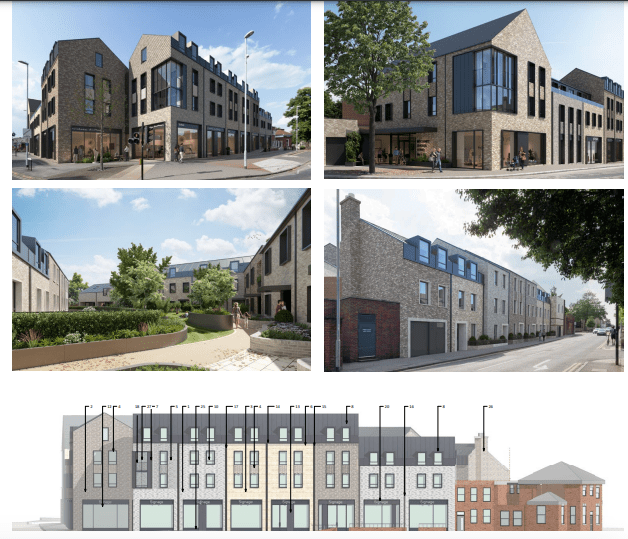
Above – the new Aparthotel approved for Mitcham’s Corner from the Committee’s plans pack here
Have I missed any out?
One has come back with more papers – the Land South of Coldham’s Lane one south of Cambridge Airport. They have submitted a public art strategy dated 18 July in the list of nearly 600 documents, so it’s on the first page here.

Above – I quite like this concept as a means of significantly improving active travel access over the very narrow existing Tins Bridge over the railway line between Cambridge & Newmarket.
Can we have some gatherings to consider the cumulative impact of the applications and developments?
By that I mean sessions where participants come away far more informed about what is going on, where, and what impact it might have /is having on our city and county?
That is *not the same* as inviting people to simply rock up, have a rant, and go home again.
What I’ve got in mind is somewhere where interested people can meet up in a place that has:
- maps and diagrams
- architectural drawings
- design and access documents,
- pictures/photos/CGIs,
- transport documents,
- public art plans
- environmental assessments…and so on
Furthermore I’d like them to have both the full and ‘plain english/picture rich’ copies of official reports that are accessible to people who are both unfamiliar with the technical language and/or may have a reading comprehension of someone at secondary school. And I don’t mean that in the pejorative sense – quite the opposite. Just because someone has a degree in English literature does not mean they will be able to make sense of the complex technical language common in the construction design sector. This also came up at the future of Cambridge event when I had a brief discussion with someone about the merits of GCSE and the old A/S level in citizenship studies vs A-level politics. The latter is designed for academia and/or a career, while the former is designed to be applied in real life day-to-day situations.
Finally, at such gatherings I think it would be great to have students of further and higher education participating – along with their teachers and lecturers so they can come up with school/college/university research topics the results of which could influence future decisions. These could involve:
- number-crunching – for example how many homes/units were promised in each development and what was the total, vs the number actually built
- comparing visually what was promised vs what was built, and accounting for the differences on a specific site
- Examining the types of jobs that were promised vs the numbers actually created/the levels of occupancy for new employment sites
This has got to go beyond the attention of those that follow politics closely, and into the wider public discourse
That inevitably means doing something new and different. (Or even going back to something that was done well before but for whatever reason fell by the wayside)
Not least because there is one looming document coming to the Combined Authority in September 2024: The CPCA Local Growth Plan
I mentioned this in an earlier blogpost, indicating that the 2022 strategy published here would need a refresh. Interestingly, the papers for the Environment & Sustainable Communities Committee of the CPCA for 31 July 2024 indicated that this is going to happen.
“The final report was due to be reported and presented to July Committee. However, after discussion with the Place Director’s Group & workshops of 3 and 11 July it was agreed that:
The narrative would need to be developed to fit with a Local Growth Plan
The consultants are now undertaking that final revision, with a completion date of 26 July.
The proposal would be to share that document with Place Directors and then develop a detailed response and plan with linkage to the Local Growth Plan to present to the September 2024 Committee.
A new Government may require some refinement of the document to align to new opportunities and policy positions
Some additional clarifications to the technical work were required to align with existing Local Planning evidence.“
Above – Item 10 Para 3.3. of the Infrastructure Delivery Framework
This follows on from the briefing the Mayor gave to the CPCA Board a few days ago:
“Following the meeting at Downing Street, Mayors travelled to the Transport for London office where they were joined by Minister of State Jim McMahon OBE MP from the Ministry of Housing, Communities & Local Government (MHCLG), as well as their respective Chief Executives. The discussion focussed on the development of the Local Growth Plans and contribute to the work on the National Industrial Strategy.
Over the coming weeks the UK Mayors will continue this engagement and work collaboratively to develop the Local Growth Plans and across our region we have already commenced this important work.
The team have conducted desk-based research, using previous agreed documents and strategies, along with the investment prospectus which has been developed for UKREiiF [which I moaned about here], to prioritise key strategic projects.”
Above – CPCA Board 24 July 2024 Item 10 Highlight Report para 3.1
“What are the previous agreed documents and strategies?”
Things like the previous economic growth strategy 2022, the CPCA Independent Report on Climate, and the Local Plans currently in place and also the emerging ones, such as those overseen by the Greater Cambridge Shared Planning Service. Oh – and the Local Transport and Connectivity Plan here.
So…heavy reading?
Yes – but with the purpose of trying to come up with something that makes sense to the general reader while enabling individuals with specialist knowledge and/or an intense interest in a particular subject or geographical area to go into the detail that the rest of us might otherwise miss.
Food for thought?
If you are interested in the longer term future of Cambridge, and on what happens at the local democracy meetings where decisions are made, feel free to:
- Follow me on Twitter
- Like my Facebook page
- Consider a small donation to help fund my continued research and reporting on local democracy in and around Cambridge.
Below: Connect Cambridge. Given the scale of growth that has happened since 2016 when the first iteration was published, and given the future direction of growth, my firm view is we should scrap the busway planning and move to light rail.

 The Cambridge Town Owl