
Our city will never be greater than the sum of our parts unless ministers remove the barriers (especially financial and legal) that crush local politicians, community activists, and civic society alike.
Then the rest is up to us.
Or rather, that doesn’t mean that in the meantime we sit back and do nothing. Whenever a local politician runs a community event online or offline, there’s nearly always a question that begins along the lines of…:
“…Yeah, what are you going to do about…?”
We saw this in the run up to the general election at several of the hustings – one such example being here where I called out the points made in one round of questions. Note I framed my Q as being about our collective lack of knowledge being a public policy problem for politicians to respond to rather than blaming the individual persons for not asking a better-informed question.
“Does that mean you’re going to force everyone to sit exams on politics?”
No.
Furthermore, the idea that improving individual and collective knowledge involves a course on something followed by an exam is part of the cultural problem. Perhaps not surprising in a city where one of the major employers has a revenue of over £1billion per year of which much comes from the existence of examination. One question I put to Cambridge City Council just before the summer break was:
“What discussions will the council have with partner organisations to organise, co-ordinate, and sequence consultation events for future proposals that affect the future of our city and beyond, and what actions could the council take including but not limited to:
- A shared single meetings/consultations calendar for public sector
organisations (such as local councils which can scrape calendar data) - Annual ‘societies fairs’ similar to the students unions freshers fairs for
societies - civic education for adults mindful of some of the questions that were put to
the general election candidates that indicated a collective lack of
knowledge on how our city functions and malfunctions - Developer-funded events that bring together multiple proposals for
residents to look at in the round rather than piecemeal and at short notice
as at present?”
You can listen to the response from Cllr Alice Gilderdale in this video.
Market Square, Cambridge as a microcosm of the challenges our city faces
While at the longstanding sweetstall at Cambridge Market, I overheard a conversation between a couple of market locals pointing out how the e-scooter delivery vehicles were blocking the pavement – as below.

Above – Market Square by M&S in Cambridge
The people talking about the issue said that this was the result of Cambridge City Council and Cambridgeshire County Council having their own civil enforcement officers – which are separate to Cambridgeshire Police. Each different officer is responsible for different issues. Blocking a pavement vs blocking a road requires a different sort of civil enforcement officer to deal with each. And only if things escalate can a police officer get involved. Yet from a residents’ perspective, they don’t care who is responsible for dealing with the issue – they just want it dealt with. The problem was that there weren’t enough civilian enforcement officers to go around anyway because the last government imposed austerity on councils and police forces to the extent that too many people behave in a manner as if the law does not exist.
There are also a host of issues that arise from Cambridge being a globally-recognised city with residents that come from all over the world to live/work here: We provide no means for new arrivals to learn about not just the law, but also civic conventions (such queuing and ‘not pushing in’.) That’s hardly surprising given that the state hardly provides for such things for children, students, and longstanding residents either. This is not an issue where people can blame incomers – this applies to all of us, and so do the solutions to the problems.
Compulsory outsourcing and privatisation enabled firms to splash their brands all over the place – at the expense of displays of civic pride.
A historical timeline behind the compulsory outsourcing and tendering of public services can be found here from nearly 20 years ago. The inertia from the late 20th Century under Margaret Thatcher still lingers.
“1980: Compulsory competitive tendering (CCT) first introduced for construction, maintenance and highways work by the Local Government , Planning and Land Act 1980.”
Patrick Butler in The Guardian, 2003.
Years ago I moaned to the county council about their Wembley-Stadium-Grade streetlights they had installed that blazed into my bedroom. I was sent on a wild goose chase before Balfour Beatty installed a pathetic little strip of metal that only partly solved the problem – at which time I gave up. And put the firm on my mental ‘don’t like’ list of contractors. The design of the streetlights is a significant contributor towards local light pollution. And yet we have the technology to reduce the pollution and automate when they come on – i.e. movement detectors.
At the same time, local history circles inevitably pick up the logos of the municipal councils of old that commissioned what is now known as ‘street furniture’ as local government’s responsibilities expanded in the 1800s in the face of continued new legislation from Parliament to deal with public health crises and the negative externalities associated with urbanisation and industrialisation. Lamp posts (street lighting to reduce crime), drain covers as part of new underground sewage systems, through to bus stops, park benches, and railings. You could say it helped remind people of where they were and who was in charge and also responsible for what – for better or worse!
“1982: Health authorities instructed to introduce competitive tendering for support services, such as catering, cleaning, portering and estates maintenance.”
Patrick Butler in The Guardian, 2003.
Want to know why so many hospitals and other public services have private companies providing the support services? Central Government policy. This also explains why there was significant pressure from trade unions and campaign groups to persuade Labour to adopt policies to reverse this.
Above – the We Own It campaign gives their five reasons to support insourcing here
The civic presence – public and active transport
One of the things the proposed bus franchising will bring in is a single brand for transport for Cambridgeshire & Peterborough. i.e. there won’t be the multiple logos and branding of the various bus firms involved. Personally I hope it’s the first step towards full on nationalisation, where additional money from the state is spend on new vehicles rather than on shareholders’ dividends. That also means the overhaul of local government in Cambridgeshire also needs to be dealt with at the same time so we don’t end up having to go to through an expensive rebranding process.
On active travel and rental e-scooters and e-bikes
A similar principle could – and in my opinion should apply. I find the bright corporate colour schemes jarring with the wider street views. Interestingly a couple of the larger hotels such as the University Arms have done a much better job with their colour scheme (sky blue and/or Cambridge blue) which is visually less intrusive than bright orange).
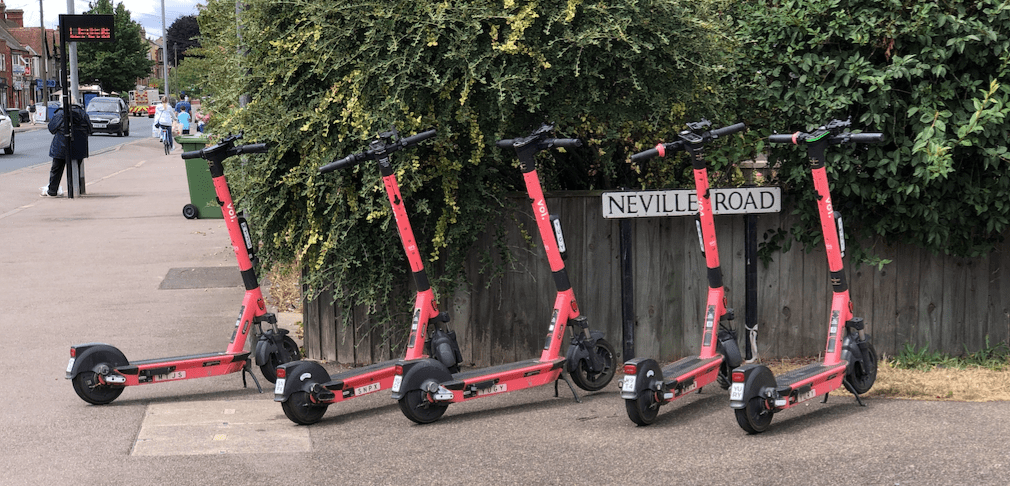
Above – the lack of docking stations has also been a long-standing complaint
If the Combined Authority is willing and able to use similar principles to bus franchising, they could do the same for e-scooters and e-bikes. It doesn’t matter who provides them, but you’re all having the civic branding and colour schemes that apply for the city rather than your own corporate colours.
Reversing the privatisation of public spaces
In one part of Cambridge where buses regularly travel through to pick up/drop off passengers, you’ll inevitably find the signs reminding you that you’re on private land. Another one is the Cambridge Leisure Park where The Junction is. I wrote about what one former sixth form college student told me in this blogpost last year – i.e. how generations of politicians had failed our county’s teenagers past (including my generation) and present. In a nutshell the over-concentration of places in such a small part of our county combined with underfunding of independent study spaces (lack of capital funding from ministers) meant that many further education students were either moving to the central library (great for the latter) or, when they turned 18, to pubs and bars that had wifi connections. At the same time, they also get harassed by private security guards on the Cambridge Leisure Park if they are not buying something.
Not so far from that development is this strange sign – cropped so as not to name
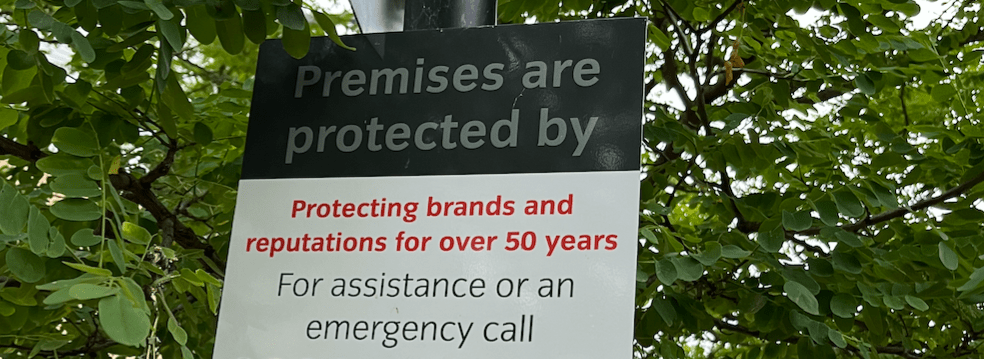
Above – who should private security firms (if they should exist at all) be protecting? People and neighbourhoods? Or brands and reputations?
In the latter case, the sketch by those former Cambridge Footlights chaps Laurie and Fry applies.
This for me reflects what Cambridge has become over the past several decades. It reflects a mindset of decision-makers that puts people and places last, and profit-maximisation first. We’ll know if the new government has succeeded in reviving local civic pride if, amongst other things we see far fewer signs like this.
Food for thought?
If you are interested in the longer term future of Cambridge, and on what happens at the local democracy meetings where decisions are made, feel free to:
- Follow me on Twitter
- Like my Facebook page
- Consider a small donation to help fund my continued research and reporting on local democracy in and around Cambridge.
Want to talk more about the future of Cambridge the town? Get involved with Together Culture on Fitzroy Street opposite Waitrose.

 The Cambridge Town Owl