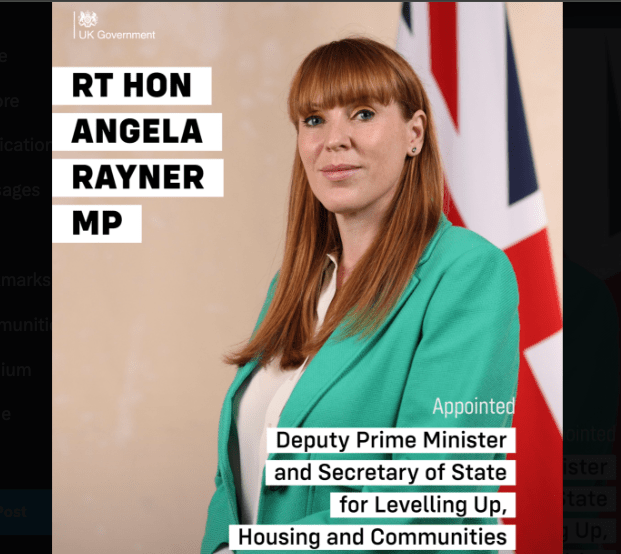
The new Deputy Prime Minister gave the sector a lot to ponder over as Parliament dispersed for the summer recess.
You can watch her statement to the Commons here, and read the press release here
“And the all-important consultation?”
You can read the consultation here – and if you are interested in the questions being asked, see here. Deadline 24 Sept 2024
“How will these affect Cambridge?”
That’s what local council officers will have to figure out over August as they crunch the policy detail and present it to councillors to discuss and thrash out. This wasn’t the only policy announcement from Westminster that councils all over the country will have to assess.
Cambridge City Council has already approved a move to impose a council tax premium on second homes in Cambridge (See here – noting ministers will need to close this and other loopholes in the looming planning legislation).
“Second homes premiums could generate in the region of £1m. A further £50k could be raised from an empty home premium being applied after 1 year instead of the current 2 years although this is more difficult to predict as eligibility of a property for this premium changes over time.
In practice these figures could be lower and impacted by customer behaviour including redesignating primary residences or switching properties into Business Rates.
Overall financial benefit is likely to diminish over time as there will be an incentive to bring those properties back into use and therefore they will not attract a premium.”
Cambridge City Council – 25/03/34 – Council Tax Premiums on 2nd Homes and Long Term Empty Property (400k file)
So council officials are already on some of the issues. The most important thing is whether it will change behaviour – which is what the policy objective is. The Welsh Assembly Government gave their local councils stronger powers – the example of Tenby on the Pembrokeshire Coast being striking – noting they also dealt with the ‘small business’ exemption.
Playing with the datamap from Jen Williams in the FT here, it seems that Cambridge’s house building target has risen by 55% compared with the previous method of measuring.

Above – Jen Willams for the FT, 30 July 2024
Going through the hard data on the number of homes we’re looking at annually, I’ve assumed that the ‘Current method’ is the previous target, the ‘Proposed method’ is under the new government’s calculations, and the final column on the right is how many homes were actually completed (accounting for demolished old homes on redeveloped sites) and averaged over the three year period.
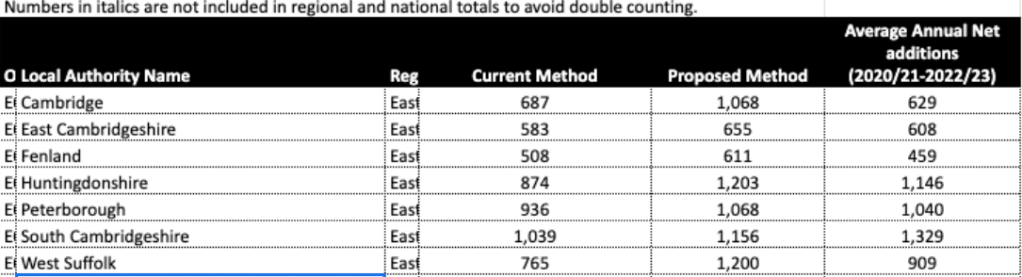
Above – from the data published by the MHCLG
“That’s a lot of new homes Cambridge has to build!”
The problem is that local councils don’t build houses anymore. So unless ministers are proposing something significant on that front, we risk being stuck with the same paper targets – with developers only building to a level that maintains profit.
Not only that, the chronic skills shortages along with the huge problems exposed by the Grenfell Inquiry require action from the rest of government.
What the MPs asked of the Deputy PM
You can read the transcripts here. Things I picked up in the exchanges (which also shows the importance of MPs being able to question ministers with informed questions):
Land value capture
The longstanding Chair of the Commons Housing, Communities & Local Government Committee, Clive Betts MP asked: “Will she ensure that when the planning permission for a site uplifts the value of that site, the total increase in value does not go to the landowners alone, but is used to benefit the public purse and reduce the cost of building those homes?”
The DPM responded: “As for land value capture, there is a little bit about it in the consultation document, but there will be more in the forthcoming planning and infrastructure Bill.”
Which looks like some form of Land Value Capture – long overdue, will be included in the legislation coming up later this year.
Enabling councils & housing associations to borrow against the value of existing housing stock to fund new development
Daisy Cooper MP – deputy leader of the Lib Dems asked about this. It’s not clear in the consultation where this is covered, although the DPM says they are consulting on it. Either way, it will need Treasury clearance – and chances are Rachel Reeves MP as Chancellor will authorise this whether in full or in part.
Council planning services being cost recovering – thus stopping council tax payers subsidising big developments
Daisy Cooper pressed on this again following Michael Gove’s refusal to commit to this. This is a very clear item in the Government’s consultation at Chapter 11 – a long overdue move in my opinion. This is something that Cambridge City Council and South Cambridgeshire District Council should start preparing for now, because that flexibility should mean they can compete on the open market against the private sector to fill their town planning vacancies.
Resources and powers to compel developers to build infrastructure first.
The DPM confirmed to Daisy Cooper that Section 106 (of the TCPA 1990) would be strengthened, but did not say how in response to the question. This is likely to be addressed in detail in the consultation for the looming planning bill as that bill may need to make provision for amending the TCPA 1990 to strengthen that piece of legislation.
On updating local plans
Cambridge & South Cambridgeshire have an up-to-date local plan. “Councils that have an up-to-date local plan will not be made to start again.” Said the DPM.
“There are a lot of questions to answer in the consultation”
Given how important the policy changes are – and given that inevitably it will be the powerful lobbyists that will be making the most noise, this can’t be a simple ‘fire-and-forget’ sort of consultation. Or one where the individual can think/believe that their area of interest is going to turn on a sixpence in the face of their response.
During my civil service days I was part of a team that had to process and analyse consultation responses. The consultation process needs a major overhaul as it is. In the meantime, my advice is to get involved in a national campaign group that closest-aligns with your views. For some of you it will be an environmental charity. For others it will be a social housing campaign. For others it might be a public transport pressure group.
We should have some community meetings about the consultation – as a means to help inform and educate local residents about both how national and local government function, and how the planning system functions
That means starting with some of the basics about Parliamentary Sovereignty, the Rule of Law, and how ministers can, by tabling legislation in Parliament (and having it enacted) can change what councils can and cannot do. Furthermore it will need to cover what the standing of a manifesto commitment means in Parliament
“We will immediately update the National Policy Planning Framework to undo damaging Conservative changes, including restoring mandatory housing targets.”
Labour Party Manifesto 2024, p37
You can’t blame Labour for doing what they said they’d do in their manifesto – noting that the convention in the House of Lords is that where The Government tables a new bill before Parliament that is enacting a clear manifesto commitment, the Lords will not block it – for ‘The People have spoken’.
What the Lords can and will do is table amendments to the legislation where they believe specific clauses do not do what ministers say they intend it to do. Or perhaps where a clause gives too much power to a minister that goes beyond a manifesto commitment, and the Lords seek to rein it in. Easier said than done given the battles of the previous parliament.
There are things that community groups and campaign groups can discuss and lobby on.
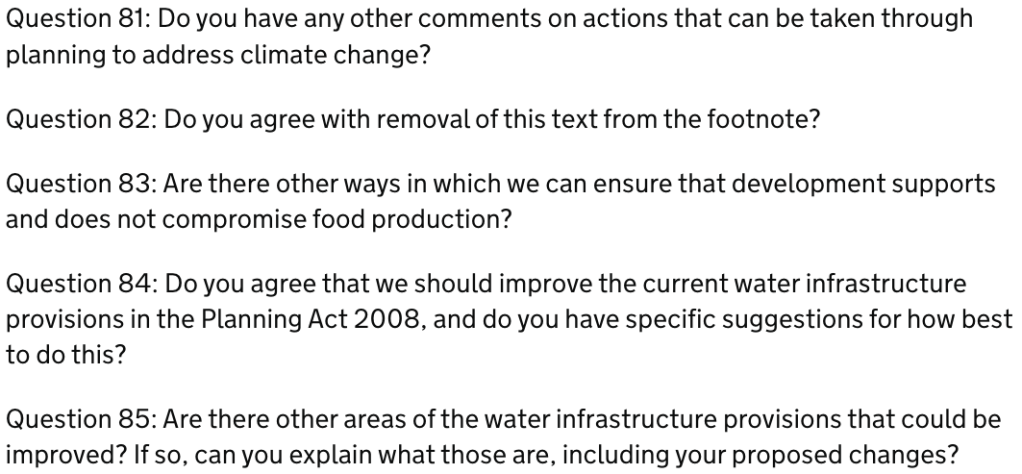
Above – questions on both climate change and water resources
This is where any such meeting would need to have someone who is familiar with the subject area and on the essentials of planning law/policy either to chair such an event or be on-hand to explain to people what ministers are both proposing, and are also likely to be open to (or completely opposed to) on any new policies *that require clauses in a new Act of Parliament*
Food for thought?
If you are interested in the longer term future of Cambridge, and on what happens at the local democracy meetings where decisions are made, feel free to:
- Follow me on Twitter
- Like my Facebook page
- Consider a small donation to help fund my continued research and reporting on local democracy in and around Cambridge.
One such space to discuss these is at Together Culture on Fitzroy Street opposite Waitrose.

 The Cambridge Town Owl