Insights from an old report from 1981 can provide insights for future education and skills policies for adults and the lifelong learning sector
You can browse through the report here
I found the report in Plurabelle Books of Coldham’s Road in Cambridge – you can search their online catalogue on ABE Books here.
As always, the contents pages speak volumes

Above – NIACE 1981 pp6-7
The advisory council under whose auspices the 1981 report was published, was abolished by Margaret Thatcher’s Government a few years later – you can read the former’s final report here which marked the start of the long term decline of adult education provision and also the declining presence of lifelong learning centres as civic institutions across towns and cities.
‘A community learning centre in every town’ demanded the Commons Education Select Committee in 2020
I wrote about that report here during one of the lockdowns – a report that has been ignored by the Conservatives. It remains to be seen what the new government has planned. For those of you so-minded, you can email your MP and ask them to contact the Minister for Lifelong Learning (Jacqui Smith) to ask them what their new policies will be in the context of that Select Committee Report here.
The statistics that struck me were ones from 1978 on the percentages of course types provided.

Above – NIACE 1981 pp15
Remember that this was pre-Thatcher and reflects social culture as much as anything else. You can explore the more recent data here, but I’ve not found a like-for-like comparison.
“In those local education authorities where adult education is organised through specialised adult education centres and/or schools, the further education colleges’ contribution to the sciences for adults is likely to be mostly GCE O level subjects, and the few initiatives in the provision of basic science are often left by the colleges to the adult education service.
“However, where adult education provision is based in further education colleges, there is evidence of basic science and technology courses being offered, consistent with the colleges taking an active role in the general education of adults.*
“A very few local authorities have adult education colleges with purpose built science facilities and specialist staff; here, provision of basic science courses for adults is likely to be at its greatest.”
Above – NIACE 1981 pp15
I’ve highlighted in bold the final paragraph. As I’ve mentioned, Cambridge does not have a civic adult education or lifelong learning college compared with the days of old. Compare that with the course offer of one of Anglia Ruskin University’s predecessor institutions, CCAT on East Road in the mid-1950s.
The structural changes imposed by central government effectively split and merged a series of institutions to create what was Anglia Polytechnic University in the early 1990s based at East Road for its Cambridge campus, and Cambridge Regional College which opened its flagship site in 1993. The latter then got rid of its academic provision in the mid-2000s, focusing on vocational studies.
“There’s a post-graduate thesis exploring the story of further education in and around Cambridge and comparing the decisions made with the political theories and doctrines that ministers across the decades were following at the time.”
Above – Lost Cambridge – Overhauling Further Education in late 20thC Cambridge
“What were the options suggested in 1981 for basic science education for adults?”
You can browse through them here. In a nutshell:
- Expand provision
- Make the curriculum more stimulating and innovative
- Provide much better learning materials
At the moment, provision feels almost non-existent. Basic skills courses focus mainly on literacy and numeracy. Personally I think the content and materials of those courses could be given a stronger applied local democracy and day-to-day living essentials for participants, but it’s not something I’d suggest imposing without their input on how the content could help them with their needs and aspirations.
Paid training and day-release: recommendations from the 1960s
Now this was a very interesting find – a policy document commissioned by the then Minister for Education.
Above – You can read the digitised version here
They have 12 recommendations which make for interesting reading today which you can browse through here. As a quick list:
- Set a target for an additional 250,000 young people to gain paid day release for further education over the next five years (which would have doubled the number at the time)
- Industrial training boards (later skills councils – presumably now part of the Combined Authority) should focus their efforts on day-release from employment
- Local councils/education authorities should set local targets dependent on local circumstances (but in line with national ones) and undertake sustained public relations campaigns (including 1-2-1 interviews with employers) to achieve the increases necessary. Basically what Dorothy Enright did in Cambridge 100 years ago.
- Central government should fund additional buildings needed, with local education authorities building them – and ensuring that the teachers are recruited in good time
- Early priority should be given to young people
- Young people taking evening classes should be supported by educational institutions in making the case for day-release – even advocating directly for them.
- Central government & local education authorities should encourage continued education especially for young people who otherwise do not receive much training in their employment (i.e. low-skilled jobs)
- Public sector organisations should show leadership in making provision for and authorising day release for their staff for training and education
- Age should not be an issue
- Evening classes couple with day release should be encouraged but not made a condition of day-release
- Employers should devote practical attention to the further education of all of their staff – in particular as a means to reduce inequalities in society
- Central Government should assess what statistical information is needed (for collection and publication) to help local areas plan day release policies
Now, compare all of the above with what we have today in/around Cambridge
Only the next Combined Authority Skills & Employment Committee meeting is on 09 September 2024. And they would be delighted if someone other than me started tabling public questions. Not least on what contribution the sci-tech sector could make, and what the public sector needs to put in place to make it easy for them to do so.
Food for thought?
If you are interested in the longer term future of Cambridge, and on what happens at the local democracy meetings where decisions are made, feel free to:
- Follow me on Twitter
- Like my Facebook page
- Consider a small donation to help fund my continued research and reporting on local democracy in and around Cambridge.
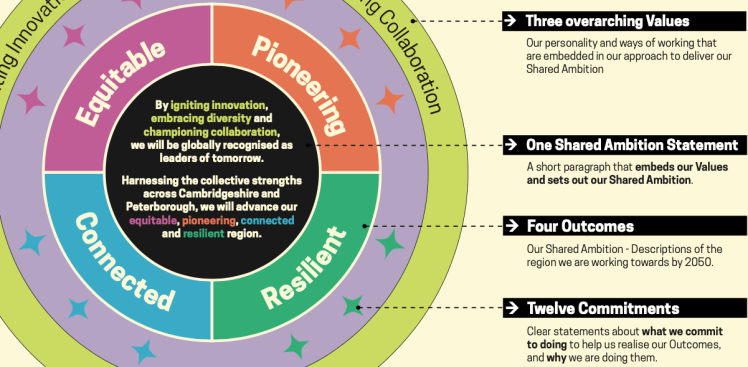
A reminder of the CPCA’s Shared Ambition consultation – which must include lifelong learning – surely?
 The Cambridge Town Owl