
Housing Minister Matthew Pennycock MP spoke to BBC Radio Cambridgeshire following the housing policy announcement on Newtowns
You can listen to the interview here from 1h43m
The Government has made ***lots*** of new announcements
The challenge is keeping up with them – and then working out how they are linked to each other. Then you’ve got to work out what they mean locally. Which is easier said than done.
You can find the announcements page here
The list of announcements includes:
- Government launches rapid review to meet Environment Act targets
- Over 1,000 more GPs to be recruited this year
- Deputy Prime Minister’s letters to:
- Press release on house building targets
- Housing Minister’s letter to the construction industry
- Newtowns Taskforce press release
- Transport infrastructure review on the £2.9bn spending gap
What the Deputy Prime Minister said about the proposed Planning and Infrastructure Bill
“We’ll introduce a Planning and Infrastructure Bill that will
- Reform planning committees so that they focus on the right applications, with the necessary expertise.
- Further reform compulsory purchase compensation rules so that what is paid to landowners is fair, but not excessive.
- Enable local authorities to put their planning departments on sustainable footings.
- Streamline the delivery process for critical infrastructure.
- And provide any legal underpinning that may be needed to ensure that nature recovery and building works hand-in-hand.“
Above – from the Deputy PM’s statement to Parliament
There is so much in all of the above – where do we start?
One place is in the recruitment of town planners.
“I recognise that delivering on the above ambition will demand much from local authorities and capacity is strained. We want to see planning services put on a more sustainable footing, which is why we are consulting on whether to use the Planning and Infrastructure Bill to allow local authorities to set their own fees, better reflecting local costs and reducing financial pressures on local authority budgets.
“While legislative change is important, we also do not want to wait to get extra resource into planning departments – which is why I am consulting on increasing planning fees for householder applications and other applications, that for too long have been well below cost recovery. We know that we are asking a lot more of local authorities, and we are clear that this will only be possible if we find a way to give more resources.”
Above – Housing Minister to Metro Mayors, 31 July 2024
For anyone wanting to find out about how the Greater Cambridge Planning Service will deal with this, you can table a public question to Cambridge City Council’s Transport and Infrastructure Committee for the 24th Sept 2024. In particular:
- pay rises for qualified town/transport planners
- re-advertising existing vacancies, and
- updates on conversations with Anglia Ruskin University on providing new town planning courses in Cambridge (They have them in Chelmsford)
The Housing Minister on Newtowns
“The Newtowns Taskforce will identify suitable locations across the UK for largescale settlements. They might be classic greenfield sites, they might be urban extensions”
Housing Minister Matthew Pennycook MP to Ben Schofield of BBC Cambridgeshire, 01 Sept 2024, 1h43m
One of the prime sites I think will be at Six Mile Bottom as I wrote in 2021 – one that speculative developers have already snapped up the rights for. The difference will be that ministers are tabling legislation that will reduce the profits they can make by capturing the land value uplift to pay for the much-needed infrastructure. I also mentioned Dullingham nearby as a site earlier in 2024, a suitable for a newtown given the presence of an existing railway station and rail line, surrounded by fields. The simple fact being for ministers that it is far cheaper for the Government to upgrade an existing ‘transport corridor’ than to start from scratch. You can see more in Rail Future East’s manifesto of June 2024
“The homes that come forward in the Newtowns programme will be in addition to the [existing targets]”
Housing Minister Pennycook.
Which means that what is in the 2018-30 Greater Cambridge Local Plan *cannot* be used as part of the Newtowns target. Which also makes me wonder about what will happen with the emerging local plan for 2031-40. Which is one of the reasons why I think they’ll be looking at the villages between Cambridge and Bury St Edmunds as possible sites.
“Where’s the water going to come from?”
This is something that ministers look like taking a much more active role in dealing with.
“…we are testing whether to bring a broader definition of water infrastructure into the scope of the Nationally Significant Infrastructure Projects regime.”
Housing Minister to Local Council Leaders, 31 July 2024
Which in one sense shows some leadership by saying ‘We’re on it’ – hence explaining the recent planning permission granted for Bourn Airfield’s development by South Cambridgeshire District Council despite the Environment Agency’s clear objection over water resources. If things screw up, that’s on ministers. Which tells me that they will be putting huge pressure on the water companies to improve their performance.
“Water constraints in Cambridge and the wider East of England are a serious issue and must be tackled. It’s certainly something we must give much more attention to”
Housing Minister Pennycook on BBC Cambs
Given past form, I wouldn’t be surprised if the word ‘nationalisation’ starts being thrown around far more often. Because Labour’s backbenchers are unlikely to tolerate a situation where water companies continue to make huge profits while the taxpayers and bill payers are seen to subsidise the improvements that the Conservatives promised privatisation would bring in the early 1990s.
“We will work with local areas to come up with a shortlist of sites from which the Government will select from”
Housing Minister Pennycook on BBC Cambs
The challenge for South Cambridgeshire District Council and East Cambridgeshire District Council is whether they can agree on a potential site east of Cambridge that could become a Newtown.
“How do you stop developers from landbanking?”
This was a question Ben Schofield put to the Minister – not least because in and around Cambridge the developers have not built out the planning permissions already secured. Some of the sites allocated in the Cambridge Local Plan 2006 were still under construction as I wrote here in 2021.
“Since 2015, over a million homes granted planning permission in England and Wales have been left unbuilt, according to the inaugural Planning Portal Market Index”
Above – from PBC 27 June 2024
This inevitably caught the headlines for a few minutes in the general election campaign, but housing policy experts highlighted a number of issues related to it such as time lags (outline permission to reserved matters etc) and undercounting of lapsed permissions, through to the need to secure financial backing and contracting/sub-contracting the firms to build.
Mr Schofield challenged the minister on the lack of infrastructure and community facilities in both Cambourne and Northstowe – again which came up in the general election campaign
“This infrastructure first problem is something we must succeed on… …There are changes we’ve made to the planning system framework, but it’s not a solution with a simple easy answer…you can expect to hear more.”
Housing Minister Pennycook on BBC Cambs
“How big will Cambridge grow?”
Understandably he didn’t want to put a number on it given he’s only been in post for about three weeks – and that was after an exhausting general election campaign. But I got the sense he’s far more open about the barriers and limits to growth – and the role of central government in overcoming them rather than ‘leaving it to the market’.
“We’re ambitious for Cambridge. It’s constrained economically by a lack of housing so we want to see significant growth. We need to assess where the previous govt got to, and re-engage local leaders and communities in a discussion about how we do growth well in Cambridge. I got the sense that there was a lot of top-down and not a huge amount of engagement with elected local leaders.”
Housing Minister Pennycook on BBC Cambs
There are also a few party political considerations beneath the statement
– not least the Cambridgeshire County Council elections in 9 months time and counting – along with the combined authority elections.
I’m assuming ministers will table the necessary legislation to reverse the voting system changes the previous government brought in, which means that the chances of Nik Johnson being re-elected are significantly higher than before. Note he won in 2021 on the basis of second preference votes from Liberal Democrat voters, coming from behind the incumbent Conservative James Palmer to win. That’s not to say it’ll be a guaranteed win for him or any other candidate.
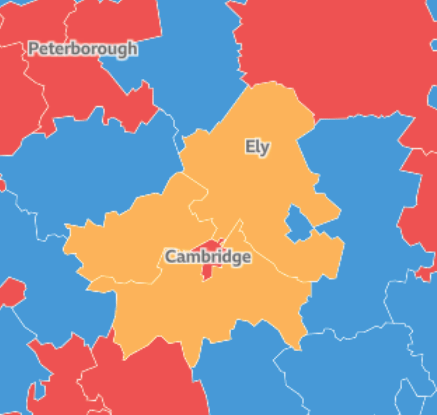
Above – the constituencies of Cambridgeshire plus some of the bordering ones post-July 2024
The organisational hit that the Conservatives have taken county-wide is significant. They’ve lost the infrastructure that came with having six of the previous seven seats in Parliament in the CPCA area – now left with only two of the eight given the additional constituency added by the boundary commission. In the meantime, the Liberal Democrats have risen from zero parliamentary seats to three. (Ian Sollom is advertising for staff – as are many other new MPs on W4MP). Having paid permanent staff who can campaign for you in their spare time can make a significant difference on the ground. It’s not unusual to have MPs employing local councillors as support staff. Sometimes they are existing staff who stand for local election and win, while other times it’s existing elected councillors that apply for the vacancies. It’s not lost on the current parliament that many MPs are former councillors – as are a number of the new ministers. The question remains as to who will put themselves forward as party candidates – given the massive £5,000 deposit for CPCA candidates.
“Which of Gove’s proposals will remain?“
The essential bureaucratic functions stay as they are – but the manner in which they work looks likely to change.
“The Cambridge Growth Company [wholly owned by Homes England, an Executive Agency of the Ministry of Housing, Communities & Local Government] remains in existence and its work continues – including the work of Peter Freeman who is the Homes England link. We’ll have a reset moment with the growth of Cambridge where we assess how we go forward in the appropriate way. We’re not putting a number on new homes but we do want to see significant growth”
Housing Minister Pennycook on BBC Cambs
The line seems to be that Government policy is pro-growth. The question is how to achieve it in a sustainable manner that brings local communities with them. Therefore the only place for ‘in principle’ party political opposition is with The Green Party. I expect they will gain vote shares in the county council elections as a result – noting they are already favourites to win the divisions of Abbey and Newnham in Cambridge. The neighbouring county councils of Norfolk, Suffolk, Hertfordshire, and Essex are also up for election along with county councils across England. Given that Cambridge’s economic sub-region crosses county boundaries, we could see some interesting results over the county border. Especially if options for newtowns sites designed to meet Cambridge’s housing demand are announced before voting day in May 2025.
“What’s his definition of ‘Cambridge’ geographically’?”
He didn’t say, but the point about the economic reach of Cambridge is one he’ll need to address. Because if we are looking at *how people live* rather than administrative boundaries, we can see from Cambridgeshire Insight’s latest housing bulletin (edition 60) how far across county borders the rental market goes.
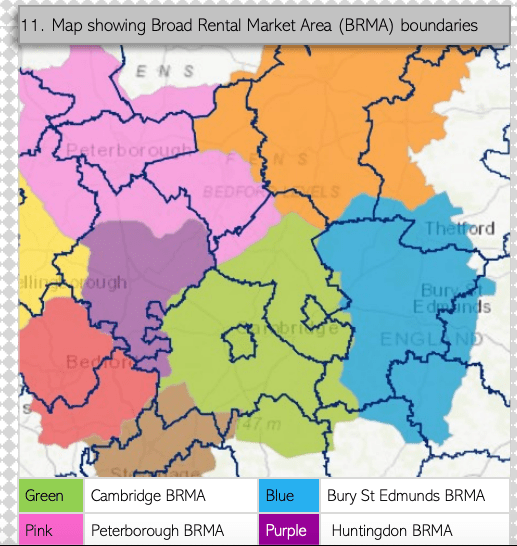
Above – Cambridgeshire Insight Housing Market Bulletin Edition 60
In previous blogposts, I’ve also looked at different historical definitions of Cambridge in the 20th and early 21st centuries.

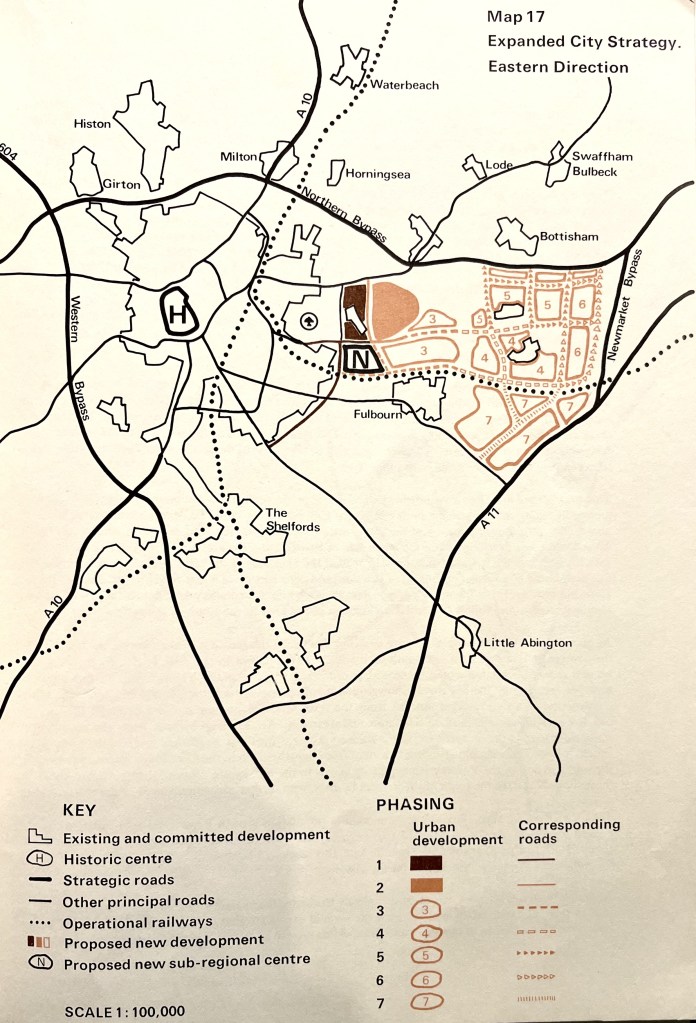
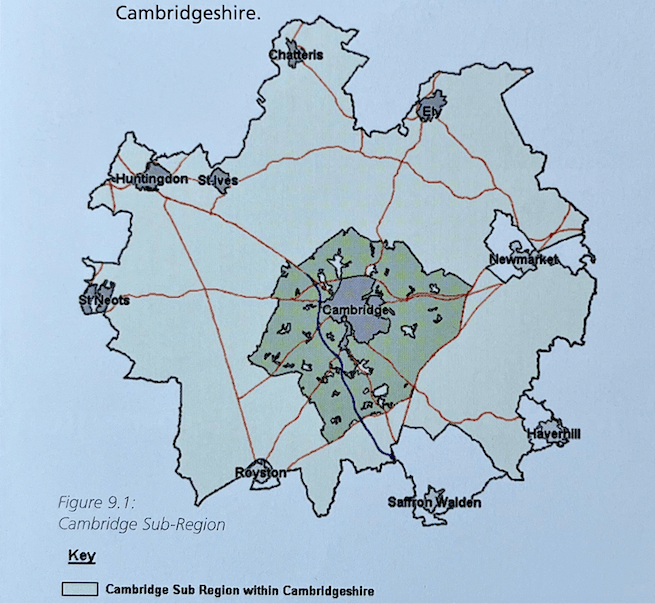
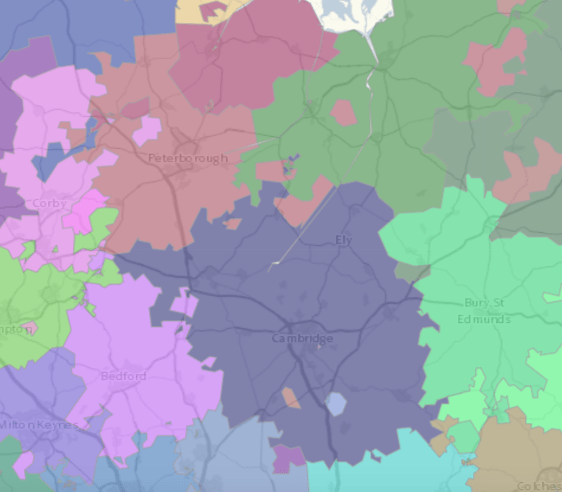

Above – clockwise from top-left:
- Redcliffe-Maud’s proposals from the Royal Commission on Local Government 1966-69
- John Parry Lewis’s proposal for an eastward urban extension of Cambridge, 1974
- Cambridge economic sub-region – from Tony Blair’s government, early 2000s
- Cambridge travel-to-work area for bus travellers – ONS 2011
- The old Cambridge County Council (1889-1964) with Cambridge Borough Council in its 1913-34 boundaries.
As the Redcliffe-Maud report showed, the commuting distances increased dramatically between the early and mid-latter 20th Century.
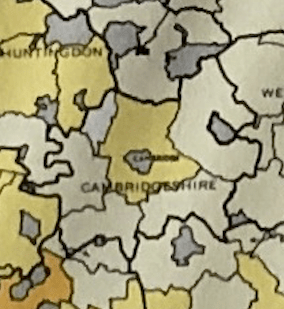

Above – from the Redcliffe Maud maps (vol 3 – commuting patterns 1921 – 1966)
The grey areas are urban districts while the rural areas are the yellow-orange shaded areas. The key below shows the percentage of the population in each old rural district (pre-1974 changes) that commuted to an urban area.
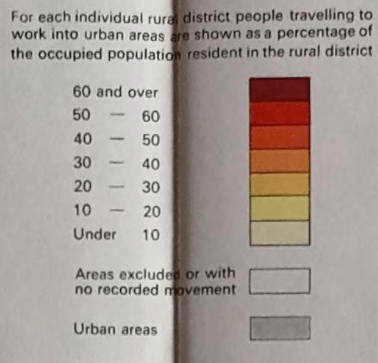
Left and above – you can see how the percentage of the working population of the rural districts in the northern half of what is now South Cambridge District Council’s area who commuted to urban areas for work rose dramatically from under 20% to over 40% of its workforce between 1921-1966
In that regard, Lord Redcliffe Maud was decades ahead of his time in concluding that local government structures needed to reflect these changes.
The one big question that ministers will also have to answer is whether they are willing to review the powers, finances, structures and boundaries of the institutions that govern Cambridge. Something you can ask your local MP to put to the Deputy Prime Minister via https://www.writetothem.com/
Food for thought?
If you are interested in the longer term future of Cambridge, and on what happens at the local democracy meetings where decisions are made, feel free to:
- Follow me on Twitter
- Like my Facebook page
- Consider a small donation to help fund my continued research and reporting on local democracy in and around Cambridge.

 The Cambridge Town Owl