
Just as the feeble, underpowered, poorly-resourced and fragmented local government sector tied up in ideological red tape created by Westminster and Whitehall is in no state to create an inclusive city, neither are private institutions. But the reasons are different.
Pictured: Cambridge City Council’s Cultural Strategy 2024-29
Cambridge City Council’s vision for the future of our city is One City, Fair for All. This is the statement on successive Cambridge Labour’s manifestos for Cambridge in a decade’s worth of local elections. If you asked anyone with a passing familiarity of local government and public services in our city whether the city council has the powers and resources to achieve that vision, most would probably say that it doesn’t.
You can read the party-political version by Cambridge Labour – both their city report and manifesto of 2024. (You can also read the manifestos from the other parties in 2024 here)
“It’s all for charidee!!!”
Some of you may remember The Charity Song by Spitting Image in 1990 with the puppet versions of Richard Branson and soon-to-fall media tycoon Robert Maxwell appearing at the start. This was very much at a time when direct state provision of public services was being cut back, privatised, and outsourced. At the same time, there was a rise of US-style television-based charity fundraising of the sort that has become the norm today, such as Children in Need to Comic Relief. The tension however, has always been between what should be a basic public service by right and funded by the taxpayer collectively, vs what can be left to charities to provide. And it’s not a new debate either, as the founder of Save the Children said in Cambridge back in 1910.
“I was a long time realising that the social reform on the part of the Conservatives is like charity in the hands of a Lady Bountiful – everything to be made nice and pleasant, but the ‘upper class’ is to be respected and obeyed. The corruption of elections first opened my eyes and I came to believe that no social reform could be of use that did not promote the independence of the people.”
Eglantyne Jebb in the Cambridge Independent, 08 July 1910
Partnerships of equals, or paternalist-recipient relationships?
Eglantyne Jebb became more radical in her political views over time – even though it’s her charity work that she’s more well known for. One of the core themes of her campaigning in Cambridge in the early 20th Century was about changing the structures and systems in the political economy of the day to enable the poorest to become more independent economically, and less dependent on charity – such as through bringing in a legal minimum wage.

Above – Cambridge Independent Press 05 Dec 1913: From the British Newspaper Archive / Lost Cambridge
The private schools – one of the most visible examples of inequality in Cambridge
The debate on the status of private schools returned in the run-up to the general election – both on whether they should retain charitable status (Labour scrapped plans to remove this) to charging VAT on school fees (The Government has confirmed these will come in from January 2025). The question on whether and how children should be educated is one of the fundamental and ongoing political debates in our society. There’s no such thing as ‘taking the politics’ out of the debate because the debate is inherently political. And I guess the only way to take the party politics out of it is to abolish political parties. (Don’t encourage them!)
“In 2022–23, average private school fees across the UK were £15,200 in today’s prices (net of bursaries and scholarships). This is £7,200 or nearly 90% higher than state school spending per pupil, which was £8,000 in 2022–23 (including day-to-day and capital spending). The gap between private school fees and state school spending per pupil has more than doubled since 2010, when the gap was about 40% or £3,500.”
Institute for Fiscal Studies – 11 July 2023
In one of the most unequal cities in the country, what is to be done?
For some institutions, doing nothing – and being seen to do nothing is not an option. In the case of Cambridge’s larger private schools, the system of longstanding bursaries can almost be taken as a given.
In recent times, One of the private schools signed an agreement with one of the state secondary schools in one of Cambridge’s most economically-deprived wards to provide bursaries for a handful of academically successful students at the latter to study A-levels at the former. There is also the requirement (in return for planning permission in this case) for new facilities to have at least some public accessibility outside of school hours.
The ongoing debate about state vs private schooling and reducing the gap between the two is continued at https://www.pepf.co.uk/ – though ultimately there is nothing to stop a political party elected with a majority in Parliament passing the legislation to nationalise and/or close down all private schools and ban the establishment of new ones. This was a regular debating point from the First World War up until the 1970s. (The last major government-commissioned studies were carried out in the 1960s – such as The Public Schools Commission 1968 here).
Yet as I wrote in my previous blogpost, there is no mechanism for local councils to use taxation powers to limit the over-expansion of economic sectors that damage other parts of the city’s economic and collective needs. Such powers of additional taxation might enable councils to do the following:
- Tax private cram colleges and language schools to fund youth activities open both to visiting young people and local resident teenagers (some of which could involve investing in existing state school buildings and playing fields)
- Tax aparthotels and AirBnB-style bookings to re-balance the market with guesthouses and small hotels, and have some existing properties converted back into longterm lets or residential housing, using the funding to invest in new council houses, repairing existing stock, and enforcement functions
- Tax day-trippers indirectly by building Connect Cambridge Light Rail and requiring coaches to stay outside of the city limits, deposing passengers at out-of-town P&R car parks who then purchase all-day travel tickets for public transport – generating revenue to re-invest.
- Tax the science park landowners to fund community arts, leisure, sports, and music activities
It doesn’t have to be all tax-and-spend, but it shouldn’t be left to charity to try and raise huge sums to acquire properties that were built by/funded by taxpayers that now have to be sold off because of central government austerity. Following my public question to the Combined Authority’s Transport & Infrastructure Committee, officials will be analysing the number of private commuter bus services in/around Cambridge along with the planned future growth – with the option of compelling such services to be incorporated into the bus franchising system that goes out to consultation on 16 August 2024 as required by The Bus Services Act 2017.
Institutions established to be exclusive will inevitably struggle with tasks that have inclusivity at their core
These are reflected by the corporate lobbying groups established powerful interests who stand to make fortunes with the expansion of Cambridge. For example have a look at the membership of the Oxford-Cambridge Supercluster. (I wrote more about them here). Who are the people making the case for the poorest in society? Do the latter have a critical mass on decision-making forums? Do the latter come from/live in the communities that they are representing, or are they people from affluent backgrounds in a full-time post with the job of ‘representing poor people’?
Another example is the planning system itself, where the paymasters and financiers have no interface with the communities most effected. Instead, an ecosystem of consultants and PR people has sprung up to act as sort of ‘professional shock absorbers’ to take the fire that comes back from unhappy residents who have seen it all before. Such as was seen recently with The Paddocks consultation where all of the consultants and representatives I spoke to were not from the area and knew next to nothing about the city or neighbourhood beyond what they had read.
Campaigning for Community Power
Some of you may have seen the We’re Right Here group and their demands for a Community Power Act. Much as I understand/sympathise where they are coming from, I have an inherent reservation about any proposals that do not strengthen local government as an institution, and the means of transparency, accountability, and community participation in the work of local government. Especially where it involves bypassing that entire tier for a more vague ‘community sector’ – especially community facilities meant to serve everyone in and around the community. Sometimes I want to shout:
“No! I want them:
- Owned by the local council
- Run by the local council
- Properly resourced by the local council
- Accountable to the people via our elected local councillors”
Which is one of my longstanding issues about faith groups delivering public services on behalf of the council. This came up with the Cambridge Chapter of CitizensUK whose launch I went to back in 2023 here. Listening to a number of people from LGBTQ+ communities, they had real reservations about the high profile of religious institutions in that network, reflected by the venues chosen for the offline events. That in part reflects the complexity of public policy – and in particular community development where you have to try and reconcile/account for inherently conflicting interests and views.
Another example – the Sci-Tech bubble swamping the Arts & Creatives sectors amongst others
The Grafton Centre’s Supplementary Planning Document of 2018 was created following a long consultation process to deal with a struggling shopping centre. The plan did not involve its transformation into a sci-tech site. Instead:
“The SPD seeks to enable the gradual transformation of the Grafton Centre and the streets and service areas which surround it. The site will continue to grow as a retail destination for the City accommodating future growth in retail floorspace, and complementing other central shopping locations such as Grand Arcade and Lion Yard, and more local facilities at Mill Road.”
Yet it somehow got planning permission to become the sci-tech site despite this.
“But that’s the market, ain’t it?”
It depends ‘which market’ you are talking about.
The market for rental retail units
On one hand the previous landowners should have significantly reduced the rental prices for potential tenants to reduce the vacancies – and to encourage independent tenants to open up there. i.e. market forces for retail units forcing down the rental prices due to low demand until ‘the market clears’ and fills up all of the units.
The market for sci-tech properties
On the other hand, the market for sci-tech properties was and is experiencing a speculative demand bubble. Therefore anything that can be turned into a sci-tech site is ripe for buying out. The same goes for other property types – such as aparthotels, although in this case it’s hard to think what else could go here in the middle of an enlarged gyratory.
The scale of the bubble will swamp any attempts to try and compensate the negative impacts with charitable donations.
There are notable examples of community outreach of late
Cambridge United Football Club has been very successful with their recent commercial link-ups. Have a browse through their news stories here. Smart and savvy move by the football club given that there is a critical mass of firms wanting to establish in the city that also recognise they need to demonstrate they are not in it just to extract value from ‘brand Cambridge’ but to invest in the wider city’s social institutions.
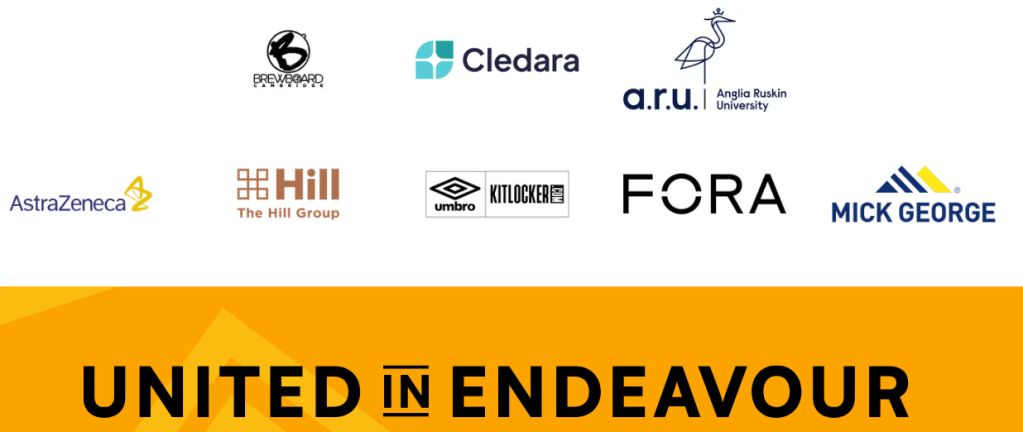
Above – some of the major partnerships signed by Cambridge United
The Cambridge Science Centre – from light industrial park to the Cambridge Science Park
This was long overdue really – the Cambridge Science Park (owned by Trinity College) now hosts the Cambridge Science Centre. Previously it was in an old industrial unit on the Clifton Road Estate. As with The Paddocks, the Clifton Road has also been allocated as mixed-use housing. It remains to be seen what will happen to it.
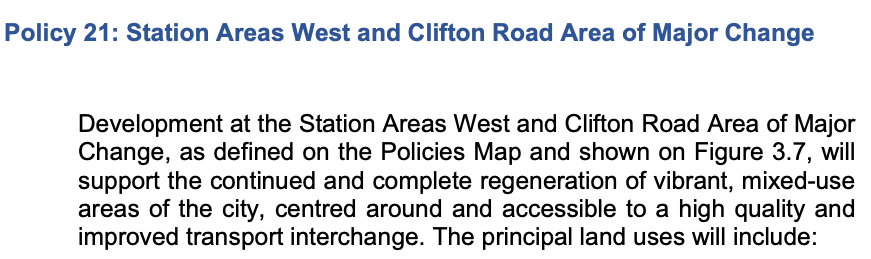

Above – Cambridge Local Plan 2018 p88 ono
The problem as former councillor Sam Davies MBE wrote about is the loss of the light industrial services that cities need in place in order for essential businesses to service the city. Think the trade retailers that supply building and construction professionals with spare parts for when gas/electricity/housing/plumbing breaks down.
My point? When wealthy/powerful/affluent institutions put their own interests ahead of the wider common good, the whole city risks losing out.
Even those institutions that find themselves unable to access the services they need to deal with a specific problem because those service providers have all been priced out of the city.
Food for thought?
If you are interested in the longer term future of Cambridge, and on what happens at the local democracy meetings where decisions are made, feel free to:
- Follow me on Twitter
- Like my Facebook page
- Consider a small subscription or donation to help fund my continued research and reporting on local democracy in and around Cambridge.
 The Cambridge Town Owl