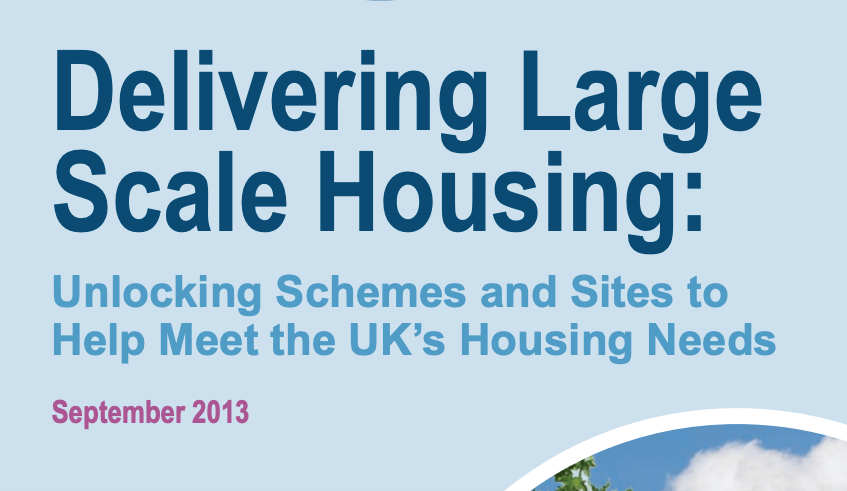
The recommendations date from 2013 – how do they read almost a decade later?
You can read the report here. The recommendations are:
Community engagement
- Recommendation 1: Local and national politicians and campaigning groups as well as planners need to make the case for large scale housing schemes by emphasising the consequences for current and future generations of failing to build enough houses, and the opportunities represented by large scale schemes to delivery quality healthy communities
- Recommendation 2: Local councils, practitioners and developers need to do more to ensure that community engagement reaches a wider cross section of the community, including potential future residents
- Recommendation 3: Local authorities and developers should ensure that the pre-application engagement process and local plan consultation are of a high standard, which means that they should be comprehensive, straightforward, accessible and represent good value for money.
Land
- Recommendation 4: There needs to be public access to information on who owns land and who owns options on land
- Recommendation 5: Local authorities should take a larger role in land assembly, for example by the use of existing powers of compulsory purchase
- Recommendation 6: Share risks around potential future land uplift in land values more evenly between local authority, developer and landowner so as to bring sites to market now
- Recommendation 7: Government departments and agencies should be required to dispose of their surplus land holdings in a way which takes account of the wider community value rather than maximising the capital receipt, and to do so with alacrity
- Recommendation 8: In view of the longer lead-in times involved, central government should incentivise large mechanisms or national planning policy
Infrastructure
- Recommendation 9: Link together infrastructure expenditure, policies and planning with policies and planning for housing in order to unlock potential sites, for example through budgetary processes or guarantees against future income streams
- Recommendation 10: Local authorities should be empowered and encouraged to use existing or innovative funding solutions and utilise central government support through existing funding streams or policies. This could involve local infrastructure funding or forms of devolved pooled resources
Finance
- Recommendation 11: Local authorities, infrastructure providers and government agencies should develop means to pool departmental and European resources in order to deliver the infrastructure which supports housing schemes
- Recommendation 12: Where funding isn’t available, central government should consider underwriting a certain proportion of the site investment Leadership and governance
- Recommendation 13: Where required, local authorities and agencies should be given much greater incentives to work collaboratively across borders to strategically plan for housing and infrastructure sites
- Recommendation 14: Leaders, Chief Executives and use planners’ skills more broadly in the design and delivery of corporate and LEP plans for growth
- Recommendation 15: Governments need to explore how, where proposed major housing developments, should be acknowledged nationally and what special delivery processes may assist their delivery
Bar the European Union reference, there’s little that policy makers would disagree with. So why does it feel like the same problems are still in place over a decade later? Brexit and CV19 are the easy-to-reach excuses and explanations. Yet even accounting for them, chronic failures in central government over policies affecting/on regional and local government policy remain at the heart of the problems.
“Who decides where new developments will be?”
On making the case for large scale housing schemes (recommendation 1) the General Election 2024 has in principle resolved that one. Labour has said that they will create development corporations for a new generation of Newtown. Furthermore, the House Minister told BBC Cambridgeshire that communities would have a say on what the developments would be like, but not on whether the developments would go ahead or not. As the Deputy Prime Minister Angela Rayner said on 30th July, the new long term housing strategy will be published in the next few months – so expect it by December 2024.
Broken consultation systems.
I won’t repeat what I’ve written previously here or on citizenship education for adults – I’m taking those as given. As far as housing and development institutions are concerned, RTPI / Planning Aid released a guide in 2010.

Above – by the RTPI/ Planning Aid 2010
Fast forward to 2023 and the New Zealand Government came up with these principles.
The challenge in Cambridge is the huge potential financial returns mean that landowners and developers have too great an incentive to bypass local communities and simply build to the lowest standards and at the lowest cost that they can get away with and/or are compelled to do by law. The challenge for public policy makers in central government is coming up with a system that designs in good practice and designs out those that have little interest in anything other than financial return.
Town planning is only one component of civic action – and a very complex one that few will want to take on, let alone have the expertise, time, and patience. Furthermore, if people are completely ignored they are less likely to take part next time around. It takes extra effort to get them back to the place they were previously at.
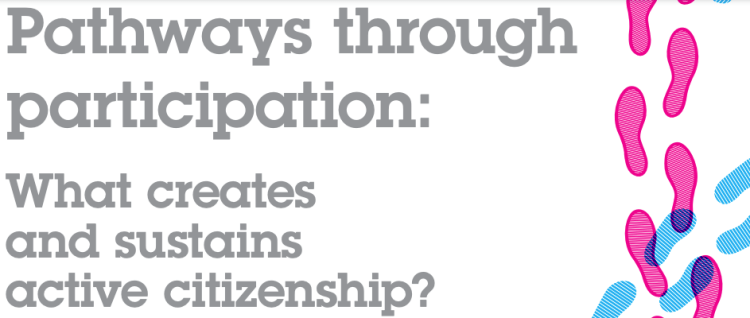
Above -by the NCVO, InvolveUK and others from 2011.
As with other pieces of guidance produced at the change of previous governments, the content will need refreshing to account for the new political contexts (eg post riots 2011 & 2024, and post-lockdowns – and even post-Brexit). At the same time, some of the core principles will remain the same:
- Undertake research and analysis
- Learn from the process (i.e. learn what works and apply to other areas if suitable)
- Continual engagement – stay in touch with communities
- Monitor, evaluate, and feed-back into the policy-making processes
Who owns what land? The case for making the Land Registry Data publicly accessible for free
Private Eye magazine sometimes picks up on this – several years ago they made a big splash here.
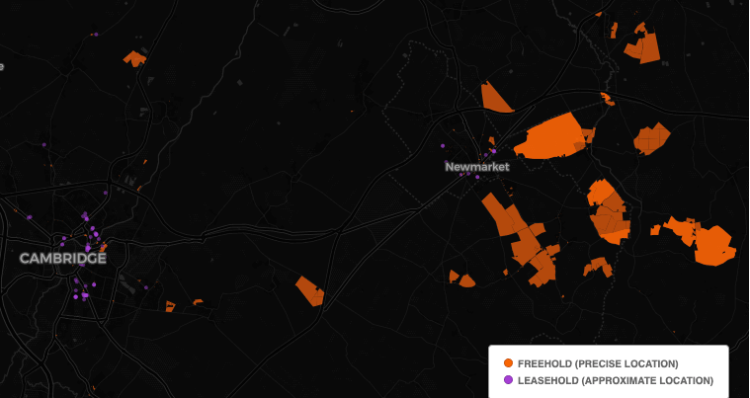
Above – who owns all those fields around Newmarket Racecourses? (note the data may be out of date by now)
The Centre for Public Data is still campaigning on this.
Land-related issues are matters for Central Government – something to email your MPs about?
Furthermore, the infrastructure and finance issues are things that ministers will be publishing their proposals about from the autumn. So see this as a ‘heads up’ for what to look out for and what questions to ask your MPs to put to ministers when the consultations are published and policy announcements are made.
“Doesn’t all of this reflect how over-centralised England is?”
Yes. Next question please.
Actually, this is why any future announcements on devolution are just as important as changes to the planning system. Such is the over-complicated nature of the current structures and systems that a host of government departments need to take co-ordinated and planned actions in sequence. Otherwise the changes will only be piecemeal. For example what’s the point on educating the people about a system that is broken if all that happens is that they become more despondent and put off by civic engagement even more than before?
Food for thought?
If you are interested in the longer term future of Cambridge, and on what happens at the local democracy meetings where decisions are made, feel free to:
- Follow me on Twitter
- Like my Facebook page
- Consider a small donation to help fund my continued research and reporting on local democracy in and around Cambridge.
Below: Want to see local government in Cambridgeshire overhauled just as we did in the early 1990s? See the Cambs Unitaries Campaign which I am supporting.

 The Cambridge Town Owl