These are my personal opinions, not those of Cambridge Connect
You can read the news report from BBC Cambridgeshire here.
You can also see the video below. If you like the video, get in touch with Cambridge Connect here.
Above – from Cambridge Connect Light Rail
For those of you who don’t want to/cannot watch the video, the most important bits are the pictures – and sequencing.
“Not the finances?”
See the submission to the Combined Authority here if you want to crunch the initial numbers. The reality is that a formal feasibility study by technically qualified people needs to be commissioned and carried out to firm up those proposals. Note the Combined Authority under former Mayor James Palmer spent a fortune on a feasibility study for the now defunct CAM Metro back in 2019 – see New Civil Engineer here. You can read through the report from p98 of the meeting papers of the Combined Authority from March 2019 here

Above – by Steer the consultants – with whom the Smarter Cambridge Transport campaign had significant issues with over their report, which you can read in their blogpost here
“Does it matter?”
Yes – because according to the meeting papers, £600,000 was spent by the Combined Authority on that above report. (See p86 here). That was then followed by even more funding so that over £3million had been spent on/committed to the work by August 2019 – work that ultimately had nothing to show for it.
For whatever reason, the former Mayor chose to go with the untried technology promoted presumably by the consultants (happy to be corrected) rather than the proposals from Cambridge Connect which are based on existing light rail technology and thus carry far fewer risks vs new, innovative designs. His replacement, Dr Nik Johnson who surprisingly won the election in what was until then a safe-as-military-fortresses blue county, scrapped the proposals on the grounds that the costs were huge and central government had not committed either any funding, or new powers to enable combined authorities to impose a land value uplift tax to pay for the infrastructure. Hence Mayor Johnson’s focus on buses which have ***finally made it*** to the formal statutory public consultation stage as of this week!
It’s almost as if the Tories chose to make the process of bringing buses back under public control as convoluted and frustrating as possible so that no one would bother. There are still question marks in the detail as to whether what’s been proposed really is proper franchising or if it’s something else – which is why you (or someone you know who’s familiar with it) need/s to read through it and send feed back.
Back to Cambridge Connect light rail:
The full press release is below:
Above – from Cambridge Connect on Birdsite-as-was
Summary:
- Cambridge Connect has formally approached ministers seeking funding for a feasibility study – up to £5million – to be included in the autumn spending review
- Cambridge’s continued growth means that bus-only proposals will not be able to accommodate the inevitable rise in road traffic – mindful that the electorate turned against proposals for a local road user charging system/congestion charge in 2023
- Cambridge Connect’s proposals align with the existing transport network, connecting with Cambridge’s three existing railway stations and proposing to connect with a new railway station at Cambourne for East West Rail, and with a re-opened Haverhill railway station where roads between Haverhill and Cambridge are already chronically congested at rush hour.
Sequencing of light rail for Cambridge
Phase 1 is the hardest part – the tunnel and the links to two out of town park and ride sites at Trumpington in the south (via the existing guided busway south) and a new one at the Girton Interchange (which comes up regularly in traffic reports)
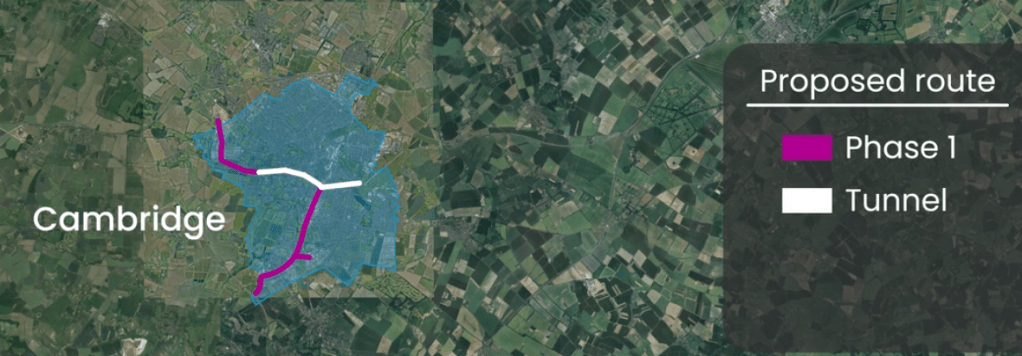
Above – phase 1
The next phase in principle is more straight forward as it doesn’t involve tunnels or ploughing through built up areas. The southern spar from Addenbrooke’s follows the existing railway line south to Great Shelford before making use of the currently disused track bed on the old Haverhill line. It then follows the line past Sawston (which could provide a new light rail stop for Cambridge City Football Club next door) before turning south west at Granta Park – a potential station stop and P&R stop. It then goes onto the Wellcome Genome Campus – which means they could be approached for funding too. In the meantime the northern spurs would follow the boundary road around the north of Cambridge to the guided busway to terminate at Cambridge North Station, while the other spur followed the existing transport corridor of the A428 (avoiding Coton Orchard) to get to Cambourne.
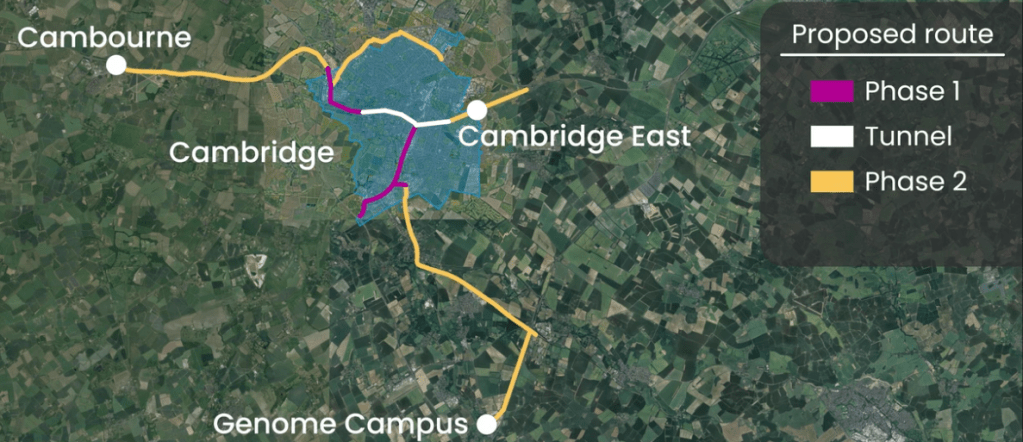
Above – phase 2
Phase 3 are the extended lines to Northstowe, Burwell, and to Haverhill respectively. Given that Cambridge East involves building on the airport site, and because that site is not going to be available for construction until 2031 at the earliest according to the emerging local plan, I’m assuming Cambridge East will be the last of the Phase 2 lines. It’s the least urgent when compared with Cambourne (large and growing population with many commuters) and the Genome Campus (who can provide more money up front if they are prioritised)
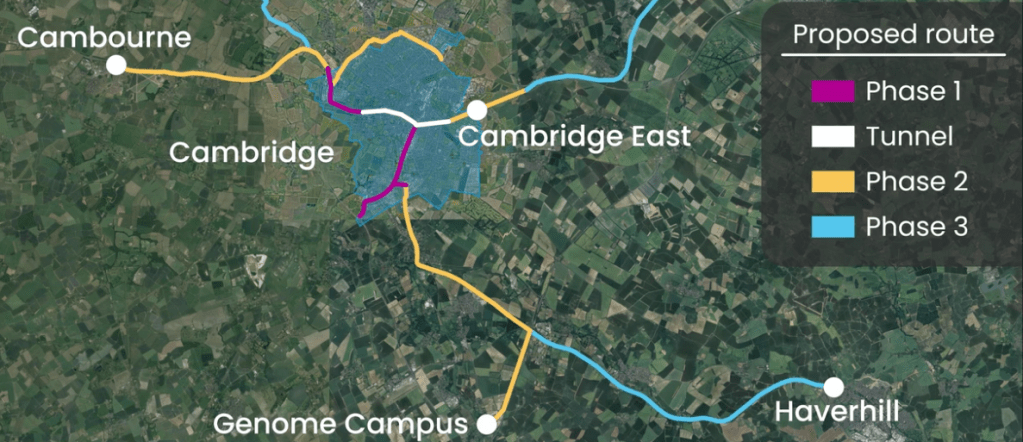
Above – Phase 3
Add the proposed railway lines in and you have something that looks like the map below
I’d be tempted to extend the Burwell line via the Newmarket Racecourse to Newmarket, Soham, and Ely – with the option of extending it to Chatteris, March, and Wisbech.
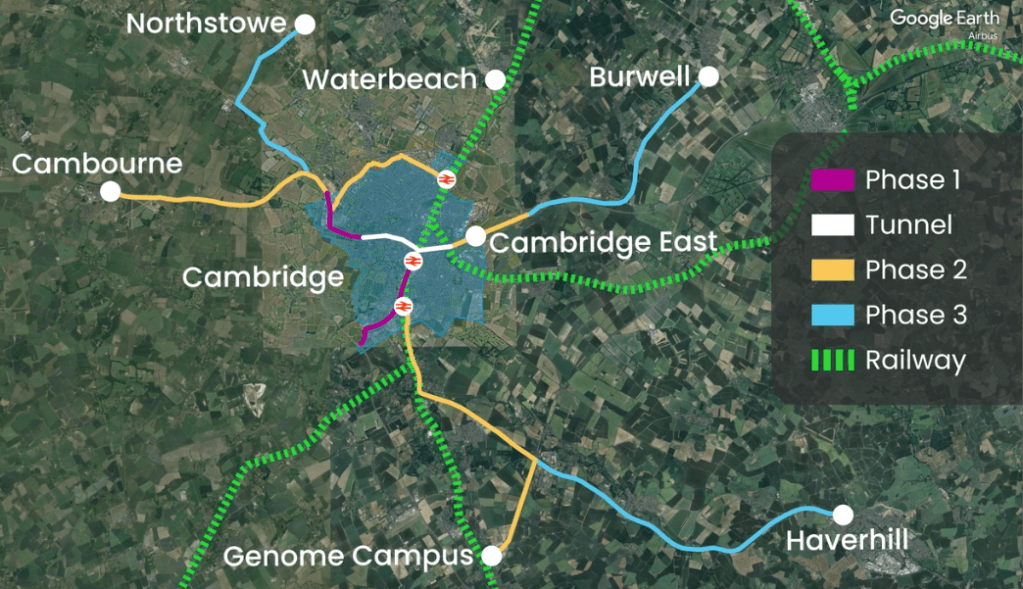
Above – the completed plan
“Can we have a closer look at Eddington?”
Go on then. You can see the both Eddington and the West Campus are served by Phase 2, as is the Science Park – the line heading along King’s Hedges Road before joining the existing busway.
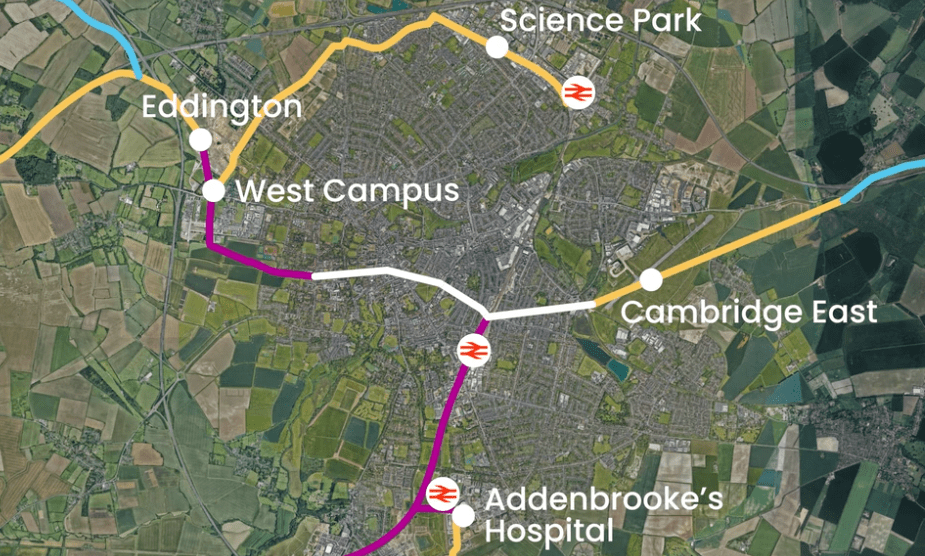
Above – detail of Cambridge.
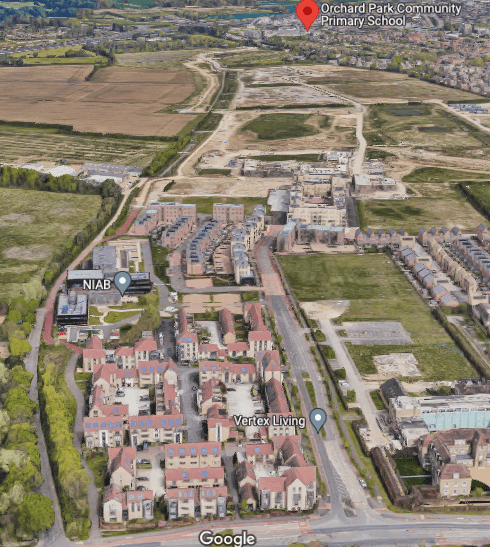
Above – detail from G-Maps from Huntingdon Road (bottom edge) to the western end of King’s Hedges Road near Orchard Park Primary School
“Is there party political support?”
The Tories only started backing the proposals after they lost power in 2021 locally, and then only started making noises within government when it was clear they were on their way out in Westminster. Their general election candidates for both Cambridge and South Cambridgeshire supported the proposals, but neither were likely to get elected. Their opponents maintained a non-committal stance. That said, the former Liberal Democrats’ Transport Minister Norman Baker spoke in favour of light rail here.
I’ve tabled numerous questions to local government organisations (such as my PQ to Mayor Palmer here in 2018). I have for a long time been of the view that given the principle of continued growth that all three parties have been supporting for Cambridge, we need a light rail system to divert a critical mass of the road traffic. Furthermore, this needs to align with whatever changes are made to how ‘Cambridge’ is governed. I have now adopted the term ‘Great Cambridge’ (as per this blogpost) to differentiate from the GCP and because it makes it clear that ‘Great’ is what I think Cambridge could become.
I have also stated in numerous blogposts (eg here) that the big tech parks and the developers should contribute significant sums for that infrastructure – not just for light rail but active travel and for civic, social, leisure, arts, sports, and music performance facilities too.
Hence continually chasing local government organisations and the combined authority about the meetings they have had with such institutions and firms about contributions. Sadly senior officers have fobbed me off every single time. As a result, I’ve called for the abolition of the lot of them and for a new ‘Great Cambridge Council’ to take over.
Parliament returns on 02 September 2024
And it starts with questions to the Deputy PM and her ministers who are responsible for local government and housing – the very department that Cambridge Connect has approached.
For those of you who live outside Cambridge constituency in the bordering constituencies – that’s all three of the Lib-Dem-held seats, feel free to email your MPs via https://www.writetothem.com/ and ask them what their views are on the light rail proposals, and ask them either to table some public questions about ministerial support for such a feasibility study, or to forward your questions about such funding for a study on your behalf.
Food for thought?
To support the proposals, get in touch with Cambridge Connect via https://www.cambridge-connect.uk/connect/
If you are interested in the longer term future of Cambridge, and on what happens at the local democracy meetings where decisions are made, feel free to:
- Follow me on Twitter
- Like my Facebook page
- Consider a small donation to help fund my continued research and reporting on local democracy in and around Cambridge.
I’m now on BlueSky – https://bsky.app/

 The Cambridge Town Owl