
…and by that I don’t mean those who shout the loudest, people with connections, or even people like me.
It’s not just to make the case for Cambridge Connect Light Rail which I wrote about in my previous blogpost (hence ‘Let’s connect’), there are a host of other issues that require various different policy & strategy units across Whitehall to get connected too.
“I didn’t know The Government had a strategy unit for our city”
Well you do now. Actually, the Whitehall one was established under Michael Gove’s tenure.
The fact there is a strategy unit for Cambridge should not come as a surprise.
This is normal. (In fact I’d be surprised if there *wasn’t* one). Whenever a government makes a major policy announcement that is a long term commitment – for example the long term growth of a specific geographical area that crosses multiple government departments, quite often you will find individual civil servants or teams of civil servants taking responsibility for that geographical area. So when Michael Gove made his ‘Case for Cambridge’, the administrative structures needed to be arranged. This was made clear with the establishment of the Cambridge Delivery Group – whose membership we are still waiting to find out about post-general election.
Since then, we’ve had a general election and a change of political party in government. Over the past few weeks, ministers and senior civil servants (whose roles and structures are made public for each department such as here for MHCLG) will have been working through what the best administrative structures are for implementing the policies of the new ministers.
Given what the Minister for Housing said about Cambridge a couple of weeks ago, it should come as no surprise that a) such a unit continues to exist and b) that the civil servants within them are already meeting with organisations that have both a strong interest and a strong influence in the success or otherwise of this Government’s objectives for city, county, and economic sub-region.
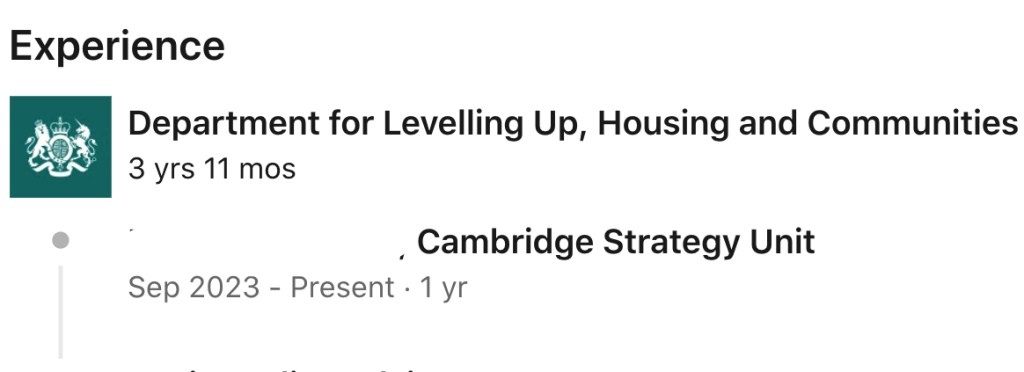
Above – detail from an anonymised profile. This is not an invitation to bundle into individual civil servants. Remember advisers advise, and ministers decide.
There is nothing to stop members of the public / local residents from submitting Freedom of Information requests to the department asking them to list all of the institutions, groups, organisations, and businesses that have either requested to meet ministers and/or civil servants since the general election of 04 July 2024. The list in itself might speak volumes and is unlikely to exceed cost thresholds.
“What’s the difference between the Cambridge Strategy Unit and the Cambridge Delivery Group?”
The Cambridge Strategy Unit is an internal part of a Department of State – in this case the Ministry of Housing, Communities and Local Government, which I used to work for between 2004-2011. These are permanent civil servants bound by the Civil Service Code whose responsibility it is to support ministers in developing policies – which ministers ultimately have to sign off (or require changes before doing so). It is not a standalone constituted unit – such units and teams are created and dissolved regularly within government departments depending on what the priorities of ministers are. Even when the party in power has a ‘reshuffle’ of ministers, teams and units of departing ministers can be dissolved and new ones created (with civil servants moving into new roles within their departments) for new ministers who often have different priorities to their predecessors.
The Cambridge Delivery Group is not an internal part of a Department of State – rather it has been incorporated as the Cambridge Growth Company with Peter Freeman, Chair of Homes England as its head. Hence the incorporated address being the same as Homes England in Newcastle. For an explainer on Homes England as an executive agency of The Government, see here or the video below.
My understanding is that the Cambridge Delivery Group will form what is likely to become a development corporation for whatever additional housing the Government wants built to support the growth of Cambridge’s economy. That corporation will, as directed by the Secretary of State the Deputy Prime Minister, take over the planning powers of the any existing local councils. With that also comes the responsibility for ensuring adequate water supplies and also designs comply with existing legislation on environmental standards amongst many other things.
“Why should civil servants meet with local residents? Why not just the key stakeholders?”
Because nearly 20 years ago I was one of those civil servants meeting with local residents and so-called key-stakeholders in a previous generation of growth around Cambridge. This was just after Gordon Brown had become Prime Minister so there was huge anticipation across public policy world about whether he would make any big changes. These included from the construction industry hoping toughening sustainability standards would not be followed through.
I hadn’t been in the job that long on sustainable new homes and had just moved down to London only to be sent back to Cambridge for the day to speak to an audience at Newnham College about the proposals for what we now call Clay Farm. It was interesting to hear what developers were trying to pressure local councils into conceding on sustainability standards – as well as the relief from council officers after they heard me tell the audience that ‘The new Secretary of State did not want developers building unsustainable new homes in and around my childhood neighbourhood’ – especially with the threat of climate change. (I had been at a reception the night before with the new secretary of state and asked her for some quotations to use for that event in what is my home town).
When visiting other towns and cities across England in those days, I found it incredibly refreshing to spend time listening to people from parts of the country I had never been to, and communities that I had little knowledge or lived experiences of. Most of all it was the greatest of stereotype-busters. Remember that given how competitive it is to get into the civil service – especially policy-making roles such as those working on the future of somewhere like Cambridge, not many may have had the sort of background that involved growing up being dependent on local council services. Inevitably there will be some who had a private school – oxbridge – civil service fast-stream – middle management upwards backgrounds who only know about Cambridge because of its ancient university and sci-tech bubble. Many may not have had the time to read around the contemporary history of the city and the problems associated with the rapid growth. They may not be familiar with how policies that are the responsibility of other departments affect the present and future of our city. In which case they are the ones to ask to bring in their counterparts from other government departments to deal with the issues – which is what I did on more than one occasion. For example:
This is where someone needs to say to civil servants that if they have not got policy advisers from the Department of Health & Social Care working with them on the future of Cambridge, they need to approach their counterparts in that department and change this. If they get nowhere with their counterparts, escalate it upwards to senior civil servants. (The higher up the chain you go, the more likely you will find someone who sits on a cross-departmental committee and/or who knows a fellow senior civil servant from a previous era – and problem solved).
“What sort of visits could Cambridge City Council help organise?”
It doesn’t need to be a robes and grandees event at Senate House. The purpose of such visits is to provide insights that current central government policy advisers do not have that will help them solve our city’s problems. And one of the things they need to figure out is what their geographical definition of ‘Cambridge’ actually is – before letting the rest of us know so as to manage everyone’s expectations.
“Where could civil servants be taken?”
Depending on accessibility and mobility, some of them could be taken on cycling tours within particular parts of the city and surrounding district. The city council does not need to do everything itself – there are enough organisations that can deliver individual aspects of any visit – for example CamCycle and/or Outspoken Cycles could be commissioned for any cycling elements that could cover successful examples of active travel infrastructure to places that have chronic problems and conflicting interests.
An easy mistake to make is to showcase only the good things that the council or a charity has done – sort of like when a royal visit is organised. That’s not what civil servants should be on the lookout for. Their job [in this case] is all about solving complex social issues and difficult problems. Therefore, show them these – warts and all. Some of these might include a tour of recently-built housing that has been built to poor standards. We know this is a problem in Cambridge because our local MP Daniel Zeichner told Parliament about it in a speech back in 2021. A question to visiting civil servants: ‘These are the issues we’ve had with a previous generation of new house building. How do you propose remediating the existing problems, and how do you propose ensuring that there’s no repeat with the new homes that your ministers propose building?’
Practical solutions for traffic congestion
As I mentioned in this blogpost on The Beehive Centre, there are two significant sci-tech developments looming between Cambridge Station and Cambridge North. The city already has a housing crisis and cannot fill all of the high-skilled vacancies that will come with these developments. With the additional developments east of Cambridge along the Cambridge-Newmarket line, what assessment can transport ministers make about upgrading existing rail infrastructure to provide for both suburban and light rail?

Above – my suggested solution is to build a new railway station or light rail hub enveloping Coldham’s Lane Bridge. That way no additional motor traffic or even private commuter buses will be needed to serve the proposed developments.
Don’t be afraid to introduce civil servants to people and groups who oppose the Government’s policies on expanding Cambridge – if anything do the opposite
As I said, ‘this ain’t no royal visit’. The civil servants advising ministers need to hear what the challenges are. That’s not to say ‘throw them into the lions’ den and leave them to it’. Rather, enable representatives from grassroots campaign groups to put their case clearly and politely – but also firmly, to the civil servants concerned. At the same time, make sure that such groups are briefed in advance that the aim from their perspective is to ensure that the civil servants have understood what their issues are, rather than demanding an off-the-cuff response to quote them on in perpetuity.
Don’t be afraid to show them what failure looks like
This also means don’t restrict them to Cambridge’s 1935-era boundaries. Take them to places like Northstowe and Cambourne to meet some of the longer term residents who have been there from the start. Brief them on things like ‘If you had the chance to go back in time to tell the planners and politicians what they were getting wrong, what would you say?’
Take them to places that will have an impact on their senses – fair and foul!
That could be to Shire Hall and the top of Castle Mound to see the whole of the city. (Or Lime Kiln Hill south of Cherry Hinton Village for that matter – as part of a visit to Netherhall School / Oakes Sixth Form College – climb to the top of the hill and look around).
Alternatively, for all things foul, take them on a short visit to the Waterbeach Waste Sorting Facility and ask them how light rail infrastructure could be used to reduce the freight traffic of processed waste along roads. I went on one such visit in the mid-2010s. You never forget the pong!
Above – you can book your Waste Education Experience here!
Get a group of you together and book a visit! Because once you’ve experienced the stink from the site (as well as seeing the mountains of waste, you find yourself recycling a lot more and consuming much less!)
And finally…
- It doesn’t all have to be on one day – things can be broken up into a series of shorter visits such as mornings or afternoons
- Open the visits up to junior civil servants – including their apprentices as well. Don’t restrict the invitations to senior managers and people on graduate programmes
- Have potential solutions to hand with the problems/challenges you raise, but don’t expect instant yes/no responses. The best thing to aim for is confirmation that civil servants will consider your issues and will provide a substantive response to them later on down the line. It’s policy-making, not a TV quiz show.
- Give the civil servants the chance to meet people they would not normally meet in policy-making worlds – including teenagers and those that use council-run community facilities regularly – and prepare them in advance for the visit so no one is overwhelmed.
- Bring along people from organisations who share in the responsibilities of local public service delivery – especially those who have insights that council staff may not have, eg community health nurses to bus drivers
- Evaluate, review, refresh, and run repeated events in subsequent years – especially where there is real progress and success to show from a low/difficult starting point.
And you can do all of the above without me needing to be there saying ‘Look at me!’
Food for thought?
If you are interested in the longer term future of Cambridge, and on what happens at the local democracy meetings where decisions are made, feel free to:
- Follow me on Twitter
- Like my Facebook page
- Consider a small donation to help fund my continued research and reporting on local democracy in and around Cambridge.
Below – if you’ve not seen the Cambridge Connect Light Rail video, see below on how our public transport systems could be transformed. Like what you see? Get in touch with Cambridge Connect here
 The Cambridge Town Owl