And not just for children, but for adults too?
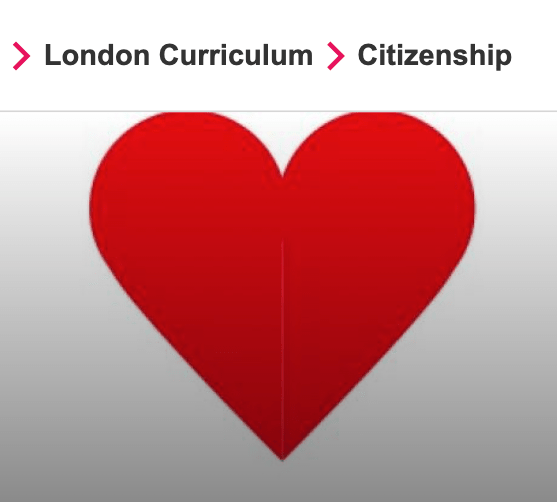
The Mayor of London and the London Assembly teamed up with the Association for Citizenship Teaching to produce a city-specific citizenship unit for the children and teenagers of London – you can read it here.
Although the drop-down menu below gives the impression that you can teach citizenship in five short lessons, it’s a lot more than that.

Above – all of these should be starting points for wider conversations involving (and even led by) young people
I’m not going to pretend I know anything about 21st Century youth culture
I’m a chronically ill single bloke in my mid-40s who boomeranged back to the home of my parents when my health imploded shortly after leaving the civil service over a decade ago and have never recovered. I have no life experience of looking after children or teenagers – with CFS/ME it’s a task-and-a-half simply looking after myself. What few insights I have are from my niece and nephews – and the fact that chronic illnesses have prevented me from taking a much more active part in their lives similar to that of my late aunt and uncle in the 1980s is something that cuts me up emotionally. Which is one of the reasons why I follow the example of Eglantyne Jebb in holding the institutions providing public services for children and young people to account in place of the parents who are otherwise far too busy.
That’s not to try and be anyone’s representative, but rather asking the public questions and making the suggestions in consultations about whether decision-makers have engaged with schools and community groups that work directly with children and teenagers – especially where their interests historically are ignored. (See Make Space for Girls and the work they do on involving teenagers in designing new parks and open spaces). Once the connection has been made by the institutions (eg the Beehive Centre Redevelopment here, which I scrutinised early on but less so of late), I can then step back and re-focus on something else.
Only 145 year 11 students took the GCSE Citizenship Studies in 2022 in Cambridgeshire
This is something I’ve continued to kick up a fuss about since finding out what the Tories did to citizenship education post-2010. Michael Gove chose to de-prioritise it – abolishing the old AS-level in the course of it, and instead gave a very strong – almost religious steer towards ‘personal responsibility and morals’ – something that fits with the themes of faith-based providers. (This has been a longstanding issue with Humanist campaigners and secular campaigners).
What does Cambridge look like in the eyes of its teenagers and young people?
In 1990s Cambridge we were never asked. Given austerity, I dread to think what the children and teenagers would make of it today. I asked one of my younger relatives and his friends about The Junction in Cambridge – itself a venue founded as a result of direct action and campaigning by a previous generation of teenagers and young adults, and they said that as a venue it’s mainly for older people, and that no one really asked them about what acts or entertainment they wanted to see there. This in an era where evening and nightime entertainment seems to have declined in Cambridge despite an expanding and more cosmopolitan population. This is one of the reasons why I think Cambridge needs a new urban centre away from both the colleges and residential areas – one where venues can stay open until the early hours without disturbing anyone.
The other thing that struck me earlier this week was a short conversation a group of teenagers on the bus who had crossed county boundaries to get to the city and whose county was under-providing for them in terms of public transport. (They mentioned how being on the top deck of a bus freaked them out – and were even more shocked when after they mentioned driverless cars, I said that Cambridge was already trialing driverless buses – hence the conversation). What struck me was how little had changed since the 1990s when teenagers (of which I was one back then!) over the county border caught trains into Cambridge for nights out because there was so little provision for them in surrounding towns. (North Hertfordshire, NW Essex, West Suffolk in particular). As for the ones that would take the train, inevitably those from low income families would struggle to afford the regular train fares into Cambridge and back. So when we talk about ‘Cambridge’, there are a host of really difficult conversations to be had.
Decisions on the future growth of ‘Cambridge’ has to involve young people in a meaningful way – to the extent that future generations can see the positive impact they had
That requires sound town planning to ensure leisure facilities as well as learning centres are shared out across surrounding towns (rather than concentrated in one or two overcrowded places), *and* are linked by an affordable, safe, and reliable forms of public transport that future governments will find it much more difficult to cut back on. Looking at what the Conservatives did to bus networks via austerity. Hence the importance of some of the principles Clement Attlee’s Government came up with in this pamphlet.
What is the vision of Cambridge that is sold by both the private schools and language schools to affluent parents, vs the reality of the children & young people of different income backgrounds?
When was the last time we asked them? Oh.

Above – the Cambridgeshire Collection’s single survey of language school students from 1992
It’s one of the reasons I’ve suggested councillors approach ministers to seek powers extending the CambridgeBID to cover private schools and language schools to fund new facilities and activities that can be made available to all young people irrespective of income.
None of the above can solve the challenge of developing a civic identity for Cambridge in the eyes of young people.
“Why does it matter?”
Because democracy and the rule of law. We already know how catastrophically low the turnout is of 18-30 year olds. This isn’t just about teaching children rote-style to list the reasons why democracy and the rule of law are important. It’s just as meaningless getting children to memorise a list of UK monarchs in chronological order. If we can involve them meaningfully in civic activities where they put democracy and the rule of law into action – whether holding democratically-elected politicians to account through to standing up for their civic rights, chances are it’ll mean more later on down the line. Which is why I hope in future years Cambridgeshire’s offer of National Citizen Service can be improved significantly.
One of our biggest barriers? Too many of our institutions have an exclusive culture rather than an inclusive one.
For some, exclusivity is a core pillar or a core foundation of their institutions. They would cease to be if they were not exclusive in one form or another. Whether private schools with expensive fees to socially-connected religious institutions, trying to find a balance that works for the wider city and the people who make it what it is won’t be easy – as I wrote in this blogpost.
It’s a challenge we will have to take on if we are to apply the questions put by the Mayor of London at the top, to Cambridge:
- “What are your identities as young Cambridge people? [Even that term sounds clunky]
- Does Cambridge recognise its young people?
- How can Cambridge’s young people participate in democracy when they don’t have the vote?
- How can Cambridge’s young people use protest and campaigns to make their voices heard?
- How can we make Cambridge a better place for young people?”
If you put these questions to the teenagers of Cambridge today, what would their answers be? Or are the city’s institutions too afraid to find out?
Food for thought?
If you are interested in the longer term future of Cambridge, and on what happens at the local democracy meetings where decisions are made, feel free to:
- Follow me on Twitter
- Like my Facebook page
- Consider a small donation to help fund my continued research and reporting on local democracy in and around Cambridge.
 The Cambridge Town Owl