
It’s one of the bubbling themes of the Cambridge Resilience Web, but with a new academic term looming, could town societies give the students a boost to form their own student society that is a sister organisation to Cambridge Past, Present, and Future?
I’m too old/ill and past it to be running anything these days, but for those of you interested in what student societies there are in Cambridge, see Cambridge University Students’ Union here, and Anglia Ruskin Students’ Union here.
The most important role such a society could play in the life of the city is to get students familiar with the essentials of the wider city as quickly as possible and as early as possible in their student days so they can decide what, if any, local issues they want to campaign on or get involved in.
Our changing city
I went on a long cycle ride (for me) earlier in East Cambridge south of the River Cam to see what the building work was like at the Springstead and Marleigh developments between Fen Ditton and Cherry Hinton. You can see the photos I took here. Also, you can see the meeting notes of the Cambridge East Forum that cover both developments which now have residents moving in.
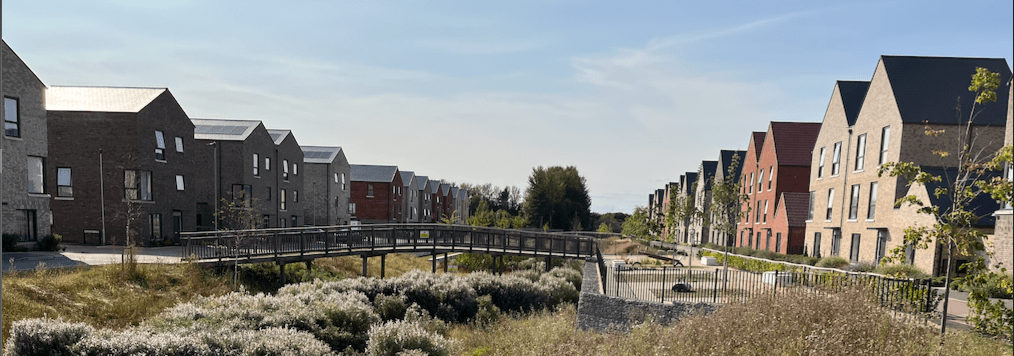
Above – the bridge over one of the attenuation/flood water ponds at Marleigh.
With a new residents’ association forming in Marleigh next month, I noted that now might be a good time to ask the Federation of Cambridge Residents’ Associations to host some events about the future of our city now that the general election is over and the new MPs are in place. If only to provide some formal networking space for residents who have recently moved into the city and surrounding villages.
“Where do the students fit into all of this?”
Ultimately it’s up to the students to decide whether they want to form such a society in the first place, and what they want that society to do. Given their campaigns of recent years scrutinising their own institutions – colleges and faculties too, not just Senate House, one principle could be that a student-led Cambridge University Town Society (*TownSoc*?) would be a recognised civic society organisation for town groups to engage with in the first instance on joint projects – and vice-versa. For example if the Cambridgeshire Association for Local History (of which I am a member) wanted to share details of an event they were running to students interested in the city and county’s local history, TownSoc would be the society for that.
At the same time if the students wanted to host an expert speaker on how future University-backed developments are affecting town and county, then someone from Cambridge Past, Present and Future would make for a suitable speaker – someone familiar with the local history *and* the public policy content. This matters because of residential concerns about the expansion of the University of Cambridge – with those of us who did not go to the ancient institution as students also being completely unfamiliar at how it functions and who can hold it accountable. I tried back in 2015 but didn’t get anywhere.
Above – Greater Cambridge City Deal Board Meeting 28 Jan 2015
What can existing students do now?
It’s probably best to go via Cambridge Resilience Web’s Get in touch feature here to see if anyone is interested in running a stall at the freshers’ fairs of both ARU and Cambridge students unions. Then appeal for volunteers via their existing networks for anyone interesting in running a stall and take things from there.
In terms of the costs of running such a society, there should be enough town-based societies (and members of, such as CambridgePPF or the local history association) who would be willing to provide annual grants to get things going and paying for things like pop-up banners and branded items. But the impetus cannot come from someone like me. It has to come from the students and young people. Not least because the experience of running a society – including managing teams and managing budgets are all important skills for students to learn through doing. Someone like me can provide things for displays – big maps and literature to browse that are relevant to how Cambridge got to be where and how it is today, I don’t think my fatigue-ridden brain could cope with much more!
What students can learn that their courses will not teach them
I covered some of this in an earlier blogpost. In a nutshell much of it is about how the city is governed, how it functions (and malfunctions) without having to spend ages at long council meetings. It’s picking up the essential and interesting points/issues and being able to run with them without being burdened with thousands of pages of additional material. That plus giving them the informed choice of which issues individuals may want to dig into the detail of – or even better, inviting students who are becoming experts in subjects to apply that expertise to a local case study. This is particularly important when we consider how little influence young people are having on the future decisions made about our city.
“What do young people think about the future of Cambridge?”
I don’t know – I’m too old to speak as one and also I don’t know enough of them well enough to be able to speak on their behalf. At the same time there are opportunities for students to come up with proposals to engage with local schools to ensure they are aware of what is coming up, while at the same time ensuring decision-makers are listening to younger generations. It’s something that is much more powerful when it comes from them themselves rather than a ‘guildhall groupie’ (as I was once labelled by a local councillor a decade ago) who turns up regularly to council meetings. Also, it’s not for me to say what is and what isn’t important for other generations.
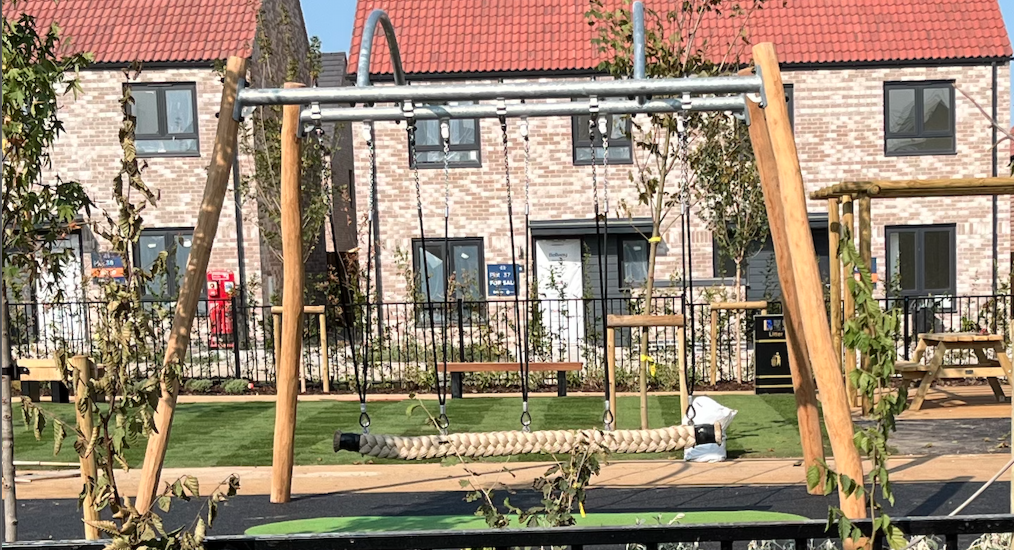
Above – from a soon-to-be-opened ‘pocket playground’ in Springstead Village north of Cherry Hinton
I’ve not seen or used a swing that is all-joined-up like this. What will the children and the locals make of it? Noting that last summer one youngster at a council-funded event told me that her generation was more than aware of the inequalities in our city. At the same time, are developers designing child-friendly communities?
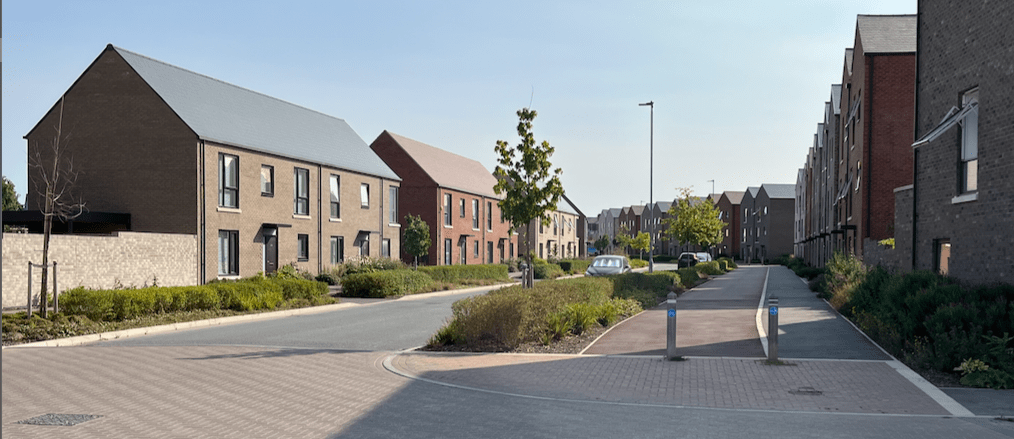
Above – in a recently-completed part of Marley, a wide cyclepath separate to the footway and segregated from the road. The challenge – as I found on The Tins Cycleway (featured in this 2016 CamCycle Article) will be the maintenance.
Especially with the tree roots that will grow through over time. The same goes for the ‘Marshall-sponsored cyclepath’ around the airport perimeter.
If you are interested in the longer term future of Cambridge, and on what happens at the local democracy meetings where decisions are made, feel free to:
- Follow me on Twitter
- Like my Facebook page
- Consider a small donation to help fund my continued research and reporting on local democracy in and around Cambridge.
Below – a reminder of the consultation from Cambridge City Council on the future of how our city is governed.

 The Cambridge Town Owl