
The other alternative is for central government to bring in residence-based voting rights similar to Scotland. If such an association was formed, it could affiliate to FECRA
‘No taxation without representation’ is a phrase familiar with many of you. In an era of globalisation where Cambridge is a city name recognised worldwide, we’re still governed like a market town. Residency-based voting has been discussed within Labour circles (eg here) having been lobbied by the Migrant Democracy Project.
What the 2021 census says.
The total for Cambridge residents born in England may seem low, but it does not cover Scotland, Wales, and Northern Ireland. Furthermore, residents identifying as White British in Cambridge in 2021 was just under 75%. Finally, there is still the tail end of the decline of Empire where long term residents may have been born abroad but whose ancestors were born in the UK – such is the case of at least two of my great-grandfathers. (But you wouldn’t guess that from looking at me!)
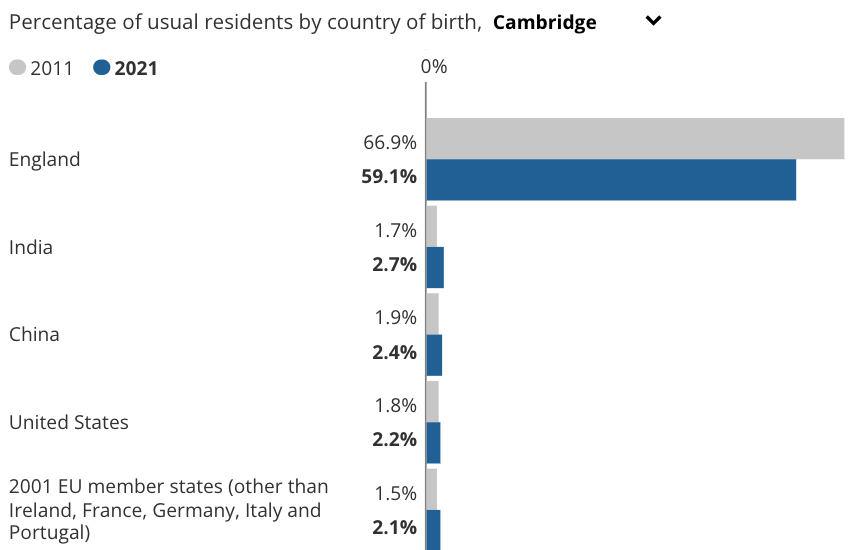
Above – Census 2021 – Cambridge
How much of a barrier is not having voting rights to local democratic and civic activism?
This is something I’ve mentioned before.
“We have a political system that excludes citizens of other countries from voting in many of our elections. How do we overcome the challenge of listening to, and acting on their concerns (chances are which may affect many other people – including voting citizens) given there is no direct political incentive to respond?”
Furthermore, who is doing what work in this field? Some of you will be familiar with the CECF formed in the early 1990s. At the time, Cambridge was going through a period of economic change that I don’t think we’ve really appreciated. The structural changes of the state changed the nature of public sector jobs – especially in administration when you look at the offices that have since closed – both civil service and NHS-related administration. Furthermore, the decline of light manufacturing (Chivers of Histon, PYE, Spillers Milling to name but a few) along with the closure/renaming of brands such as Eaden Lilley, Joshua Taylor, and Robert Sayle reflect the growth of ‘clone town Cambridge’.
Addenbrooke’s inevitably was one of the places where people from all over the world came to work in healthcare. Only more recently is this story beginning to be researched and told such as through the Museum of Cambridge’s project here. At the same time, we are also 20 years into the removal of the barriers to work from the 2004 new EU countries (Czech Republic, Estonia, Cyprus, Latvia, Lithuania, Hungary, Malta, Poland, Slovakia and Slovenia), the residents who moved from those countries and their children will have their own stories to tell and record.
“Do we need another association or group? You’ve already suggested a town society for the students!”
See here on a student society for those interested in all things town. I’m putting the question to see what the responses are – it may well be that the issues are not as big as I think they are (hence no new associations are needed) or that someone else has a better idea on how to deal with them.
I suggest that if such an international residents’ association is formed for the city, it’s open to anyone who lives in it on the grounds that we are an internationally known city, and who willingly signs up to the aims, objectives, and any codes of conduct such an association bring in. (That would aim to keep out disruptive people). Furthermore, a constituted organisation has more influence with people acting in unison than independently. Finally, if the organisation became large enough (and given the thousands of residents without voting rights in local and general elections there’s no reason why not), they could elect representatives to lobby local and central government to give those without the vote due to nationality, a voice.
“Why can’t people just take out UK citizenship?”
One big barrier is cost. If you are in a low-paid job, then the costs of acquiring citizenship are prohibitive – £1,630 for each adult at the last count, and over £1,200 per child. For a family of 4, that’s over £5,000. It’s almost like the Tories didn’t want people to take the path of becoming citizens – they were the ones who ramped up the fees. It’ll be interesting to see what the new government does with the fees – amongst other things (such as the continually laughable ‘Life in the UK’ test whose only practical use seems to be for pub quizzes).
“Aren’t there already organisations that deal with issues most likely to affect people without the vote?”
There are – such as Acorn the Community Union (which has an active Cambridge branch – I”m a member) that seeks to unionise and represent those in rented or insecure accommodation. I joined because amongst other things I’m several steps *behind* being able to rent a place of my own, having boomeranged back to my childhood home after my civil service days and then health implosion. In that sense I’m sort of part of the hard-to-define ‘hidden homeless’ – in my case living in stable accommodation but where I would rather have a place of my own. (How it would work with my disabilities I’m still not sure).
Part of the wider policy problem is the lack of data and lack of evidence-bases. This comes up time and again in decision-making organisations – especially where you have different interests with conflicting views. It came up last night in Cherry Hinton over the East Cambridge Lakes (80 people on an August Sunday night is a huge turnout) on concerns about how polluted the lakes might be from leaching from the landfill next to it.
Linking up new and existing residents associations
One of the things that is hard to avoid is how the presence of local government in Cambridge has declined – the victim of budget salami-slicing and micro-management from Whitehall. (I used to be one of those micro-managers – sorry!). Furthermore, legislation in the 1980s forced the contracting out of so many services that local council brands were replaced by corporate brands. Municipal swimming pools are a textbook example – Parkside Pool used to have a strong city council branding incorporated into the public art. Not today.
This is also reflected in the resources provided to different parts of the city. The new housing estates have the medium term benefits of ‘Section 106 Money’ from developers being required to pay for community development officers. For example Marleigh Residents’ Association have got their first AGM next month. Because of the poverty indicators, Arbury, King’s Hedges, and Abbey wards get more council support than say Coleridge and Queen Edith’s – the former being dormant in comparison and completely dependent on volunteers (i.e. no paid staff). Again, the party political culture since Thatcher’s Government has been that such functions should done by charities, not local councils because that’s ‘municipal socialism’. There’s no right or wrong answer – people will take whatever view depending on their dispositions and life experiences.
Shared problems that manifest themselves in different ways
Take Loneliness (again) – only because there was an interesting piece of research from Anglia Ruskin in the news earlier.
You can read the full research article here.
Consider how loneliness manifests itself in different cohorts of society using these case studies:
- A family who have arrived in Cambridge from abroad for work – in a sector that does not have established social functions (such as the social clubs of old with large employers)
- A middle-aged single person who has seen their childhood friends and workplace friends move away because of (things like) the cost of housing, career changes, family changes
- An elderly person who has been moved into a care home away from their old community and family networks
There is no ‘one size fits all’ model – there seldom is for anything it seems! It’s one of the reasons why ministers of all parties have talked the talk about giving local councils the ‘flexibility’ to develop solutions that work for their ‘unique individual circumstances’. Only those flexibilities don’t extend to revenue-raising powers. Sadly.
The one big area of potential that an international residents’ association could bring through is new ideas that have been tried (and have been successful) in other countries.
While we have a handful of councillors past and present from a range of countries, it strikes me that we’ve never had the mechanisms to tap into the expertise of the international researchers especially in academia who might have something to contribute to improving how our city functions. Only it’s malfunctioning – and has been for far too long.
If you are interested in the longer term future of Cambridge, and on what happens at the local democracy meetings where decisions are made, feel free to:
- Follow me on Twitter
- Like my Facebook page
- Consider a small donation to help fund my continued research and reporting on local democracy in and around Cambridge.
Below – a reminder of the consultation from Cambridge City Council on the future of how our city is governed.

 The Cambridge Town Owl