
..said one of our German residents to John Jervis in the RIBA Journal
You can read the full article here – it’s damning on both ministers who created this mess and the institutions who either went along with it or are flailing in the tangled web of ‘partnerships’
Quoting the very end in full, you could be excused for thinking the article covers the past howevermany years I have been blogging for on this and my previous blog over Cambridge’s governance problems.
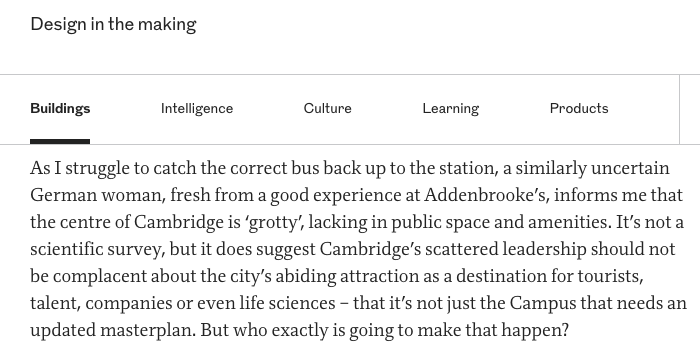
‘Who is going to create that updated masterplan and make it happen?’
Me and Puffles apparently. At least the dragon fairy’s been to the meetings!
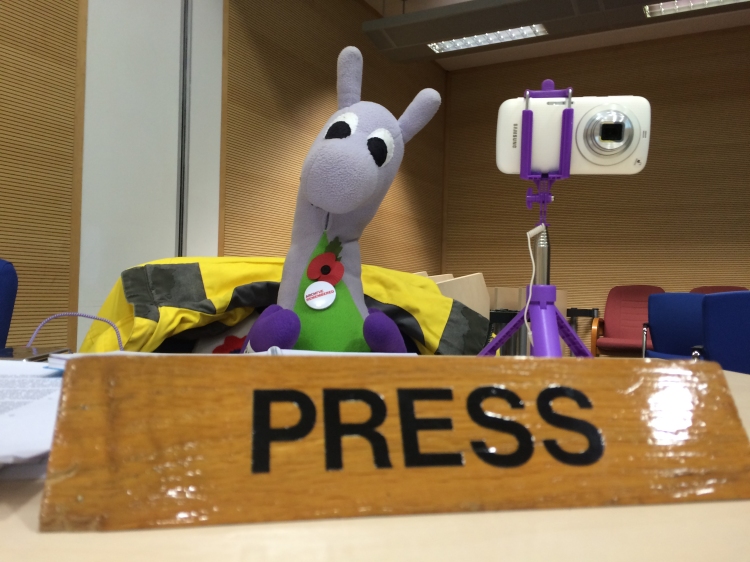
Above – former Cambridge Twitter persona Puffles the Dragon Fairy – now in retirement
‘The City of Cambridge needs a Great Cambridge Masterplan to reach its potential’
Here’s one time we made the same call. Eleven days ago to be precise.
The consistent theme throughout nearly 15 years worth of social media posts and blogposts is how central government has functioned as a block – or Michael Gove’s famous ‘blob’ – only the blob was him and his now former fellow ministers. Furthermore, the huge amount of money spent on strategies and consultancy reports is not matched by the actual construction of the facilities the reports say are needed. Furthermore, the removal of The State (and thus ‘politics’) from being a central commissioner and provider means that funding for such large projects as towns and cities expand, are harder to come by (or are more unstable). Cambridgeshire Horizons – the old housing and infrastructure quango had this list that was supposedly linked to London 2012 (amongst other things). The Ice Rink already had the funding provided for it through a bequest. It took over 30 years to find a site.

Above – from Cambridgeshire Horizons (undated)
“What are the important questions John Jervis raises?”
Familiar ones that local residents have been raising for decades but to which few national publications have been listening to. Which actually comes as no surprise in a place like Cambridge where an individual’s influence is tied to the institution they represent or are part of. I saw this phenomenon across the country during my civil service days where the influence of having the name of a Whitehall department behind your words went a very long way – longer than it should have done if I’m honest. It reflects the over-centralised structure of government.
“[The] main impression [of Addenbrooke’s] is of dirty portacabins, streaked concrete, a hidden entrance and confusing signage.”
Jervis, J in RIBA Journal, 20 Aug 2020
That wasn’t meant to be the plan. It was meant to be a ‘Hospital in a park’ – in sharp contrast to the crowded city centre.

Above – Cambridge News, 05 Sept 1963 via Mike Petty MBE / Cambs Collection

Above – Cambridge News, 16 March 1966 via Mike Petty MBE / Cambs Collection
There was some sort of a plan to it but the financial woes and party political instability of the 1960s onwards inevitably had an impact on what got built and where. In the case of the Rosie Maternity Hospital, it took Sir David Robinson’s intervention to get it built – an intervention that those making their fortunes in our unequal city would do well to follow.

“What’s wrong with having a population that is informed, educated, and having some time on its hands to scrutinise development plans?”
My thoughts entirely. I want ***every town and city*** to have a population that is informed, educated, and engaged in the processes that shape the future of where they live. Which is one of the reasons I want a Universal Basic Income brought in for everyone. It’s not like the grossly unequal distribution of wealth can’t be distributed better. (There are also health benefits too). In my civic workshops in Queen Edith’s – the ward that Addenbrooke’s sits within, participants have told me that lack of time in their busy lives is the biggest barrier to them engaging in the detail of what’s happening to our city. The broken structures and systems of governance mean that even more time has to be wasted on trying to make sense of it and trying to locate where the centres of power actually reside. (I will be running some more sessions this autumn). Mr Jervis also highlighted the issues with visions past and future.
“There’s also a feeling that promises of increased healthcare provision in the Campus’s earlier ‘Vision 2020’ document have dwindled in the new ‘Vision 2050’.” – Jervis
I wrote about both of them here. The challenge with any long term vision is that it has to be flexible enough to account for changing circumstances that are all but impossible to predict. What formal evaluation of the 2020 vision was carried out? (Here’s me moaning about the lack of post-occupancy evaluation of housing developments – something I’ve raised with the city council’s Planning & Transport Scrutiny Committee on more than one occasion).
“In short, expanding the Campus may well benefit UK plc, but what’s in it for nearby communities is less clear – proposed fitness classes and street food don’t really cut the mustard.” – Jervis
It’s like he’s read my blog. Lots.
“A gym and a few yoga classes in every new sci/tech development won’t meet Cambridge’s sports & leisure needs”
Not that I’m complaining. I take the view with the suggestions I make that *someone* in power should do something to make the good things happen.
“[Cambridge’s] ageing road network remains unaddressed, with a ‘Greater Cambridge Transport Strategy’ at least a year away.” – Jervis
I moaned about this in May last year when the Tories on Peterborough vetoed the original plan – before an internal fallout saw them kicked out of office and the proposals later approved by the Combined Authority Board. I also stung them on getting their Cambridges and Cambridgeshires confused.
Above – ICYMI you can read the Greater Cambridge Transport Strategy here.
The local sections for the rest of the combined authority area are here.
The problem as Mr Jervis highlights, is that the full sign off of this plan won’t be until ***after*** the county council and mayoral elections. The current status as below is from the CPCA’s Transport and Infrastructure Committee of July 2024 – see item 6 para 3.2
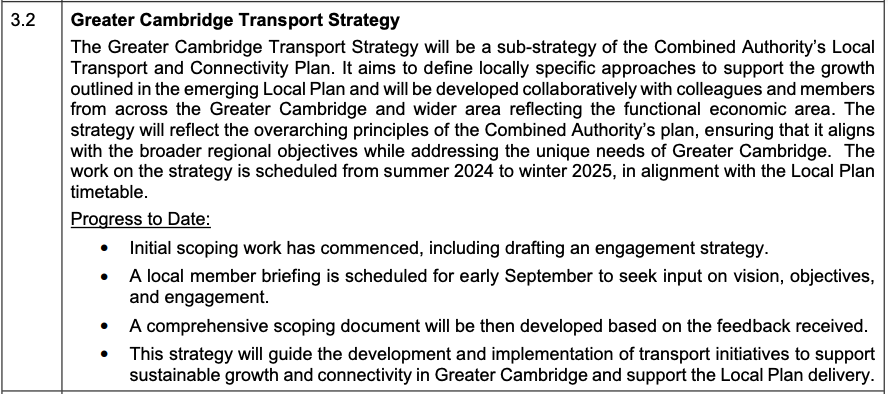
Above – CPCA T&I Cttee item 6 para 3.2
There’s no tram or light rail plan in the current Greater Cambridge transport proposals
This will be a party political issue for all candidates contesting the mayoralty next May – which is just over eight months time. Not least because the Conservatives changed their party’s policy in the run up to the general election to support a light rail plan for Cambridge. One of the reasons Dr Nik Johnson did not back any light rail plan was because the state of the bus services was so poor following the hit to county council budgets by George Osborne and successors, combined with the complete lack of funding and powers for light rail anyway. Without that ministerial commitment, quite understandably he chose not to progress with something that risked ministers pulling the rug from underneath him. Despite being the Conservative Mayor at the time, Dr Johnson’s predecessor, James Palmer made a sound argument for a land value capture to pay for the light rail, but was unable to secure a ministerial commitment from The Chancellor that provision would be made in legislation to give combined authority mayors such powers to pay for infrastructure improvements.
“What needs to happen to change things?”
A change in the law. The Chancellor Rachel Reeves needs to set out what The Treasury’s policy is going to be on any land value uplift levy, direct her officials to write the necessary clauses into the annual Finance Bill, and make the formal announcement in her Budget speech. If she can do that before the elections next year, it gives Mayor Nik Johnson the political and financial cover he needs to change local Labour policy on light rail. Without it, all candidates supporting light rail will be asked: “Where’s the money coming from?”
Broken governance – and why a Peterborough-style unitary council for Cambridge will not work
I refer Mr Jervis and anyone finding this blog via RIBA to previous posts I’ve written about Cambridge’s broken governance structures. The proposals from the Cambs Unitaries Campaign so far are to kick-start a long over-due conversation, which we last had in the early-mid 1990s. That resulted in Peterborough becoming a unitary council – one that simply resulted in the combining of existing city and county council powers rather than creating any substantial new ones. As things stand, this is the only option on the table from central government (unless/until ministers announce new policies). On top of that (other than the huge complexity of the process), the Labour leader of Cambridge City Council announced he was sceptical about proposals for a unitary council recently.
Personally I think a unitary council based on Cambridge’s 1935-era boundaries (the last time they were changed) would be fruitless because you can see from the rental market area the distances people working in Cambridge have to travel in from. (The ‘travel to work’ area is slightly broader for car commuters).

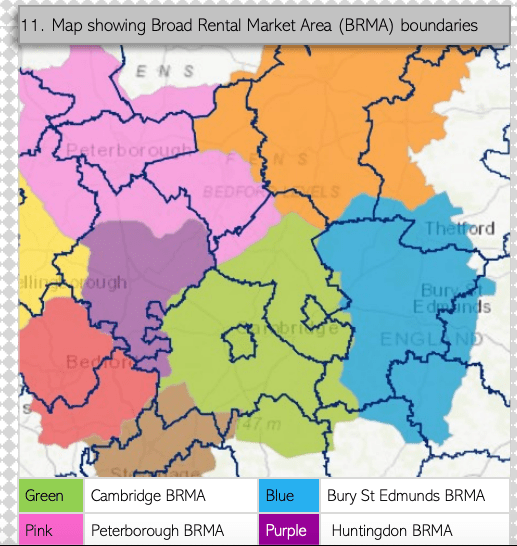
Above-left, the rejected proposals from Redcliffe-Maud 1966-69. Above-right – you can see how the rental markets indicate the spread of economic spheres of influence (via Cambridgeshire Insight Housing Market Bulletin Edition 60), and how this relates to current council boundaries.
Hence my preference for a system similar to what Lord Redcliffe-Maud proposed in 1969 in his epic report, combined with strengthened parish and town level councils which I wrote about in 2023 here. That way, unitary councillors get properly remunerated, have a higher profile, and form the link between the most local tiers of government and a unitary tier that matches wider living and working patterns. It also strengthens local and unitary tiers at the expense of central government which should not be micromanaging at this level anyway.
The Cambridge [Urban] Room
Mr Jervis mentioned this – see https://www.cambridgeroom.org/ – it’s a little behind schedule, so in the meantime I’m pointing people to Together Culture down the way on Fitzroy Street if anyone wants to discuss the future of the city from a people’s perspective.
Two things Mr Jervis missed out on: The role of ministers, and the role of taxation
I think he should have pinned the blame on Cambridge/Cambridgeshire’s messy governance structures on the ministers that created them.
Ministers created the broken structures
The Coalition created the Greater Cambridge Partnership, and the Combined Authority felt like it was created to give something for Andrew Lansley, the former Health Secretary and former MP for South Cambridgeshire something to do.

Above – from ITV 17 March 2016 – Lansley as the favourite
…only the proposals were kicked out by councillors across the piece, and the present Combined Authority only got the go-ahead after Chancellor George Osborne agreed to fund a significant amount of council house building by Cambridge City Council. It’s up to the Conservatives to explain why they think the current structure of governance for Cambridge and Cambridgeshire is splendid.
Ministers are preventing local government raising revenues themselves independently of Whitehall to pay for the much-needed improvements
In Cambridge we know it looks awful to see a city with such a famous university being seen to get all this money from central government. Furthermore, hardly anyone gets to hear about how much of the business rates revenue is surrendered by Cambridge City Council and redistributed to the rest of the country.
Above – from State of the City December 2023 at The Guildhall
Successive Conservative ministers promised but never delivered on overhauling the business rates regime. I would rather an empowered local government tier for what I call ‘Great Cambridge’ have the powers to tax the wealth itself and leave Whitehall to use central funds to target those areas that need it more. The problem is previous governments are still haunted by both the Poll Tax and by the decades of wrangling over local government reform and boundary commissions that both seem to be candidates for a second edition of Charles Clarke’s Too Difficult Box – the former Home Secretary having retired to round this way. Mr Clarke gave a talk recently about what a Labour government might be like, using history to tell his narrative. I wrote about it here and included several references to past attempts to overhaul how councils are financed.
“You can understand a writer in an architectural journal not wanting to get into local government finance as a topic, right?”
I can understand *anyone* not wanting to get into the mess that is local government finance! But until policy-makers and decision-makers get to grips with it, Cambridge (and not just the city centre) will remain a place with a globally-recognised name that has grotty and potholed streets, a lack of access to green spaces, and few public facilities because (amongst other things) it is governed like a market town. And it’s up to the Deputy Prime Minister Angela Rayner to change that.
And wouldn’t it be a wonderful thing for politics in the UK for a solid working class woman from Stockport in Greater Manchester to be the person that whips this broken and unequal university city into shape?
If you are interested in the longer term future of Cambridge, and on what happens at the local democracy meetings where decisions are made, feel free to:
- Follow me on Twitter
- Like my Facebook page
- Consider a small donation to help fund my continued research and reporting on local democracy in and around Cambridge.
Also, if you want a crash course on local government finance, read this from 1993 by the LGIU. (Just not at one o’clock in the morning!)

 The Cambridge Town Owl