
A mid-1990s academic journal piece from a former theology student-turned youth worker in 1960s Cambridge puts into words my experience of ‘being educated to be ignorant’ in my 1980s and 1990s childhood in Cambridge.
Image detail – from Adult Education for Democracy publushed 1944
It’s that experience – and the consequences of it, along with my inability to leave the city to live an independent life that is one of my big internal drivers. I tried to leave Cambridge permanently – twice. And failed on both occasions. So the only option I’ve got left is to turn what I’ve learnt towards the institutions that, in my eyes failed an entire generation.
You can read the article titled Youth Participation – Concepts and Structures here from p12
It’s from the Australian-based journal Transitions – this being a special edition on youth participation and it’s worth browsing the other articles too. Not least because the lessons seem universal – and have not been learned by those in power.
An idealised, ultra-simplified way of dealing with the issues of what to do with bored youths was illustrated in the same journal below


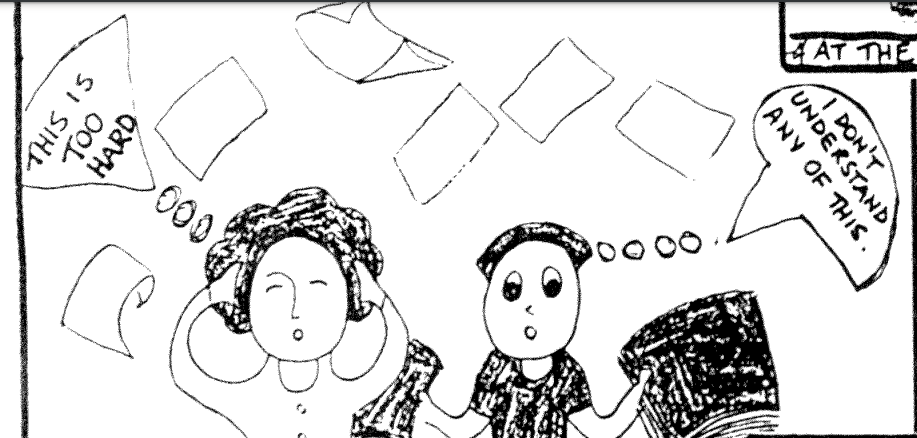

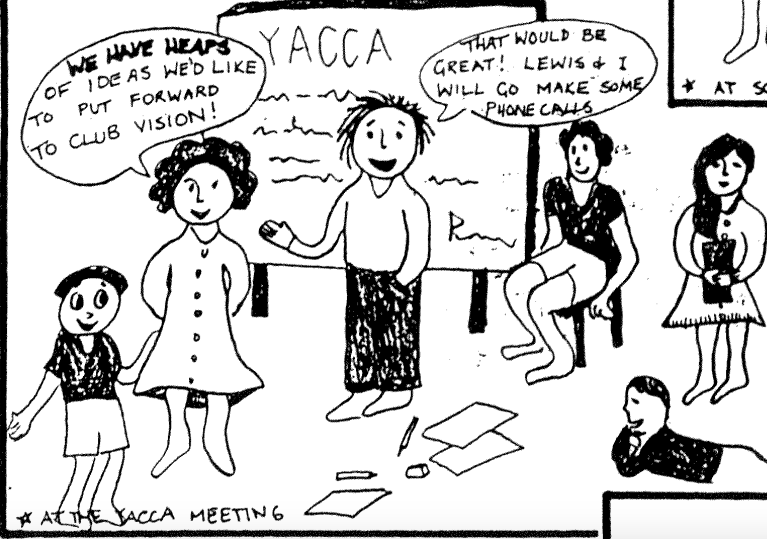

Above – a short story from the intro – YANQ Journal 1995-96, p4
If only dealing with teenagers and young people was that straight forward!
I skimmed across this in an earlier article because being in my mid-40s, I know nothing about young people. Which is why in part I see my contribution towards their collective wellbeing in our city as one where I focus my attention on the institutions, ploughing through the bureaucracy where others have neither the time nor patience. The other thing is because technology, society, culture, politics, and our city have changed so much since my childhood in the same house I’m typing this blogpost up in, if I got involved in the detailed solutions I would risk recommending solutions for a 1990s youth rather than to challenges that teenagers and young people of the 2020s now face.
Cambridge graduate John Ewen’s youth work in The Kite, Cambridge
I wrote a blogpost about John Ewen here, which in part transcribes his work in Cambridge in the early 1960s in historically one of the worst slums in our city’s history. Today the venue he worked out of is somewhere under the Grafton Centre – the current and future versions being unrecognisable to the neighbourhood he was familiar with. i.e. the old Wellington Street Youth Club.

Above – from the National Library of Scotland, a digitised detail of a map of Cambridge from the mid-1960s here. You can see the youth club where they met labeled bottom centre at the end of Wellington Street. Newmarket Road and the old Christ Church on Newmarket Road are top-left.
“What’s a youth club?”
***It’s one of those things young people used to go to before Thatcher’s Government shut them all down by cutting funding to local government and requiring them all to contract out services to the private sector – meaning there was little in-house expertise to rebuild past movements.***
The political mindset of ‘providing distractions for young people or they will get into trouble’ is part of the challenge. At the heart of the issue is the failure by adults to provide what should be for children and teenagers by rights.
Another Lost Cambridge hero, Eglantyne Jebb, told us this 100 years ago when she drafted the Geneva Convention 1924 on the Rights of the Child – since updated and strengthened by the United Nations. You can read the summary version here.

Above – Article 31 – the right to rest, the right to play; incredibly important
‘You need to forgive yourself – you were not to blame for being educated within a broken system’
Just after I wrote this, Sian Eleri of BBC Radio 1 had the following to say to the teenagers receiving their GCSE exam results in the next 12 hours.
“Sending you love if you are expecting some exam results. Be proud and kind to yourself, Your life and happiness is limitless. no matter what letters appear on the screen, you deserve joy.”
Above – Sian Eleri, BBC Radio 1’s Powerdown Playlist, 10.52pm, 21st August 2024
The voices saying the above were few-and-far-between a generation ago. The culture on being judged by (and judging each other on) your exam results was – and still is toxic. When the Department for Education doubled-down on it on social media back in 2020, I wrote this in response.
“Given school is supposed to prepare kids for life, if they emerge unable to do or understand loans, tax, planning, driving, nutrition, fitness, interpersonal skills, confidence, resilience, basic electrics and cooking, then school is basically just…useless”
Above – Tansy Kelly Robson in a Twitter exchange with me recently (I agree with her)
Not least because it wasn’t just me that was complaining about the gap between what we should have been taught at school and what we were actually taught at school in the 1990s – a time when ministers really started micromanaging things via the National Curriculum.
“Mr Kelsall remarked that he learnt more about the skills needed for the workplace working on a fruit stall in his teens in mid-1990s Cambridge than anything he had learnt at school, college, or even his degree.”
As I said in the blogpost linked, it was all the more powerful coming from him because our childhoods had shadowed each other between early primary school to our last A-level exams.
The youth rebellions of the 1960s against the established cultures of the time – John Ewen’s experience and analysis
Someone should write a biography about his life if it hasn’t been written already. There’s lots to be picked up on his Cambridge town experiences. Fast forward to 1995 and he stated the following:
“Young people’s demand for participation formed the catchcry of the late 1960s. It reflected the optimistic search for alternative, freer and happier lifestyles, and dissatisfaction with elitist models both in education and in society at large”
“Around the world, students began to realise through their own experience that education reflected values with which they disagreed and which placed them in a powerless passive relationship to society, and moreover that it was education itself which was the most powerful guardian and perpetuator of those values and hence their powerlessness. Educational institutions therefore became the first of the Bastille Walls to storm as a rehearsal for more extensive social change”
Above – John Ewen (1995) Youth Participation, concepts & structures – YANQ Journal 1995-96, p12
Ewen then goes into why he thinks we ended up where we did in 1995 – make of that what you will. His analysis later on of the different types/models of youth participation vis-a-vis the state is an interesting one – looking at the pros and cons of the different levels of state involvement.
The part that particularly interests me is the relationship between the individual and the state – in particular at a local level. Only as a teenager ‘central government’ was something ‘over there on telly’, while the local councils’ presences (city and county) was all but non-existent, as I wrote here. It should not have been like that.
With school not educating us about civics, politics and democracy (a party-political choice by the Conservatives that also cut the funding and abolished some of the key institutions for adult education), combined with larger established religious institutions happy to do the Government’s bidding on Section 28, I came to the conclusion that it was a combination of the government of the day (The Conservatives in my case), and their policies implemented by the schools (which the law compelled them to), combined with the cultural and social influence of institutionalised religion – in my case the Catholic Church. Thus I could rephrase John Ewen’s words as:
**I began to realise through my own experience that school and church reflected too many of the values with which I disagreed, and which placed my generation in a powerless passive relationship to the society in which we lived in. Moreover that it was school and church themselves which were the most powerful guardians and perpetuators of those values. Hence our generation’s powerlessness.**
The hard bit – as Ms Marsden said to me last year, was learning to forgive myself for the decisions I took effectively under duress and with very, very limited knowledge and awareness. There wasn’t anyone around me to contest the narrative or to put alternative options forward that I otherwise wasn’t aware of. For example the artificial split between the arts and science, or the idea that you had to give up everything fun or frivolous to prioritise exams and coursework.
Which is why one of the high profile songs around the time I did my A-levels sometimes feels like it’s trolling me from the past. Because at the time I knew that sensation was going to hit me, only I didn’t know in what form, in what context, and what the emotional pain would feel like. Ditto with the Sunscreen Song from just before I left Cambridge for university down in Brighton.
Learning how to fail well – and recover, and do things differently next time around
We see this played out in the print press every year with the concepts of modules and resits – rather than asking whether our education system is flexible enough to enable students to take exams in their chosen subject when they feel ready for it rather than at a point in the timetable that suits institutions. I knew I wasn’t ready to go to university in the year that most of my cohort went. Ideally I wanted an extra year in college, but that was never really on the cards. I did however get an back-office job in town at a big bank – which amongst other things taught me that I wasn’t cut out for the industry and that it was important to try things out to find out what you don’t like (and why), as much as what you do like.
Lifelong learning and additional life chances – for everyone
Earlier this week I was browsing through the file of papers in the CCAT folder in the Cambridgeshire Collection (3rd floor of the Cambridge Central Library). It was heartbreaking to see what used to be available for adults but no longer is.
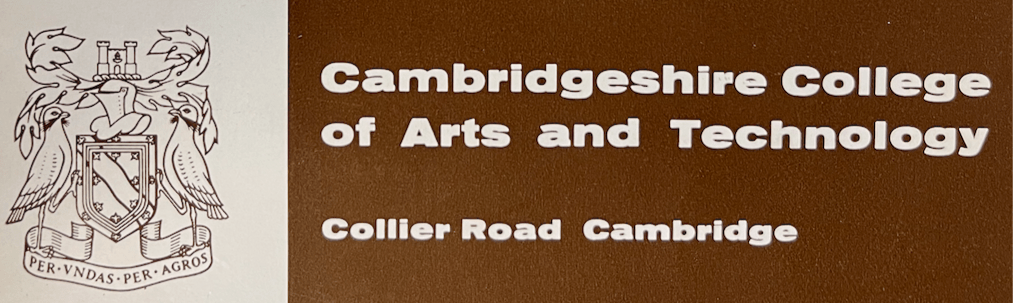
Above – detail from the CCAT brochure from 1961 showcasing the modernisation of the site off East Road and Collier Road – ask the Collection staff and they can bring this out for you
This was on top of the Workers Educational Association in Cambridge that declined because of so many funding cuts in recent times – it used to have a thriving local branch.
**It’s too late for me**
…but not too late for everyone else, is the mindset I have when lobbying for things like a new dedicated lifelong learning centre for Cambridge, or new arts/music/leisure facilities in and around our city. One of the reasons for linking so much of this to local history isn’t just because of what I lived through, but because it resonates so much more when people who live here – including those that have recently moved here, to find out about what previous generations fought for, won, and then had taken away from them (often by central government). My hope is that some of them might become active not only to reverse those losses, but to help build something better than what was there before.
If you are interested in the longer term future of Cambridge, and on what happens at the local democracy meetings where decisions are made, feel free to:
- Follow me on Twitter
- Like my Facebook page
- Consider a small donation to help fund my continued research and reporting on local democracy in and around Cambridge.
Below – I’m on Bluesky as well

 The Cambridge Town Owl