
It’s not quite the full cost-recovering powers that some (myself included) want to see, although that is going out to consultation. The £650,000 grant is also linked to putting boosters underneath Northstowe.
You can read the full press released from the GCSP Service here (or the tweet below).
“One area of focus for the accelerated implementation includes two existing projects: Northstowe and the Wellcome Genome Campus expansion. These projects will serve as focal points for testing and refining the accelerated process delivery model.
“GCSP will work closely with development partners, namely Homes England for the Northstowe project and Urban&Civic for the Wellcome Genome Campus expansion.
“Senior planners have said that these collaborations are essential in ensuring that the accelerated planning processes meet the needs of everyone involved and deliver tangible benefits.
GCSP Press Release 23 Aug 2024
Some of you will recall the Government’s intervention at Northstowe shortly after the general election. I remain of the view that both Cambourne and Northstowe should be the subjects of inquiries into the problems that the developments have had.
Design codes and neighbourhood plans
One of the things I’ve struggled with is the huge time commitment involved in scrutinising and contesting developers’ design codes in planning applications for large areas of land. I was particularly critical of the designs put forward on the controversial Land South of Coldham’s Lane scheme when their proposals for a sci-tech development were first announced following the sale of the site to a speculative developer.

Above – from CTO 25 March 2023
“I pleaded with them not to design and build entries suitable for a second edition [of Hideous Cambridge – a city mutilated]!”
South Newnham’s Neighbourhood Plan – and objections from a powerful college
You can see the documents here – with the following supporting and additional documents towards the foot of the page being of particular interest:
- The street appraisals (the larger the documents, the more pictures there are in them)
- The very hostile response to the Neighbourhood Plan from Queen’s College, Cambridge
Response from the college’s representatives
You can read the full document here

Some of you might think that it’s a bit rich for a college to be complaining about not being invited to be involved in the preparation ‘until this late point’ – noting that the South Newnham Neighbourhood Forum contest that claim.
“Your claim is not correct. Between March 2016 and February 2018, the Chair of the Forum sent multiple emails to nine Bursars of Cambridge University Colleges who own land and property in Newnham inviting them to attend the first community meeting on Neighbourhood Planning, a series of three Neighbourhood Plan Workshops, and the inaugural meeting of South Newnham Neighbourhood Forum. Of the nine Bursars, six either attended a Forum Workshop or met with Forum Committee members, and the Bursar of a further College sent a representative to a Workshop.”
Above – quoting a letter from SNRF in a letter to Turley dated 3rd May, 2024
The hostility of the college makes me wonder what sort of engagement the college undertook with its resident students living in the neighbourhood. The fact that the college had the resources to instruct specialist consultants to act on their behalf reflects the power imbalances between residents and the colleges.
It comes as no surprise that the only area within Cambridge’s municipal boundaries that has a critical mass of people with the time, resources, and motivation to get this far is one of the city’s most affluent. There is absolutely no chance of similar neighbourhood plans being developed in parts of the city that have a much higher rate of population turnover in non-college accommodation and/or with greater rates of poverty and multiple deprivation. Furthermore, it’s not something that councillors or ministers pulling a single policy lever can solve. Even a big one such as local government restructures. There are so many other issues that feed into this. Hence the complexity of public policy.
When your designs are so ugly that even Cold War propaganda posters from the Communists are better than contemporary designs
I picked this up off of the Municipal Dreams BSky page here

The clear illustration of modular building with the crane shows that the attempts in times gone by and the problems faced today with such techniques are not new. Similar techniques were used for the single-storey pre-fabricated homes of which post-war Cambridge had hundreds spread across the city.
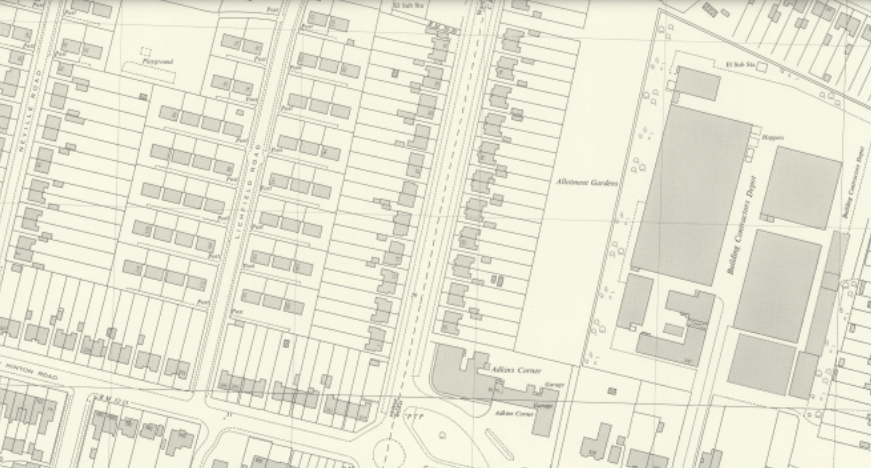
Above – centre-left in rows of three and four either side of Lichfield Road (with the big warehouses of The Paddocks – now up for redevelopment) from the National Library of Scotland – see here for the map of the pre-fabs next to Coleridge Rec

Above – the Lichfield Road pre-fabs 1946. Mike Petty MBE/Cambs Collection
A design code masterclass from The Government
You can see the free online workshops coming up from the Office for Plance in September here
It’s easy to forget the history of government-sponsored publications on housing design issues. (Have a browse on the Internet Archive here). These help explain how we got to here with so many towns and cities.


Above: Town Centres – Current Practice (1964) HMSO – Featuring Cambridge (above-right, top)
One publication on the density of residential areas is particularly timely for places that have a large low-density post-war social housing stock that is in need of upgrading in the face of tightening environmental regulations and high waiting lists.
“It is a common error to assume that the population consists entirely of married couples with children wanting houses and large gardens. Secondly, the price of higher density is better design. It is one thing to lay out houses at 6 or 8 to the acre, it is quite another to design houses and flats in mixed groups at medium or high densities, and ensuring all the time that all the dwellings have privacy, daylight, and good aspect, and that every square yard of land is used to the best advantage. This is a field of design requiring skill of a high order.”
Above – Density of Residential Areas (1962) HMSO p53
Poor housing design would become a chronic issue in England.
“A 2020 national audit of residential design found three quarters of the housing environments being created in England to be either ‘mediocre’ or ‘poor’ and that less affluent communities get particularly bad developments – perhaps an inevitability within a marketised system.”
Above – from Reflections on the normalisation of poor quality in England’s low-income housing, Town Planning Review, Cullen April 2023
The campaigns for more traditional designs are not without their pitfalls
“This is not a Modernist v. Traditionalist critique. It’s bad Traditionalist architecture by Traditionalist standards, principles, precedent, and purpose.”
I’ve been trying to find the words that reflect liking the principles of more decorative buildings – where the art is incorporated into the design rather than having a spreadsheet building with some expensively-commissioned but bland ‘abstract sculpture’ which you need a Ph.D in post-modern public art to make any sense of. (I jest. Sort of.) It’s the difference between traditional architecture and the wallpaper featuring. Compare it to old bookshelves and the wallpaper in the design of old bookshelves.
A space to talk about urban design of new housing estates
I’m hoping the Cambridge Room – which is designed to host such debates – will open soon! Furthermore, I hope it will stimulate demand for evening classes and workshops for people to learn more about the principles so that the public is in a better position to question and challenge developers over poor design.
If you are interested in the longer term future of Cambridge, and on what happens at the local democracy meetings where decisions are made, feel free to:
- Follow me on BSky <- A critical mass of public policy people seem to have moved here
- Like my Facebook page
- Consider a small subscription to help fund my continued research and reporting on local democracy in and around Cambridge.

 The Cambridge Town Owl