
Browsing through old course catalogues from the 20th Century and finding out what previous generations can teach us
Before I get going, this isn’t to say there’s nothing happening in present day 2020s Cambridge. There clearly is – not least because several of the groups that have rebuilt after the lockdowns are advertising online for people to get involved. Such as We Are Sound (previously the Dowsing Sound Collective).

Above – Tenors especially wanted
Another one that also rehearses in South Cambridge is Collegium Laureatum which unlike the above, has a more traditional classical/church-based repertoire. The national community music federation, Making Music lists a number of societies in/around our city.
There are also long-running societies such as The Cambridge Folk Club, and longstanding venues such as The Junction and The Portland Arms that for decades have been supporting new local music. Ditto The Strawberry Fair & the Mill Road Winter Fair as annual events.
Yet our city’s music scene feels almost as fragmented as our city generally, where we are functioning nowhere near the sum of our parts, let alone greater than. It’s a pattern that is repeated in so many other sectors, which hints at a greater structural malaise. Which I’ve been blogging about for over a decade. It’s that old Exclusive Cambridge vs Inclusive Cambridge tension again.
The decline of lifelong learning for recreation and leisure in the 20th Century
I won’t go over what I’ve written previously on adult education (See here if you’re interested otherwise) other than to say successive governments squished the budgets of essential vocational skills with leisure learning on adult education together, and prioritised the former without considering the wider impact on the latter. One of the things Whitehall silos make it really hard to do is to work on policies that cross departmental policy boundaries. (I found this out the hard way 15-20 years ago in my civil service days). It’s only now that public policy world is really appreciating the negative impact of this in local communities. Locally in Cambridgeshire this is reflected by Cambridgeshire Skills. The name sort of gives it away. The offering is linked to tightly-controlled funding streams linked to very specific policies. Those outside skills and vocational learning are, for example tied to healthy living, and/or the environment.

Above – from Cambridgeshire Skills – nothing comes up for music
What Cambridgeshire used to have
For those of you interested in such things, The Cambridgeshire Collection has a range of course catalogues and brochures from a range of institutions from previous generations. One of those institutions was the Workers’ Educational Association that used to have a huge presence in Cambridge. Sadly, decades of funding cuts and the decline of large, labour-intensive employers (along with the trade union membership that came with them) meant that there is almost no presence left.

Above – from Lost Cambridge – what happened to the WEA in Cambridge?
As well as the WEA there was also the old CCAT – the Cambs College for Arts & Technology. Some locals have been around long enough to still call ARU on East Road ‘The Tech’. However, in the 1980s in Thatcher’s huge upheaval of further and higher education, CCAT effectively got split into two – with one part going onto become Cambridge Regional College, and the other Anglia Ruskin University. The longer term result was the focus of the former on vocational courses as they dropped their academic GCSE/A-Levels in the mid-2000s, and the latter (incentivised by funding changes) aiming for an international market.
Sadly this meant the leisure courses as well as what I thought was a pioneering ‘module course catalogue’ where you could pick and choose evening classes on almost any course offered at East Road, declined.
One of the things we’ve lost is demonstrated in the 1981 evening class course catalogue below.
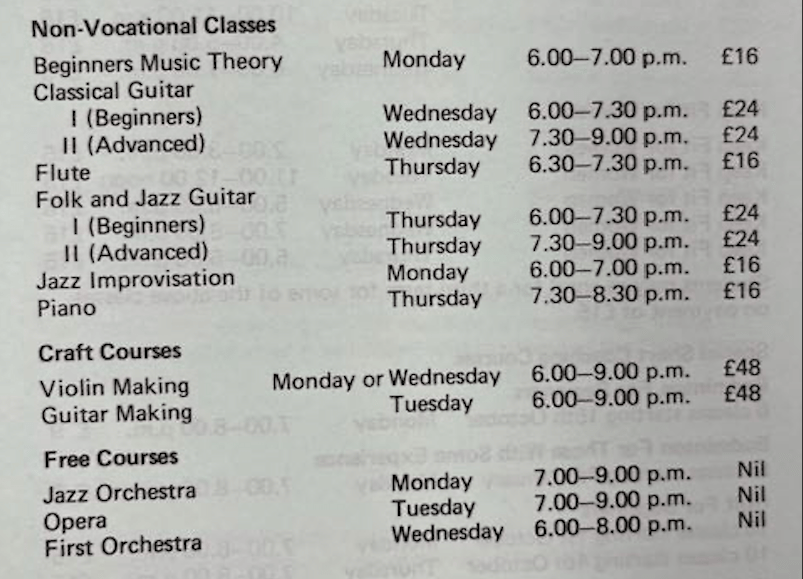
Above – CCAT Evening Class Catalogue detail from 1981 – from the Vertical File in the Cambridgeshire Collection C.36.7 vf
The importance of group lessons in ensuring price accessibility for learners
Today you’d be looking at a three-figure sum for a group course per term for more than a few leisure classes. That same sum might cover a couple of one-2-one sessions with a professional level music teacher, but inevitably you never get the social aspect that comes with group learning.
Who is there to pick up the pieces for adults who stopped playing in their teens but would like to restart or try out a new instrument?
It was several years ago that I picked up on some formal research on why teenagers ‘give up’ playing musical instruments (see Survival of musical activities. When do young
people stop making music? (2021) by Ruth & Muuellensiefen, and also Dr Anna Bull’s book which I wrote about here).
Combining the experiences of those that didn’t have a great experience of school or religion – especially those that came away with few if any qualifications from the former. It was only through listening to those experiencing the latter that the importance of building design and urban design became apparent: i.e.
- Don’t make your buildings for lifelong learning look like a school or a religious building
- Don’t locate your premises on the edge of a community that prioritises car access – especially where it means no/limited bus services in the evening
- Have your learning centres at the heart of communities – easy to walk/cycle to
Active rather than passive/transactional engagement
The context here is Cambridge’s rapidly-growing population combined with a high turnover of population beyond university circles, combined with the epidemic of loneliness in society – so large that it’s a public policy issue that Parliament publishes research papers on. As I’ve alluded to before, one-off events such as ‘The Big Lunch’ might bring people together, but how does it help the people who like ‘Julie’ in the long by The Levellers who feel ‘alone in a crowded room’ – one of the bleakest songs reflecting the economic reality of the mid-1990s for too many teenagers.
One of the things that a number of the singing groups get right is having the large end-of-season concerts. A large number of singers almost inevitably brings in a large number of friends/relatives along. It gives participants a collective target to work towards – something that was also written into the CCAT music programmes: public performances. That’s assuming the public venues exist and are affordable – in the latter half of the 20th century venues were collapsing like skittles. The Junction was one of the few ‘new’ venues that opened in response to that local crisis – or rather, the rioting that happened in 1985 after peaceful protest didn’t lead to anything positive.
I’ve wondered for years what classical music in Cambridge would be like if we had a much more inclusive culture that enabled more adults to pick up a new or past instrument, and learn collectively – both the Mawson Road Community Orchestra and the Duxford Saturday Workshop being two of the best examples we have of community orchestras. However, if we want to link up our fragmented city, our ambitions have to be much larger. And that’s not a criticism of the above-two-mentioned groups. Quite the opposite. In the current economic climate of land speculation, a cost of living crisis and a grossly unequal city, trying to organise anything with volunteers alone is a huge ask. Without the stability of funding or of venues – noting that developers all-too-often under-provide for such things, and with house prices completely out of synch with wages, the changes needed to make things happen are, I’m finding more often than not, are at a central government level. Over-centralisation is finally being acknowledged for the barrier it is in public policy circles. Whether it will lead to anything significantly positive for Cambridge remains to be seen.
Becoming greater than the sum of our parts
I won’t bore you with concert hall talk (it’s here if you’re interested). There’s a wider principle at stake which is covered in Rob Cowan’s book on Urban Design. Given Cambridge & Cambridgeshire’s population growth over the past couple of decades, and given the ambitions national politicians and ‘business leaders’ tell us they have for our city, what are the amenities and facilities we need to serve the needs and wants of that growing city and region as a whole that at present we do not have?
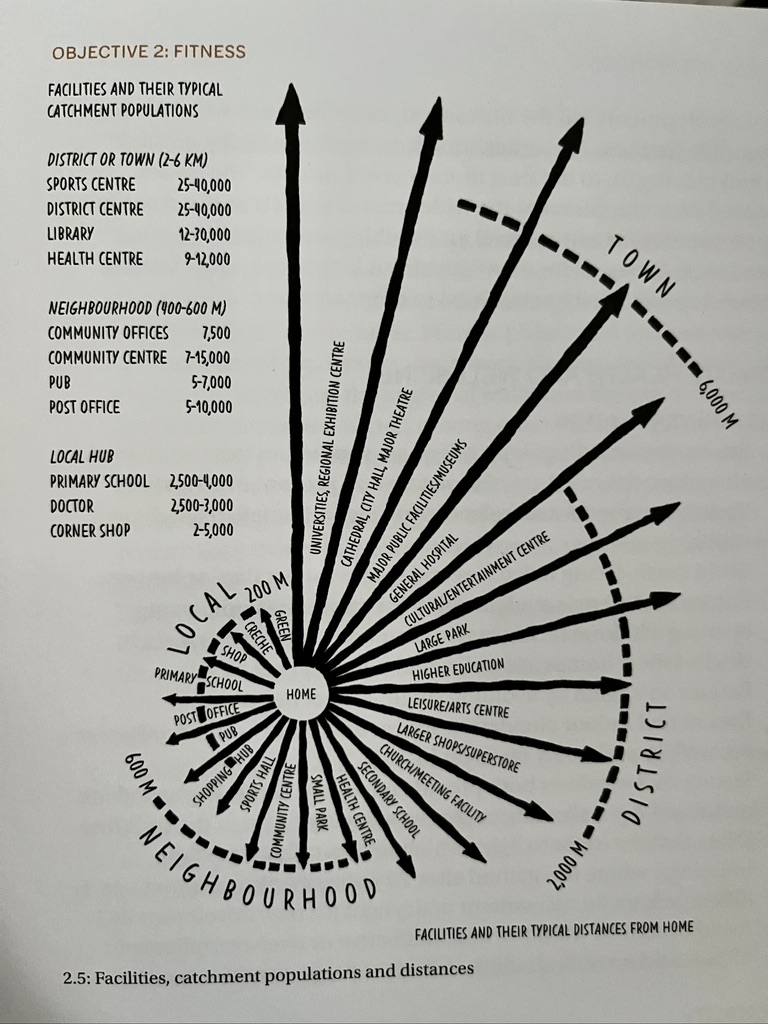
Above – Essential Urban Design (2021) by Cowan, R, Fig. 2.5
Cowan’s diagram is also a reminder to policy-makers of how our present system means our towns and cities under-provide for the social and leisure needs of its residents. All the more reason why we can’t ignore the wider political and democratic issues that underpin the provision (or lack of) community facilities. But how can we talk about such things when as one former councillor wrote recently, our councils are so underfunded and under-providing for the basics?
Food for thought?
If you are interested in the longer term future of Cambridge, and on what happens at the local democracy meetings where decisions are made, feel free to:
- Follow me on Twitter
- Like my Facebook page
- Consider a small donation to help fund my continued research and reporting on local democracy in and around Cambridge.

 The Cambridge Town Owl