
The Minister Mr Pennycook has indicated he wants to visit as soon as possible, and has instructed his officials to link up with the local councils to arrange this. (Which reminds me, can they come up with a new logo/branding?)
You can read the letter from the Minister to the council leaders and the Mayor of the Combined authority here. While it was an open secret that the previous government didn’t get on with the councils of opposing political parties, the clear and very public statement from the minister that he wants a ‘reset’ of relations will come as a relief to the council leaders concerned. Furthermore, Mr Pennycook may also have a Political eye on the Mayoral elections in 2025 – just over eight months away.
What the minister said and what it might mean for ‘Greater Cambridge’
First of all I’m assuming the minister’s definition of ‘Greater Cambridge is the area of land that Cambridge City Council and South Cambridgeshire District Council are responsible for. i.e two of the five partners of the Greater Cambridge Partnership. From a ministerial perspective, it makes sense to work within existing structures if there are ‘quick wins’ to be gained. One of the things I recall Daniel Zeichner telling the Form the Future annual conference last December (I asked him about citizenship education) was not to expect major structural reforms from the off. Even then, it sounded like there was too much fire fighting to do – something we’ve since found out with police and the courts was verging on meltdown.
The next thing to note is that this letter almost certainly will not have been typed out by the minister. This will have been drafted by an official, checked/corrected by a team leader, signed off by a senior civil servant, and included in a wider set of documents for the minister to read, comment, and approve.
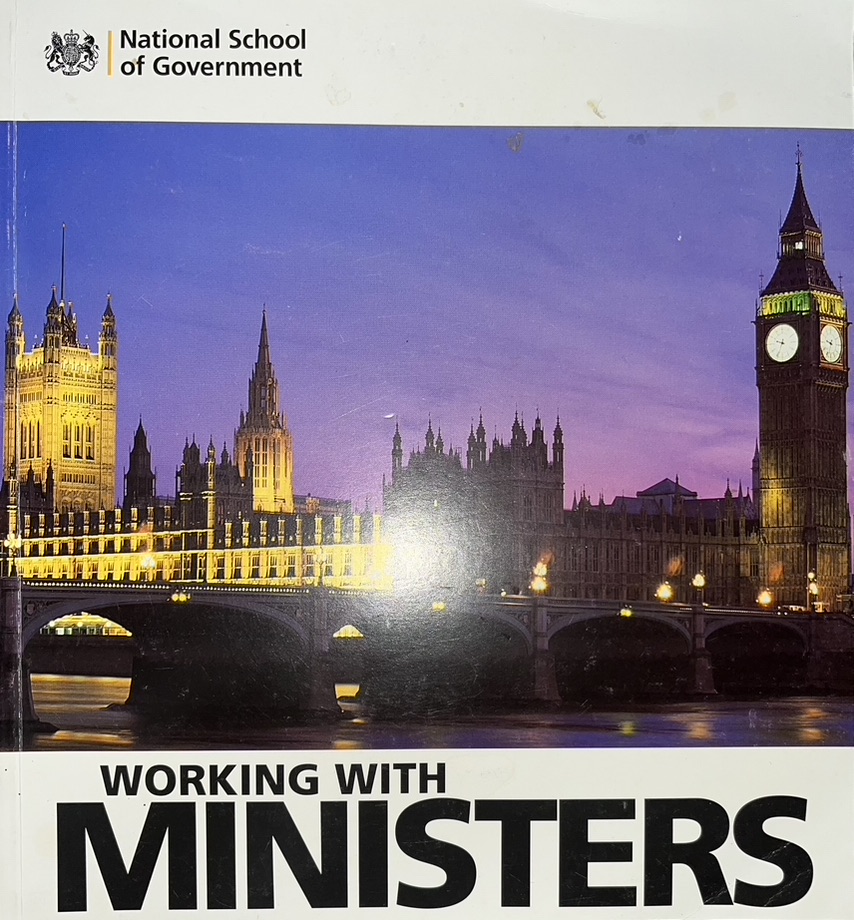
Above – by the long-since-defunct national school of government which the Tories shut down
The Letter begins:
“I am therefore writing to set out the approach we will take, working with local partners, to support the sustainable growth of Cambridge.”
It will be interesting to hear from councillors and council officers what the culture change is like in the department with the new team in place. I experienced that change both when Gordon Brown became Prime Minister and again when the Coalition ministers came in back in 2010.
It was only a year ago that Michael Gove plans for Cambridge were first reported via a leak in the Times – plans that he didn’t tell local council leaders about, nor his parties’ own local MPs who happened to be ministers at the time. So when it comes to a reset, professionalising the working relationships and giving ‘partners’ due notice of big things is…a relief more than anything. I don’t want to say ‘welcome’ because it should be one of the very basics that we should *expect* of Ministers of the Crown.
“Cambridge is of course more than an economic asset. It is home to tightknit communities who are proud of their city, but justifiably, have some concerns about its future…Cambridge is also one of the most unequal places in the UK, a sign that the benefits of its economic success have not been shared by all.”
This is to try and provide some reassurance to local residents that we have problems and challenges – and that the new government is not ignorant of, or dismissive of them. It’s a useful line for councillors to challenge developers and financiers to come up with proposals that will reduce those inequalities.
“The Deputy Prime Minister and I are determined to help remove them and overcome the issues that have held up planned development for essential housing and laboratory space.”
Given the Environment Agency’s withdrawal of their formal objection (while still keeping on record their issues) to the East Cambridge Lakes Sci-Tech development, it may well be that, as with the Cambridge North development overturned by ministers under the previous government, the water infrastructure issues are perhaps something that a more interventionist approach is something ministers assume will resolve those issues. Therefore where there are large planning applications that have been allocated for the current local plan, getting them going is something they may lean towards. At the same time, Cambridge has found out the hard way what happens if developers are given a freer rein – as the demolition of the new and partly-built Darwin Green homes demonstrated. Furthermore, the Housing Minister’s colleague Daniel Zeichner (who as a Minister of State is of equal rank) is acutely aware of the poor record of building firms in Cambridge when it comes to newbuild homes. If anyone wants to give the Housing Minister and his officials a transcript of Mr Zeichner’s speech to help ‘concentrate their minds’, be my guest.
“I am determined that we take a collaborative approach to them, appreciating as I do that your insights about the city, its surrounding area and the communities you serve need to fully inform the Government’s thinking.”
This is the flag that invites you, the local residents, to find out from your local councils what sort of insights and information the councils will be providing ministers with. This can be via email (https://www.writetothem.com/) or tabling some public questions at meetings coming up in Cambridge for Cambridge City Council, and Cambourne for South Cambridgeshire District Council.
“What information could the councils provide?”
Things for councils to bear in mind:
- Providing too much information all at once will mean ministers and officials won’t read any of it. I should know about information overload given my number of social media posts.
- Don’t forget the junior staff in Whitehall – ensure you make provision for additional low-publicity visits for them that:
- Provide space for competing interests to debate with each other in front of more senior officials and ministers so that they can observe without feeling they have to commit to anything on the day.
In particular provide the opportunity for well-briefed and knowledgeable representatives (not just ‘well read’ but also people with lived experiences of, for example living in social housing) of a range of campaign and community groups to cross-examine the representatives of the big private institutions. Not only will it be useful for civil servants to hear the different points of view from people they would not normally meet, but also it will give them more insights to see big interests being cross-examined by people who have that detailed human, social, and environmental knowledge on the ground. The sort of information no corporate consultancy can provide.
Again, this does not need to be a big media set piece or a public meeting. Having a minuted meeting where a note confirming:
- what issues were discussed
- the fact that community and campaign groups had the opportunity to raise specific named issues
- who committed to providing what answers/information at a later date
…might go a very long way. Because that makes it easier for politicians to hold powerful interests accountable to any commitments that they make, and judge accordingly where they renege on such commitments as happens all too often with large developments such as Cambridge Station. There’s a research project waiting for someone to compare the financial value of the commitments Ashwells/Brookgate got out of, versus the profits they made later on.
Keeping things short and sharp
I don’t use it for these blogposts – or anything these days. But basically group the pieces of information for each section into three groups:
- Must have
- Want to have
- Would like to have
Anything that is not a ‘Must have’ you drop.
Visits for junior civil servants and public sector partners unfamiliar with our city and district
I did a number of these during my civil service days because with what I now believe is undiagnosed ADHD amongst other things, I would accept invitations to the opening of an envelope or front door. Didn’t matter if it was at a community centre at the sharp end of one of the most economically deprived council estates far away from Whitehall, if I got an invitation I went. What I didn’t realise is that I absorbed information and insights from those visits like a sponge. Furthermore, junior officials don’t get the chance to go out of the office on such visits. Paradoxically they also have more time/space for that learning – learning they might not otherwise get the chance to have. Remember that for some working class Londoners working in the civil service, they might not have been to Cambridge before.
The civil servants are there to help ministers solve social policy problems.
Don’t keep them cooped up inside a university conferencing venue or a corporate hotel aimed at wealthy corporations. Instead, book your events at community venues where:
- It’s much more efficient to take visitors on walking tours that showcase the challenges and long term issues
- It’s easier for local residents to meet the visitors and even take part in joint activities
- the revenue from such visits such as room bookings and catering provision can be reinvested into the local community rather than the dividends of a tax-haven-based multinational. (If you *must* use a college venue, insist on them sub-contracting with local firms)
- Make sure teenagers and young people – in particular those from economically-deprived backgrounds – are involved in as many of the visits as possible, and ensure they are briefed about what it’s all about *in advance* of their participation. That may mean additional workshops for them. If that’s the case, reward them for their participation too. (Get them to suggest what might be suitable)
Use these visits as opportunities to get more new people involved in the debates on the future of our city
We have lost a number of active residents in recent years. People who used to be prominent have either moved away and/or onto other projects. That’s not good for democracy or our civic society. It’s not an ‘all or nothing’ deal – rather an invitation for people to find out more and then focus on the things that interest them the most. For some it will be subject/issue specific (eg water stress) while for others it will be geography-specific, eg their village/parish. Enable people to make an informed choice.
Challenge the large employers to encourage their staff to get involved as residents. For example the supermarkets or the care firms.
Finally, acknowledge that this does not just affect the residents of Cambridge and South Cambridgeshire. The travel to work data tells us people living over county borders will be affected. How are their experiences and opinions influencing things like new transport infrastructure?
Finally, I don’t feel a particular need to have a front row seat in all of this. (I might have done a decade or so ago!)
I’d rather be blogging this time next year where a new generation of people had taken the opportunity to get involved in the shaping the future of our city and county. Ideally, that would then kick-start a new generation of civics education for adults – something we currently lack.
If you are interested in the longer term future of Cambridge, and on what happens at the local democracy meetings where decisions are made, feel free to:
- Follow me on BSky <- A critical mass of public policy people seem to have moved here (and we could do with more local Cambridge/Cambs people on there!)
- Like my Facebook page
- Consider a small donation to help fund my continued research and reporting on local democracy in and around Cambridge.
Below – Citizenship: There are a number of cheap second hand copies of Citizenship Today by Jenny Wales (The pre-2016 versions tell us of what rights we used to have pre-Brexit!) if you want to learn some of the essentials from a user-friendly textbook not written by the Home Office!

 The Cambridge Town Owl