Transport ministers will need to come up with a public transport alternative if further road congestion is to be avoided.
The Deputy Prime Minister Angela Rayner was quoted in a press release earlier, name-checking both Biggleswade and Northstowe.
“Further work will get underway to accelerate sites including Stretton Hall in Leicestershire, Tendring Colchester Borders Garden Community in Essex, and Biggleswade Garden Community in Central Bedfordshire which have the potential to unlock more than 10,000 new homes when completed.
“The New Homes Accelerator was announced as part of the Chancellor’s speech outlining the Government’s national mission to drive growth in July and since then, four large housing sites are already progressing that will deliver over 14,000 homes across Liverpool, Worcester, Northstowe and Sutton Coldfield. “
Above – Press Release HMG 29 Aug 2024
Biggleswade Town Council’s Neighbourhood Plan

Above – Biggleswade Neighbourhood Plan p22 – the light orange sections being the proposed housing allocations.
The map shows the town is surrounded by floodplains – the ancestors of today’s residents having built their settlement on the higher ground. Sensible people. You can read the East-of-Biggleswade Garden Community section of the Central Bedfordshire Local Plan here – scroll to p72. It states there will be approximately 1,500 new homes.

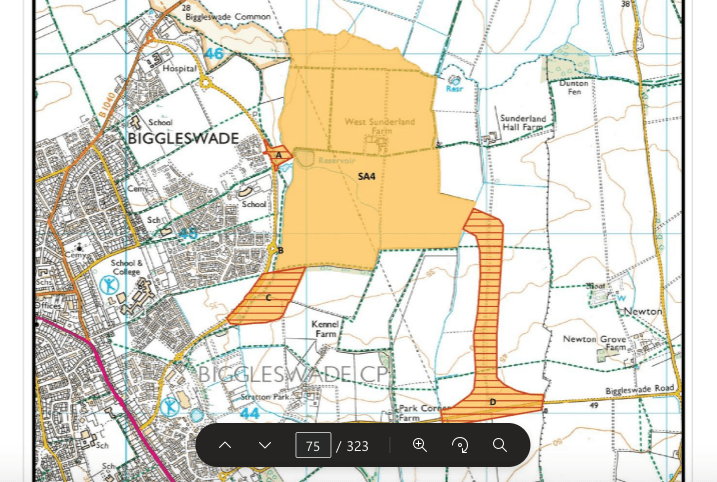
Above – detail of the proposed site for East of Biggleswade Garden Community (p75) that the Deputy Prime Minister referred to earlier.
“What right does Cambridge have to designate anywhere as overspill for its own housing failures?”
It doesn’t – and also the housing crisis is a national one. An enfeebled city council structured like a market town council is in no position to do anything substantial about it. Parliament via ministers tabling legislation took away what few tools they once might have had. Also the people of Central Bedfordshire have their own 2050 vision
But given the ambitions successive ministers (including the present ones) continue to have about Cambridge’s economic growth, the continuing housing crisis and the distances people already commute to get to work in Cambridge mean it’s inevitable that some of the 1,500 new Biggleswade homes will be bought up by people who cannot afford to buy/rent in Cambridge. Furthermore, the Biggleswade Neighbourhood Plan acknowledges the presence of Cambridge.
“What about the twenty-first century? To add to the A1 and the East Coast Main Line, we will now have dual carriageway from the M1 to Cambridge and an east/west railway just a few miles to the north with a possible parkway station where it crosses the East Coast line.”
Above – Biggleswade Neighbourhood Plan Foreword p9
The dual carriageway from the M1 to Cambridge refers to the very controversial development linking the M1 just south of St Neots (the ‘Black Cat Roundabout’) to Cambourne – the route from Cambourne to Cambridge having already been upgraded.
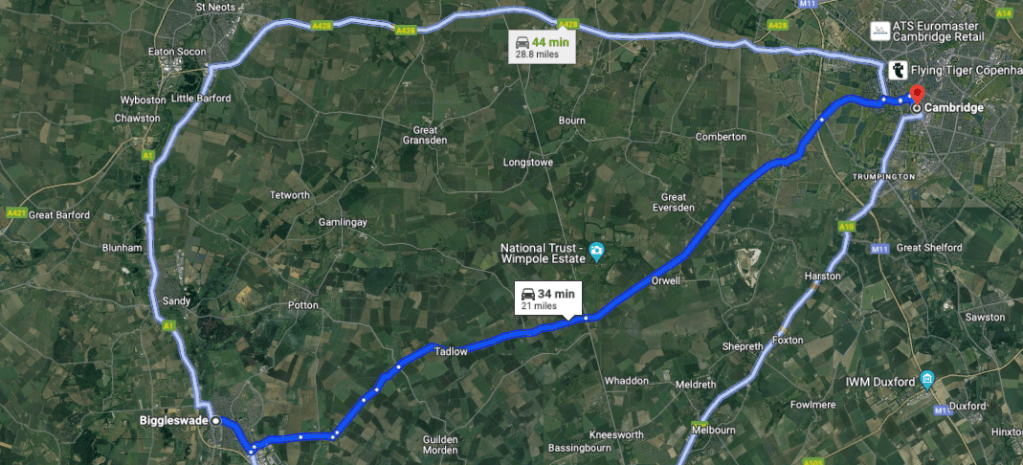
Above – Biggleswade to Cambridge on G-Maps
Given the already-congested roads west-of-Cambridge, the ‘do nothing’ option is only going to make things worse.
No existing direct rail services from Biggleswade to Cambridge
The town has a railway station that links to St Neots on the GNER main line, (and likely Tempsford if/when it gets built on the East West Rail line). Otherwise, rail commuters have to change at Hitchin. And changing trains is not fun. Part of the convenience is you get on at station A, close your eyes/read a paper/doom scroll, and then get off at station B which is meant to be your desired destination. The faster the better, but such routes are seldom as the crow/dragon/owl flies.
I’ve played with the concept of suburban/light rail loops to serve Cambridge’s economic sub-region – one that links existing communities by rail-based electrified transport lines (ideally with active travel paths next to them) as well as linking the historic towns (of which Biggleswade is one) to Cambridge. My principle is that each town should be provided with support and funding to develop an existing facility or to build a new one that will get people from Cambridge to go and visit their town and boost their local economy. It should not be a model that turns the towns into dormitory settlements for the great Sci-tech bubble.
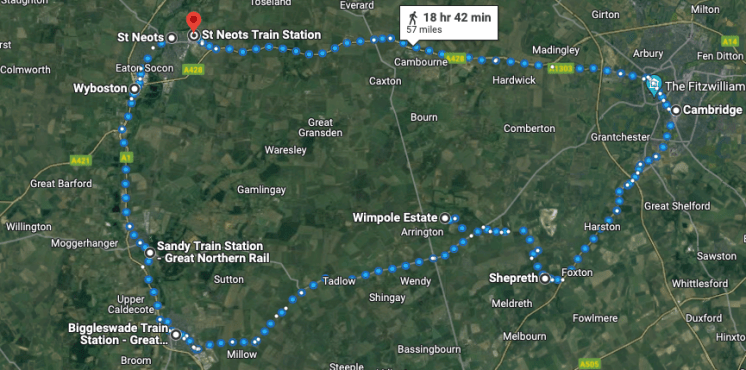
Above – a Cambridge – Cambourne – St Neots – Wyboston Lakes – Biggleswade – Wimpole Hall – Shepreth Wildlife Park link
What is effectively a 60-mile loop links up the University City with one – possibly two newtowns (given Tempsford), three leisure sites, and three historic towns if you add Sandy in Bedfordshire.
The Luton option
This is where Rail Future’s Herts and Beds group could link up with the East Anglia branch. I referred to this back in 2023 (don’t ask me how I remembered), but someone else has already done some of the thinking on this.
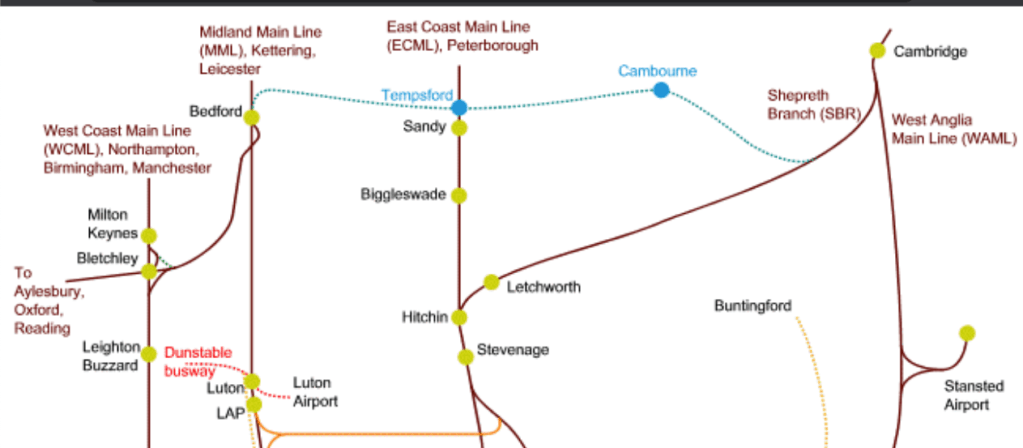
Above – from Rail Enable – note the chord to Luton Airport Parkway that joins the East Coast Main Line south of Stevenage at the northern end of the ‘Hertford Loop’.
In the grand scheme of things, Luton is not far from Stevenage or Hitchin at all. You could walk there in a few hours – set off in the morning and be there before lunch. It’s just over 12 miles from Luton Airport Parkway Station.
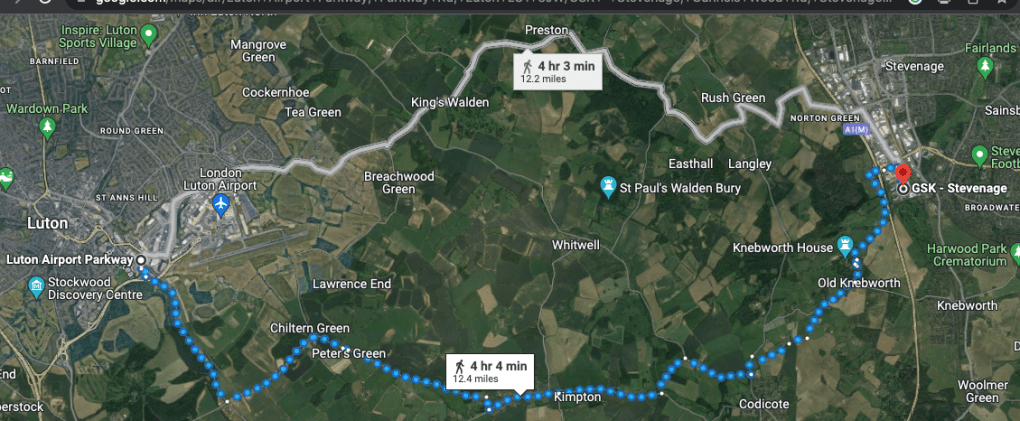
“12 miles may not sound like much but upgrading a railway line and then scheduling new services that share already-congested routes is fiendishly complex”
Agreed, but ultimately it’s trying to reduce road traffic that’s the challenge, as Jonathan Roberts told Rail Future East back in December 2022
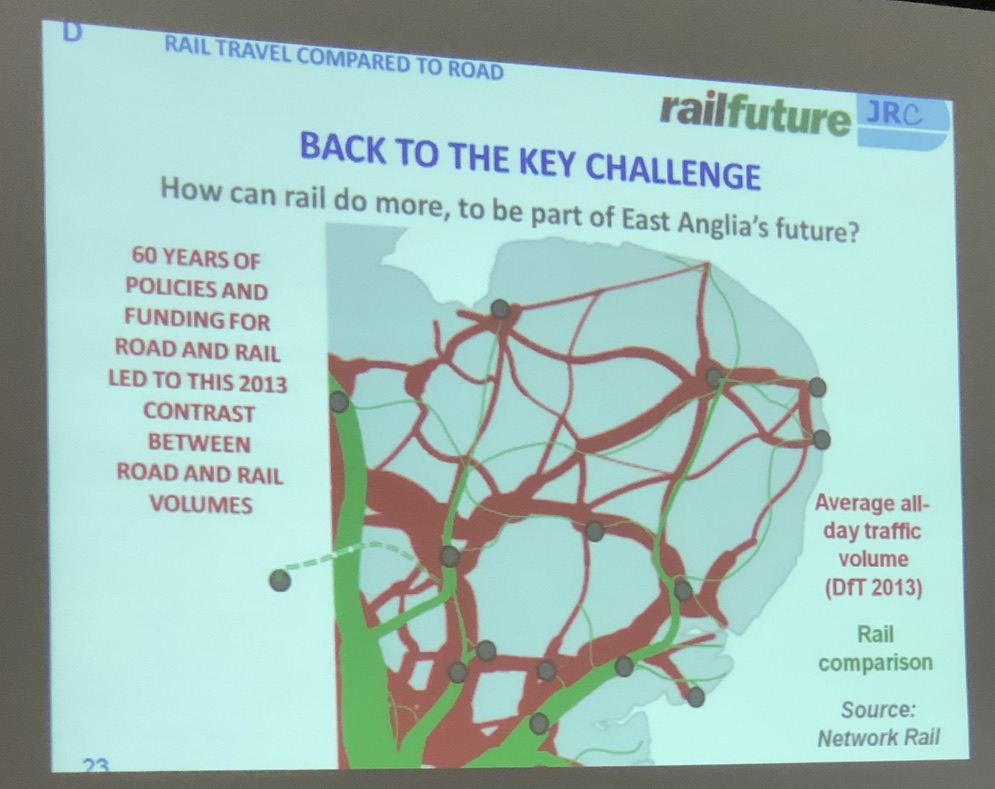
Above – Jonathan Roberts’ analysis of road and rail traffic volumes in East Anglia.
You can see where the major road transport corridors are – the thickets of the red lines being the M11. How much of that traffic could be diverted onto rail, and what upgrades would need to be made to which lines/rail junctions to facilitate this?
To conclude, as Cllr Simon Smith (Labour – Castle) stated today at the Combined Authority, there have been significant market failures in the privatised utilities to invest in infrastructure. In his case he was talking about electricity generation – just as important if the East of England is going to have the generating capacity to power the new rail routes. And finally just to restate the point, Not everything needs to be in Cambridge.
Food for thought?
If you are interested in the longer term future of Cambridge, and on what happens at the local democracy meetings where decisions are made, feel free to:
- Follow me on Twitter
- Like my Facebook page
- Consider a small donation to help fund my continued research and reporting on local democracy in and around Cambridge.
Below – the Cambridgeshire Collection in Cambridge’s Central Library – Ask the librarians to see the newspaper cuttings files on town planning and transport issues to get a sense of what our city & county has been struggling with for the past half century or so

 The Cambridge Town Owl