
The controversial proposals (which I wrote about here when the application went out to public consultation) are now up for Cambridge City Council’s Planning Committee to consider.
You can see the summary files here – the meeting is on 19th Sept 2024 at The Guildhall. The application states:
“Outline application for Parcel A for Offices, Research and Development, ancillary retail & facilities, car and cycle parking, landscape and public realm, infrastructure and associated works, all other matters reserved except for access.”
“Detailed proposal for Parcel A Building 3 Offices, Research and Development, the Hub Building with associated car and cycle parking, employment space, and leisure uses, and the Pavilion Building for community uses, and Detailed proposal for landscape works and access to Parcel C. (The Development is subject to an Environmental Impact Assessment).”
If you want to do a ***deep dive*** and wade through 595 documents in the planning application, type in 23/04590/OUT into the GCSP Planning Portal at https://applications.greatercambridgeplanning.org/online-applications/
The planning officer’s report recommends approval subject to conditions and a S106 Agreement – and given the nature of the site (including a capped old landfill site) I expect them to be substantial. Furthermore, the officer’s report states:
“Formal confirmation of the final phasing scheme will need to be secured by planning condition in the event planning permission is given. Subject to market conditions, the Applicant envisages completion of development within a 10-15 year timeframe.”
Which means the work may not be complete until 2040. Which is incredible.
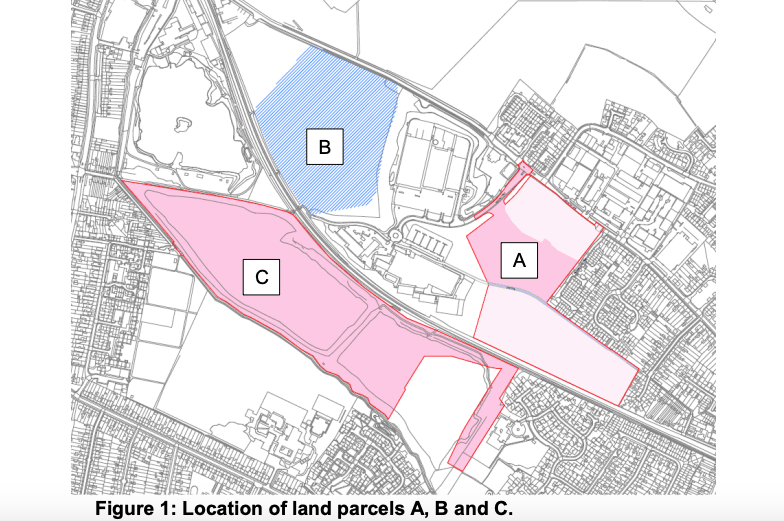
Above – Officer’s Report p7
“Historically, all three parcels were quarries used to extract chalk marl (or ‘marlstone’). Parcels A and B became disused by the 1970s and were backfilled with industrial, commercial and domestic waste between 1979 and 1989. Extraction of the two pits at Parcel C ceased in the early 1980s and were subsequently allowed to fill with groundwater to form lakes, referred locally to as ‘Burnside Lakes.’”
Above – Officer’s Report para 2.4
Over 100 people and groups have objected to the application for a host of reasons. My big issue is with transport – I asked them to consider working with the Combined Authority to upgrade the railway line that runs along through the site, but no deal.
Transport issues
The officer’s report states:
“Additional sustainable transport provision including a shuttle bus connecting its development site to strategic park and ride facilities (tbc) or equivalent contributions made towards supporting commercial bus services will be explored with Cambridge [sic] County Council Highways in accordance with its commitments under the Travel Plan/monitor and manage approach.”
Above – Officer’s Report para 1.14
What slightly changes things is that the Combined Authority has confirmed that it will be assessing the number of private commuter bus services in/around Cambridge (both current and planned) as part of its wider bus franchising policy (Cllr Anna Smith confirmed this in response to my PQ on this). My point is that local communities gain little from diesel-powered private commuter buses, and lose lots in terms of the health impacts of polluted air and noise. Therefore such funding from the developers should be used to subsidise new bus routes that are available to everyone. In this case, it is something that the Greater Cambridge Partnership will need to look at in its proposals for East Cambridge Access (which I wrote about here and will be debated next week at The Guildhall in 12 Sept)
Main objections from the public
You can see the list on p35 / para 9.0 onwards in the Officer’s Report (item 4 the 3MB file – not any of the annexes). Understandably the tragic death of the teenage boy recently has concentrated minds on security of the site. Such is the size and scale of the development that of the 100+ objections they are grouped into themes:
- Principles/Land use
- Character of the proposed new buildings
- Ecology and biodiversity
- Amenities
- Highways and transport
- Miscellaneous
The highways and transport issues came up frequently given the scale of the development alongside the sci-tech target market which inevitably means having to bring new qualified staff into the city because of the existing labour shortage and housing crisis here.
Transport issues are dealt with in more depth from p106 / para 26.0 onwards
They cover the forecasts of car trips generated.
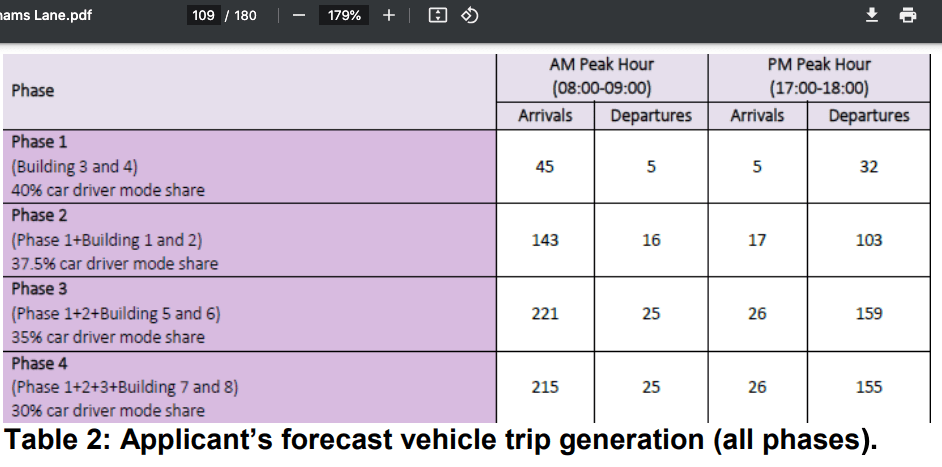
Above from p109: ***Does anyone do any post-construction evaluation of traffic and transport???***
Because if not, then that is a major failing of the planning system in that it fails to capture the learning from such developments. This is something I have raised repeatedly with local councils. This is something that ministers need to take a much firmer line on with developers. Especially after the failings in the entire system exposed by the Grenfell Inquiry.
The Officer’s Report concludes on commuter buses:
‘Through the Monitor & Manage Strategy, the Applicant commits to providing a private shuttle bus or contribution towards a commercial bus service in order to reduce car driver mode. The detail of either chosen measure is to be agreed with the LHA via S106 planning obligation and information provided as part of its performance monitoring under the Travel Plan for each phase.”
Above – Officer’s Report p128
The report also mentions: “Provide a new spur off existing railway into Parcel A for a new Cambridge East station.” Several of us made this point in the consultation – something picked up on as well by Rail Future East.
“There are currently no long-term plans to provide an additional rail link or station into and/or near this part of Cambridge. The Applicant proposes a car driver mode share target of 27% (of all trips) by completion of Phase 4. Achieving this target mode share will be supplemented by the Monitor and Manage strategy which will monitor car driver caps for each phase and ensure any excess car usage is mitigated in the prescribed ways, e.g. Applicant’s own design interventions or financial contributions to strategic travel initiatives where mitigation has not been successful. The Monitor and Manage approach measures are in addition to other commitments made to upgrade and incentivise active travel opportunities.”
Above – Officer’s Report p128
Back in May 2023 I said that the new sci-tech parks should contribute towards the major upgrades to the Cambridge-Newmarket railway line. The problem is transport planning has proved to be filled with uncertainty regarding central government policy, and confusion given local government structures in Cambridgeshire, that the opportunities to secure these from developer contributions seems to be fading fast. I hope this is something that the mayoral candidates debate in the run up to the elections in May 2025 – ideally having greater policy certainty from ministers in the meantime.
Should you wish to raise the transport infrastructure issues with the Combined Authority (please do!) you can contact them here.
If you are interested in the longer term future of Cambridge, and on what happens at the local democracy meetings where decisions are made, feel free to:
- Follow me on BSky <- A critical mass of public policy people seem to have moved here (and we could do with more local Cambridge/Cambs people on there!)
- Like my Facebook page
- Consider a small donation to help fund my continued research and reporting on local democracy in and around Cambridge.

 The Cambridge Town Owl