
The report – and the reaction to it exposed the mess that are the systems and structures of politics and political institutions in the UK
You can read the reports here. The conclusions were damning on the institutions and individuals with power and influence. And rightly so.
In terms of the media coverage, many picked up on the scenes in Parliament.
Given how top-down centralised the top two political parties are – and the political culture that goes with it, this was a huge failure of the whips/party managers to tell their MPs to stay in their seats.
It would – should have been obvious to anyone vaguely familiar with Westminster that the statement from the Prime Minister was one that was going to have a higher-than-usual number of people watching on TV/online. On optics alone, they should have been aware of that.
That’s not to let individual MPs off the hook. It will be up to them to account for where they were after PMQs – which in previous parliaments quite often might have involved having lunch with a lobbyist/party donors visiting/constituents/businesses etc. With over half of the MPs of the current parliament being new to the job, it’s too early to tell whether such habits will change or continue.
Either way, this was just another example of the public being shown why Parliament and politics needs an overhaul.
The Commons Chamber is too small for one seat each
New Green Party MP Ellie Chowns raised this issue by calling for the chamber to be revamped. In other parliament chambers, each member has their own seat with microphone, console for voting (they have them in council chambers too) and connections for laptops and mobiles etc so that they can be seen to be in the chamber during debates even though they might be working on something else. But for major statements such as the Grenfell one, it would be easier for constituents to see if their MPs were in the chamber or not during the statement.
The report’s contents
See https://www.grenfelltowerinquiry.org.uk/phase-2-report and click on the Phase 2 Report if you want to see the detailed breakdown. Volume 1 at the start lists the full contents.

Above – the Grenfell Tower Inquiry
Volumes 1 & 7 contain the parts of most interest to those scrutinising the actions/inactions of central government.
I declare an interest in that I worked in one of the neighbouring teams in what was the Department for Communities and Local Government between 2007-08 for just under a year, working on the Code for Sustainable Homes. I was on the Civil Service in-service Fast Stream and ultimately found myself to be *way out of my depth* in the face of the pressure involved. As I said to people in the years that followed, I aged about ten years in ten months in that post. As a result, I got to know three of the key civil service departmental witnesses – Brian Martin, Anthony Burd, and Richard Harral – all of whom came in for criticism in the report. To give you an idea of how much depth the report went into, the research team summoned hundreds of thousands of emails dating back to the 2000s, one of which was an email from April 2008 that I was cc’d into by Brian Martin during Gordon Brown’s Labour Government. It reflects the incredible work by the research team in leaving no stone unturned.
In terms of a major big picture failing within central government, the Report highlights resources – or the lack of.
“Between 2006 and 2015 the number of staff within the Building Regulations Division had been significantly reduced. In 2006 there had been 14 construction professionals and three Grade 6 civil servants in a division whose responsibilities were narrower than they later became. By 2015 that had fallen to five technical specialists and one Grade 6 official. As a result the department’s capacity was significantly below that which some officials thought was really required.”
Above – p171 /179pdf of Phase 2 Vol 1 Grenfell Report

Above – p171 /179pdf of Phase 2 Vol 1 Grenfell Report – note the wider issues of staff shortages as a result of continued job cuts
One of the things I still feel strongly about – dating from the previous Labour Government, is how wrong it felt to have a powerful building industry being able to bring to bear a greater wealth of resources against the state when the latter was – for the Code for Sustainable Homes at least, fighting the fight on climate change by trying to get new buildings built to higher standards of sustainability. Many powerful industry interests were against the proposals not least because of the increased construction costs and the hit to their profits. In the end, the big business lobbyists won – persuading ministers Brandon Lewis and Sajid Javid taking a different view.
“Julie Hirigoyen, chief executive of the UK Green Building Council, condemned the sudden announcement on low-carbon homes smuggled into a wider package designed to boost housebuilding by relaxing planning laws. She said: “Let us be in no doubt this announcement is the death knell for zero-carbon homes.”
Above – The Guardian 10 July 2015
During my time in the post, the UK Green Building Council and members wanted the Government to stay the course on ramping up sustainability standards, while the larger Home Builders’ Federation wanted to do the opposite, and relax them.
The report’s conclusions match what I recall in terms of how the department (and our part of it) was being managed. This was something that covered governments of all three of the main political parties. Public sector pay is a front-page-screaming-headline issue for the print press proprietors and their editors. Yet there are a number of strategically important civil service posts that require specialist training and knowledge – the sort the private sector is willing and able to pay significantly more than what the civil service is allowed to pay. It was an incredibly frustrating situation to be in – one that I observed with things like the Government Digital Service as I headed out of the civil service in 2011.
The analysis at 10.94 is something that ministers should apply across the wider public sector
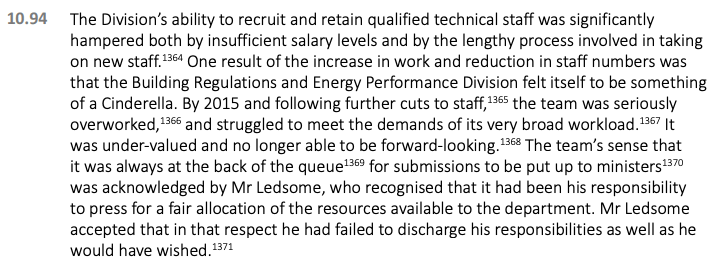
Above – p171 /179pdf of Phase 2 Vol 1 Grenfell Report
Ministers need to decide which are the specialist and technical functions that are strategically important for the public sector
By that I mean that the failure of which could lead to catastrophes such as at Grenfell, and/or the serious limitations on how effectively the state can function. Think specialist senior tax officers that scrutinise the accounts of large corporations. (Something that should move towards a wider level of co-operation & agreement with the EU on how multinationals should be taxed, regulated, and also subject to greater Parliamentary accountability through select committee hearings).
Ministers should go out to consultation on which functions fall within new criteria that reflect the importance to the state – not just central government but local government, the NHS and so on, that separate pay structures should be created. Furthermore, bringing in mechanisms on the firms that compete for such talent should also be considered – if only to provide them with an incentive to train up their own staff rather than poach underpaid public sector staff. For example the move to create town planning functions as fully cost-recovering in local government, long overdue in my opinion.
Public policy organisations should commission research work streams to scrutinise progress made by ministers on specialist and technical posts that are strategically important
This is normally Institute for Government territory but any university-based public policy unit that wants to set up an ongoing research and scrutiny stream for future researchers might want to consider this one – especially if their university is large enough to join up with other departments/subject areas in the same institution.
Wider cultural and philosophical changes in politics
It shouldn’t have taken the deaths of 72 people in that towering inferno to force the issue – but history tells us that many a law change or culture change comes from reports into avoidable deaths. One of the drivers behind the growth of trade unions were the appalling accident rates in work places and on the railways in the 1800s – leading to the modern day health and safety in the workplace legislation.
Outsourcing – out of sight, out of mind?
I hope one of the cultural changes we see is the overturning of the decades of ‘outsource by default’ and the reversal of bringing in consultants to do things (as highlighted by Mazzucato and Collington in The Big Con). If you want to see an example of how much money has been squandered on consultants when it comes to infrastructure planning, just look at the Greater Cambridge Partnership.
“There is remarkably little to show for the more than £200million that the government has so far given the GCP and Combined Authority to spend on transport. Nearly all of it has been paid to consultants for reports rather than delivering new transport options.”
Above – Smarter Cambridge Transport 08 Dec 2021
A far more efficient and effective structure would have been for Cambridge’s economic sub-region to have had a unitary council similar to what Redcliffe-Maud proposed, along with an in-house team of transport engineers with multiple specialisms (not just highways and roads, but light rail, cycleways, and so on) to draw up the options for them. The fragmented structures have made it much harder for councillors and the public (not just the local residents affected) to scrutinise the proposals. As it is, a decade after the GCP was established, not a single busway has started construction despite these being the apparent ‘big ticket’ items for it.
Changing the relationship between local government and local residents
The report was damning on the contempt for local residents shown by the local council (Royal Borough of Kensington and Chelsea) and the Tenants’ Management Organisation. I rarely talk about social class in my blogs because of the images of far left paper sellers and academics going on about it in my uni days in a manner that seemed to alienate so many people. Yet when we had the old food hub in Queen Edith’s ward in Cambridge along with the community cafe following the first lockdown, I learnt quickly of how different the relationship with local councils different groups of people have depending on their tenure of housing.
In Queen Edith’s we have micro-pockets of poverty in some of the areas originally built as council housing down the road from homes that go for seven figures. And I went to school with and played football with children who lived in both types of housing. I’m not convinced decision-makers from affluent background appreciate how significant the role of a local council is in the lives of people who live in council housing – and how that differs completely from those who are owner-occupiers where so long as the bins are collected, that’s about it. (See the analysis by former councillor Sam Davies MBE here, and then reflect on the inability of local councils to tax the wealth being generated in their areas – something even more stark in Kensington and Chelsea).
What would it look like and be like if there was a more equal relationship between council tenants and councils? Or between councils and residents more generally which involved breaking down the social class barriers? This is a particular issue in a place like Cambridge where I often wonder what it would be like if the colleges were compelled by law to amend their royal charters to account for the interests of the people of Cambridge – in particular those on the lowest of incomes, when it comes to decisions made by colleges that affect our city? Would the Dons take a much greater interest in the wellbeing of our city if that were the case? (Especially if it was something that campaigners – including their own students, could hold them accountable on?)
It will take more than one committee or institution to cover the progress and responses to the recommendations in the Grenfell Report
In the short-medium term, the best thing Parliament can do is to set up a Lords Committee (more stable membership given the nature of peerages) to embark on a co-ordinating role to identify which institutions should be responsible for overseeing the responses to specific recommendations, and to compel those institutions to submit annual progress updates that can then be presented to Parliament. That way at least someone will ensure progress across the piece.
Food for thought?
If you are interested in the longer term future of Cambridge, and on what happens at the local democracy meetings where decisions are made, feel free to:
- Follow me on BSky <- A critical mass of public policy people seem to have moved here (and we could do with more local Cambridge/Cambs people on there!)
- Like my Facebook page
- Consider a small donation to help fund my continued research and reporting on local democracy in and around Cambridge.

 The Cambridge Town Owl