
The inability of local government to compel developers to build out planning permissions, and enabling landowners to ‘squat’ on sites as they try to squeeze out more financial gains from sites is something that new ministers need to clamp down on. These should be issues that The Cambridge Room should also host future debates on
En route to the Stourbridge Fair at the Leper Chapel by Cambridge United’s Abbey Stadium earlier, the bus drove past a number of undeveloped sites along one of our city’s biggest missed opportunities for a grand eastern entrance.
Future generations may lament the period of history that so many of the buildings were built in along the section of Newmarket Road between East Road/Elizabeth Way roundabout and The Abbey Stadium.
As you head westwards, what you have are a series of car-fed warehouse businesses on the Cambridge Retail Park and similar on the other side of the road, these sitting atop what used to be heavy (by Cambridge standards) industries including brickworks, gas works, and small iron works – some of which later became municipal tips.
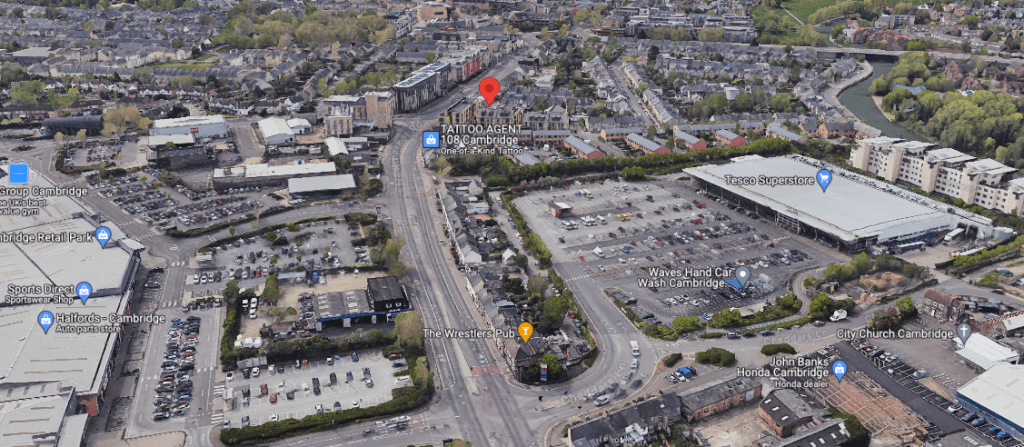
Above – Newmarket Road (top-centre) looking westwards, with the River Cam and Elizabeth Way Bridge top right, Tesco centre-right, and the retail park along the left. You can also see the higher-density apart-hotel-student-flats-type developments that don’t have to make affordable housing contributions, allowing developers to game the system
The growth of student housing, budget hotels, and apart-hotels has been an issue for Abbey residents and the wider city given the chronic housing crisis. Furthermore, the construction of these properties does not seem to have alleviated demand as former councillor Sam Davies MBE wrote on her blog in November 2022. I don’t blame the city council for it as Parliament has not provided local councils with the powers to restrict the size and growth of the economic activities that drive this demand. Powers and policy tools could include:
- Use of planning permissions and restrictions on land/property use (and the legal enforcement of, with court punishments acting as a significant financial deterrent for breaches)
- Use of strategic planning to limit the growth of certain economic activities such as language schools and private colleges that do not provide for their own accommodation on land they already own
- Use of new local taxation measures to make the unrestricted growth uneconomical and unviable financially
- …and more
Newmarket Road buildings
Here’s me moaning about Newmarket Road back in 2018. Did it have to end up like it has done today? Have a look at the Eastern Gate Development Framework of 2011 that was created under the 2006 Local Plan.


Above – see the design and improvement strategy within the EGDF SPD (the 31MB pdf) from p56 here
What are the lessons to learn from it?
A crowded junction of Newmarket Road and Coldham’s Lane
It always has been for as long as I can remember Two budget hotels (Premier Inn, Travellodge) and student accommodation (128 en suite rooms for Anglia Ruskin clearly aimed at the corporate out-of-term market as students from less affluent backgrounds repeatedly say they cannot afford en suite) were meant to be joined by yet another budget hotel – the proposed EasyHotel until a property next to it that the developer also owned was ‘mistakenly’ demolished without permission, scuppering the whole project. The site then got sold onto new owners, UNEX according to the Riverside Residents Association in 2023, and on the bus earlier I saw a new ‘For Sale’ sign attached to that site. I’ll leave it to Abbey Ward Councillors to account for what’s happened between then and now as they are closer to the ground.
Opposite the site, another site has been sold for over £1million which looks like being turned into flats according to Savills – 212-214 Newmarket Road. Not surprisingly, this looks like being another case of banking the planning uplift after securing planning permission – search 18/1679/FUL in the planning portal here. I’m not sure what the actual status of this is in terms of whether any existing planning permission has run out or whether something has, like with the Romsey Labour Club, started.
The same seems to be the case at 185-189 Newmarket Road Ref 22/04356/FUL. which was granted planning permission and is now up for sale.
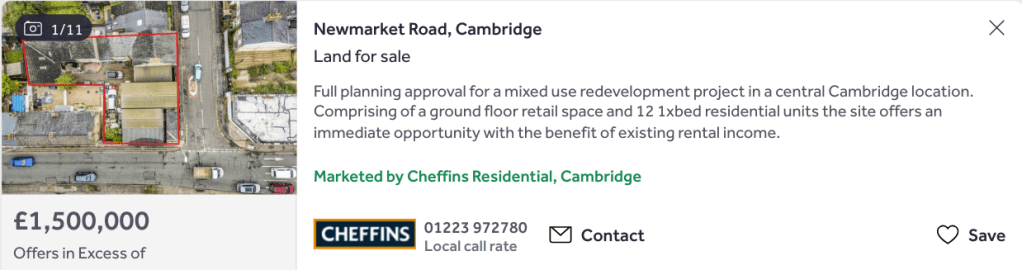
Above – over £1.5m if you’ve got it for a site in one of the most economically-deprived parts of Cambridgeshire.
And that is how the property and development industry ‘extracts finacial value’ from the land, enabling the final developer to plead poverty under the current system to get out of not building much-needed community facilities and transport infrastructure.
Further down the road at 444 Newmarket Road, another controversial site for student accommodation that was granted permission on 20 Dec 2019 See 19/0340/FUL in the planning portal to browse through the documents and images. I’m assuming that the documents linked to it – the last one dated this time last year, count as having commenced the development regarding ground remediation works. Still, it has been nearly *five years* since permission was granted. Even with the pandemic and other economic issues, it’s still a very long time.
There are also similar issues with the site at 143-149 Logic House Ref 20/01125/FUL in terms of ownership issues. It looks like a new firm has taken on the responsibilities of building out the site, but at the moment not much seems to be happening.
“What does it mean for Cambridge to grow?”
This is a question Cllr Katie Thornburrow asked earlier this year here. Not just grow physically, but to improve. So improving energy and water efficiency, or improve biodiversity. Her article was from an event we went along to at CRASSH at the University of Cambridge. This was one of the first events that the University of Cambridge had hosted looking at the growth of Cambridge from a critical analytical perspective rather than a financially-vested interested party benefiting from it. Cllr Thornburrow’s list of issues includes things like happiness and wellbeing, as well as ecological – and also covers what to do with the existing built environment. This is something that during my time in the civil service was put in the ‘too difficult to deal with’ box by successive ministers. But now with the combination of fuel poverty and the climate emergency, it cannot be avoided.
The problem is we have an extractive economic model that is proving very difficult to shift from. The comparison with trying to break away from an extractive, environmentally destructive economic model sounds similar to the financial and political barriers that anti-slavery campaigners came up against in the early 1800s. In the end the Government paid substantial bribes/compensation to the existing slave owners for them to withdraw their political opposition to that barbaric trade. With land and property in/around Cambridge now inextricably linked to global financial markets, what hope does local government as currently structured have of planning a sustainable future for the people they represent?
The existing development plan is far too limited in scope to deal with the multiple crisis
Taking this book from 1971 by Judy Hillman on Planning for London, note the quotations and also note the chapter headings.


Left: Looking at the list of headings compared with the current generation of local development plans, we don’t see Cambridge considered in a regional context – in part because Eric Pickles, the former Communities & Local Government Secretary abolished the tier of regional planning and the structures that went with it. Furthermore, the previous Labour government separated transport planning from development planning for the built environment – something I think should be reversed.
While there are comparative studies of the England vs other countries in terms of town planning and governance, I’ve not seen anything that is:
- high profile (i.e. goes beyond what policy specialists know)
- concise
- influential
in terms of *how* to change the existing systems we have in England (the functions are devolved competencies in Scotland, Wales, & N.Ireland) to enable councils not only to plan ahead, but have the legal, political, and financial tools/competencies in order to carry out what they set out to do in their plans. Furthermore, for all the planning for ‘affordable’ housing there is in local plans, there’s nothing to compensate for when developers are able to weasel out of commitments to build affordable homes, or when they simply do not build what they committed to build such as the University of Cambridge’s West Cambridge Swimming Pool.
I won’t go into the detail into overhauling local government finance other than to highlight that the big flaw of the current model of developer contributions is that it places too much of a burden on developments to build new facilities that other landowners benefit from whether in a higher land value price for sale, or being able to charge higher rentals. (Hence the case for land value taxation to fund local services).
Food for thought?
If you are interested in the longer term future of Cambridge, and on what happens at the local democracy meetings where decisions are made, feel free to:
- Follow me on Twitter
- Like my Facebook page
- Consider a small donation to help fund my continued research and reporting on local democracy in and around Cambridge.
Below – if we want our city to fly (metaphorically), let’s start with The Kite

 The Cambridge Town Owl