
Huntingdonshire District Council has some very big decisions coming up – and I’m surprised there hasn’t been more publicity on its options across Cambridgeshire. *(It’s actually an update to their existing local plan rather than a brand new one – my apologies!)
You can browse through the large files in the meeting papers here by Huntingdonshire District Council – currently run by a joint administration of LibDem, Labour, Green, and Independent Councillors – one that kicked out the Tories for the first time in that council’s existence.
I wrote about Huntingdonshire’s Futures programme back in 2022 here. It was more a crash course in local history and civics more than anything else – in the context of changing local government structures imposed by Westminster and Whitehall.
How the emerging local plan will change in the face of Angela Rayner’s plans for new towns and local growth plans remains to be seen. But the further issues and options published by HDC for their Cabinet make for interesting reading – in particular Item 4 – Issues and Options.
“Why?”
The options mirror what Cambridge was presented with in the late 1990s
The options on p38/ p40 pdf follow a tried and tested model. And those are the seven options that were included in the Cambridge Futures Report 1999 archived here on the Wayback Machine

Above – old school pre-Millennium graphics – the seven options
In the case of Huntingdonshire, minimal growth is not an option. If councillors tried that, the Deputy Prime Minister would simply override the local council and impose commissioners to do the job for them. Hence the options they have involve growth one way or another. Which brings a whole host of issues such as environmental impact, water stress, carbon emissions, community facilities, and transport infrastructure. Along with the construction industry’s ability to build it competently. Which after the Grenfell Tower Phase 2 Report is not something we can take as a given. Anything but.
The options for Huntingdonshire
- Option A – Continue with the existing growth strategy set out in our current Local Plan (Policy LP2 Strategy for Development). This currently focusses on 75% growth in Spatial Planning Areas and 25% elsewhere e.g. Key Service Centres and Small Settlements.
- Option B – Focus on strategic expansions to existing towns
- Option C – Focus growth on public transport corridors. This corridors would be located around the A428/A421, the guided bus route and future ambitions to provide East West Rail, the proposal to reroute the A141, a a public transport corridor from Cambridge to Alconbury Weald and a possible railway station at Alconbury Weald.
- Option D – Car-centric – Concentrate development around the strategic road network i.e. the A1, A14 and A428
- Option E – Distribute growth across many settlements in Huntingdonshire and limit growth in our towns creating dispersed growth.
- Option F – A New Town: Provide 1 one or more new community/ies plus some dispersed growth.
On transport planning
I’m of the view that strategic planning should combine housing and transport, which is why I don’t like the current structure that separates the two. Furthermore, I have general issues on local government having the responsibilities for but not the powers to make happen the massive reduction in carbon emissions and wider environmental impacts.
HDC screen-grabbed the transport options from the RTPI’s 2021 report.
I can see why – it’s easy to understand. It just needs to have something about trams and light rail to be much more prominent. ***Get tramways magazine damn you!!!*** (I jest!).


Above – RTPI Net Zero Transport (2021) p28
At the same time, the accessibility issues come in
The blogpost by Jarrett Walker here on accessibility for people with limited mobility of which I am one, culminates in this diagram below.

Above – by Jarrett Walker – author of Human Transit.
Hence why part of any future planning (especially on transport) needs to involve big maps at public events that show where the major civic amenities are, and then inviting the public to suggest things like new bus routes, new cycleways, new tram/light rail routes – the things that would make their lives easier and more enjoyable in terms of being able to access and take part in more things. It shouldn’t be A-to-B commuting.
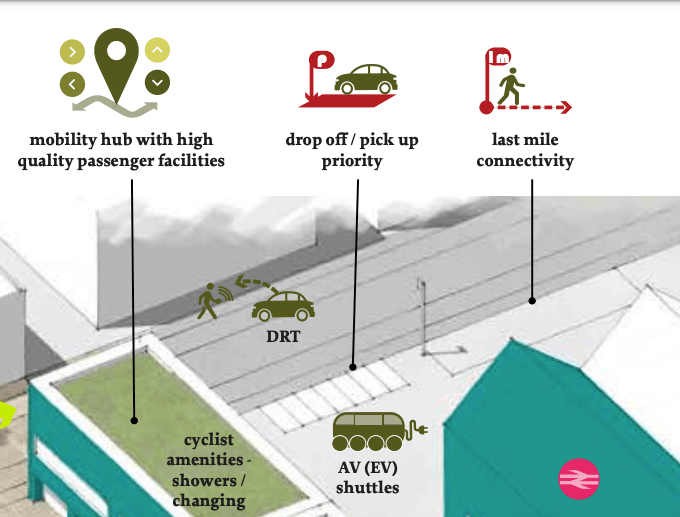
More interesting concepts at a human scale from the RTPI’s 2021 document.
It was the ‘last mile connectivity’ icon that caught my eye – if anything because the Greater Cambridge Partnership have glossed over their serious shortcomings on this. The two images below are details from p25 here

And finally…what type of growth do people want?
This question won’t go away, especially if what people want and/or need is outside of the powers & competencies of local government. This has been raised by
- Cllr Katie Thornburrow who asked this question in her blog here
- Geoff Mulgan – former head of Tony Blair’s Delivery Unit in Downing Street, for NESTA in 2017
- Geoff Mulgan (again) in Sept 2024
While there are some lessons to learn from Cambridge’s experience, Huntingdon does not have the University of Cambridge and its colleges so dominant and influential. That said, given the political earthquake in the north of the district where Cambridge City Councillor Sam Carling MP unexpectedly won the safe-as-military-fortresses blue seat for Labour, now might be a good time for Huntingdonshire and its civic institutions (and Cambridgeshire’s one too) to redouble efforts to get people aware and involved – and perhaps continue some of the local conversations that were happening in the general election campaigns too.
Food for thought?
If you are interested in the longer term future of Cambridge, and on what happens at the local democracy meetings where decisions are made, feel free to:
- Follow me on BSky <- A critical mass of public policy people seem to have moved here
- Like my Facebook page
- Consider a small donation to help fund my continued research and reporting on local democracy in and around Cambridge.

 The Cambridge Town Owl