And now they are caught between a rock and a hard place as the Greater Cambridge Partnership enters its final third of its existence.
I can’t say today at The Guildhall was fun – especially listening to a very partial history of ‘how we got to here’ and also the collective failure of the GCP Assembly to hold senior executives to account over statements that could have been (and should have been) challenged.
TL/DR?
Read the public questions in the meeting papers for the Assembly of 12 Sept 2024 here.
“As Assembly members, your roll is to scrutinise and question the proposals presented to you. In your report, why is there no mention of the main reason this option for CSETS was selected or that there is any doubt that the wrong decision may have been made?”
James Littlewood, Chief Executive of Cambridge Past, Present, and Future – extract from his PQ of 12 Sept 2024 to the GCP Assembly at Cambridge Guildhall
The video clips starting with public questions are as follows:
- Cambridge Eastern Access
- Cambridge South Eastern Access
- Cllr Heather Williams (Cons – South Cambs District Council) opposing CSET
- Cambridge Greenways
I’m not going to go into individual character assassinations in this blogpost – I’ve been around for far too long to have decided that what all these issues are, are symptoms of wider systemic and structural failures governance not just in Cambridge & Cambridgeshire but for local government in England generally. The lack of critical scrutiny over the combined authority arrangements is something I find alarming – especially from public policy institutes and think tanks. Furthermore, I’ve been on a ballot paper at local elections calling for the abolition of both the GCP and Combined Authority, saying both should be replaced by unitary councils. Scroll halfway down in this blogpost and you can read how empowered town and parish councils could fill the local democratic deficit.
As Smarter Cambridge Transport stated, it felt like The GCP as an institution has already decided what it wants to do and has designed the consultation processes to provide some sort of an evidence-base indicating popular support – something that the Cambridge City Council elections in 2023 proved was limited to say the least. Furthermore, the GCP Boards repeatedly authorised expensive feasibility studies in response to popular protest (especially on the long-delayed Cambourne-Cambridge busway)
“We’ve written an enormous amount, from consultation responses to technical explainers. The breadth of our team has helped us produce – entirely for free – more imaginative, cost-effective and deliverable proposals than any of the schemes devised and developed by the GCP’s consultancies at a cost of tens of millions of pounds. Our ideas are all published on our website and available for local authorities to use.”
Smarter Cambridge Transport 08 Dec 2021
What local history tells us
There are three things that stand out:
- Ever since Davidge’s regional plan of 1934, future planning proposals for Cambridge have often been overtaken by events, resulting in them being either obsolete in the face of rapid growth, culture change, and technological change, or lacking in sufficient flexibility to deal with changes in political power
- Generations of politicians, university chiefs, and business leaders have failed to take the people of Cambridge along with them over the decades – to the extent that things they took for granted ended up being nasty surprises to future generations.
- Planning applications have not stopped, and Cambridge as a city has grown to such an extent that the emerging Greater Cambridge Local Plan really should designate an area of land for a new urban centre – ideally along an existing or new rail corridor.
Below – new designs for the biomedical campus coming up for consideration by local councillors. Brutal as it may be, at least Addenbrooke’s Chimney is genuinely iconic and functional. It may not be pretty but we can see it and it carries out an essential civic function of incinerating medical waste. (And presumably will stay there once a better method is discovered of dealing with such waste).
Above – more ugly stuff – one that has unexpected consequences when it comes to social media memes and algorithms

Above – from the Greater Cambridge Shared Planning Service: Cambridge 2041
Of the shading, the areas (essentially green belt) say:
- Blue – don’t build here, this is flood plain
- Pink – don’t build here, Wandlebury and Magog Down (archaeological sites & protected)
- Orange – don’t build here, Cambridge PPF own the land and whacked a restricted covenant on it
- Green – don’t build here, it’s one of the few areas that could be turned into open green space for North Cambridge residents because Cambridge University & colleges refused to allocate the land that Darwin Green is now on for the people of Arbury & King’s Hedges.
- Bold Purple – designated build here sites
What John Parry Lewis recommended in 1974
This:
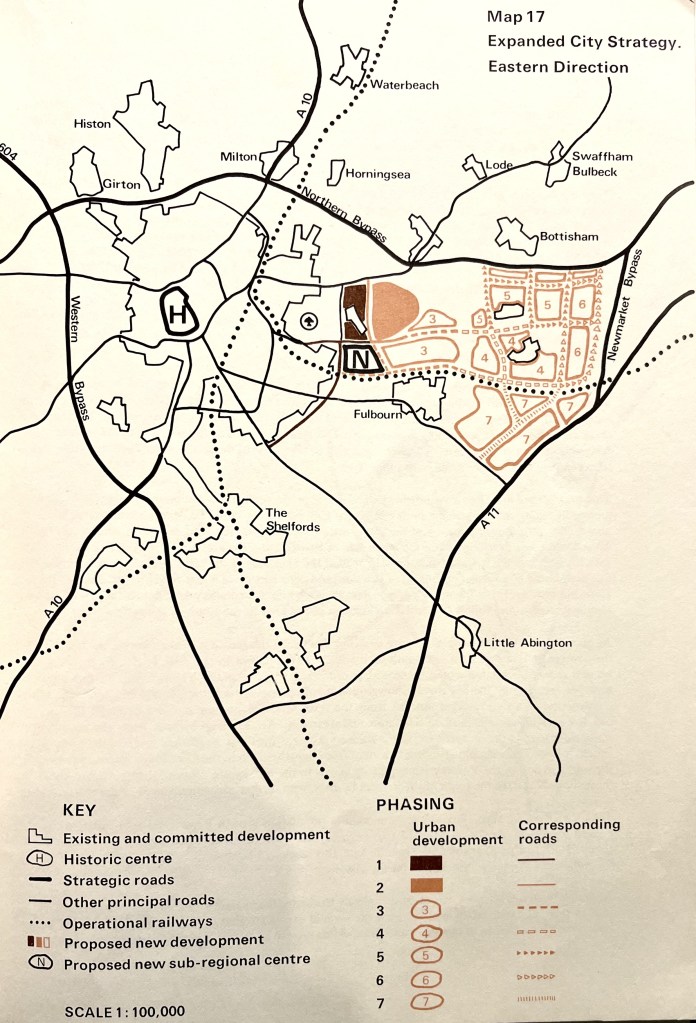
Above – you can see at N, between Fulbourn and the Airport is where JPL recommended a new urban centre could be built. As I wrote for Lost Cambridge, he had an impossible job.

The alternative to JPL’s plan was the comprehensive redevelopment of The Kite. The irony was that while the Conservatives won their battle with JPL – seen as a Labour appointee from a Labour-created regional quango by local Conservative councillors, by backing the redevelopment of The Kite they effectively signed their party’s political death warrant, opposing the grassroots alternative that people and politicians would jump at today. Within two decades the party went from holding the seat in Parliament and controlling the city council to having no seat and no political representation within Cambridge on either the city or county councils. Today their representation is still only one single councillor.
Why has everyone forgotten about Cambridge Futures 2?
The origins of how we got to here are rooted in a pair of studies around the Millennium – the Cambridge Futures Studies which I wrote about on Lost Cambridge here. That points you to the detail, but in the grand scheme of things local and national politics failed to take the people of our city & county with them regarding the expansion of our city. 20 years ago the principles of redeveloping five major sites were published:
- Oakington (later Northstowe)
- West Cambridge (long since scoped out by Holford and Wright in 1950)
- Cambridge Airport
- Cambridge Waterworks at Milton (Anglian Water Sewage Works)
- South of Addenbrooke’s – the Biomedical Campus.
We know this because the Cambridge Futures 2 report has a nice big map.

Above – taken from an earlier blogpost on what happens if the busway plans fail
The blogpost mentioned above covers the problem of motor traffic in the 1990s and the A14. What’s changed? The problem is going back to Cambridge Futures 1 and the decisions on what sort of growth we should have, Cambridge had seven options.

Above – from the Wayback Machine
The options were:
- Minimum Growth
- Densification
- Necklace villages
- Green Swap
- Better transport links
- Virtual highway
- New Town
Above – from Lost Cambridge here – the irony being that such has been the scale of growth since 1999 that we’ve effectively had a bit of all of them.
Hence my point about the GCP being overtaken by events including the city becoming too big for its city council – effectively created to run settlements the size of market towns. Not surprisingly, the reality of private wealth and public squalor has crushed our civic spirit.
The one other thing the Cambridge Futures 2 proposed: A congestion charge.
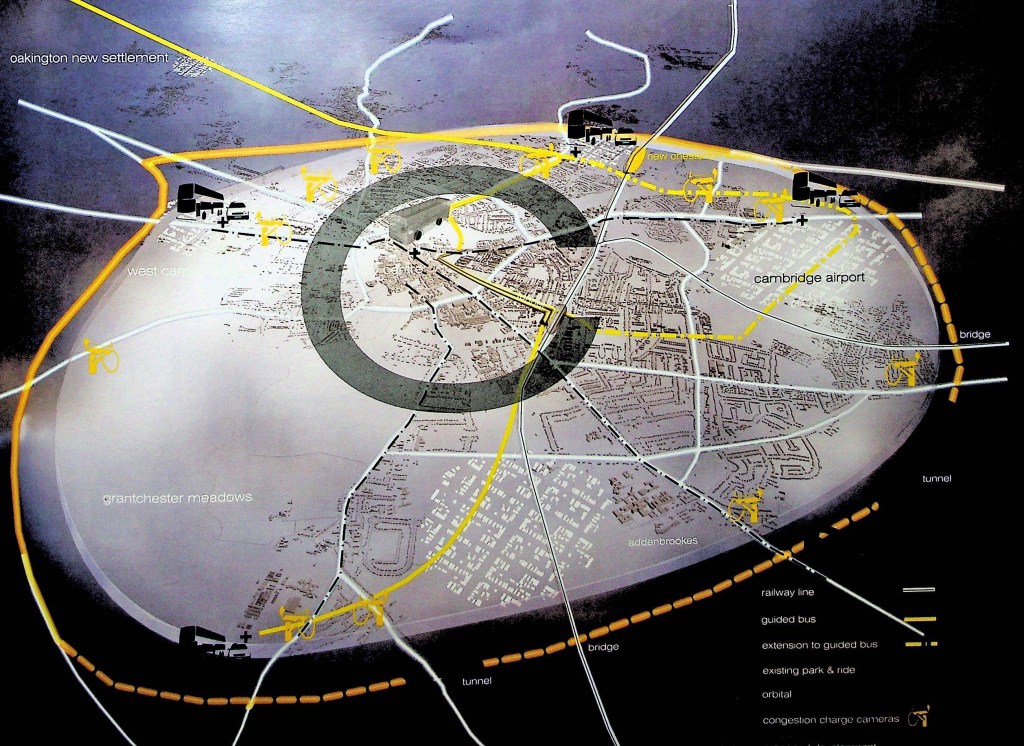
Above – the proposed Congestion Charging Zone from Cambridge Futures 2 – along with the proposed camera locations and the various new underground orbital bus tunnels (and the quite bizarre short one in the city centre!)
“Is anyone still around from those days a quarter of a century ago who remembers this?”
Probably – although as far as I’m aware they are not in any publicly-accountable decision-making post eg with voting rights on the GCP Board. Rather, I think we are where we are because between the times when the GCP’s Board could have radically changed direction regarding its big budget projects – namely:
- The election of Mayor James Palmer in 2017 (who was extremely hostile to the GCP and County Council, even though his political party controlled both)
- The election of Mayor Nik Johnson and of the new Joint Administration of Cambridgeshire County Council
The problem was that none of the politicians took that opportunity. The losses on things like the busways should have been cut years ago.
“The Greater Cambridge Partnership (GCP) is at an advanced stage of planning to build three busways and five car parks at a cost of £419 million. That’s £1,370 per resident of Cambridge and South Cambridgeshire, or up to £180,000 per new bus user. Furthermore, the GCP still has no plan for where all the new buses will go in Cambridge city centre after leaving the busways.”
Above – Smarter Cambridge Transport Petition June 2021
The GCP could have funded serious feasibility studies for Cambridge Connect Light Rail – a light rail scheme now being official local Conservative Party policy which their candidates in three of the four seats in and around Cambridge went public with their support for. But they all lost their contests in that political earthquake earlier this year. Ironically when the Conservatives had control, they could have approved the feasibility studies back in 2017. They didn’t.
“Here’s me calling out the GCP officers in 2017 about their failure to assess the rail link from Haverhill to Cambridge and no further. I asked the GCP to reappraise the assumptions:
- Proposals cover the full rail link reconnecting Haverhill with Sudbury
- Rail haverhill be incorporated into the light rail proposals from Cambridge Connect going on to Cambourne.
There were repeated failures to fund even the most basic feasibility assessments“
Above – from April 2023 where I called for the abolition of the GCP
You could say that the electorate punished them at the ballot box, and that every political party has the right to change their policies in the face of such electoral thumpings. Contrast Labour’s manifesto of 2019 with 2024 – and the people/factions in control.
Where are we today?
Still without approvals for, let along construction commencing for any of the proposed projects. While the consultants may have made some cash, who are the real winners here? Anyone? (And who would want to be a consultant writing feasibility studies for projects that never come to fruition?)
We’re better than this. Hence supporting Cambs Unitaries to overhaul how we’re governed – noting I’m acutely aware that simply creating a Cambridge version of Peterborough City Council won’t be enough. Not only do the structures & systems need to change, the cultures and values need to change too.
Food for thought?
If you are interested in the longer term future of Cambridge, and on what happens at the local democracy meetings where decisions are made, feel free to:
- Follow me on BSky <- A critical mass of public policy people seem to have moved here
- Like my Facebook page
- Consider a small donation to help fund my continued research and reporting on local democracy in and around Cambridge.
Below – go and fly The Kite with Together Culture. Much more fun.

 The Cambridge Town Owl