
Cambridge University Hospitals NHS Trust sends out another high-demand warning as the Greater Cambridge Planning Service publishes an independent report on demand for sci-tech space.
Image – get involved with Together Culture if you’re interested in the future of our city – as one of the sci-tech sites is The Grafton in The Kite
TL/DR? Cambridge needs a mechanism for local government to designate sites for specific essential functions that our city, county, and region needs – and also needs the powers to raise directly (i.e. without involving central government) the revenues & resources from the wealth generated within it to pay for them.
The chronic capacity issues at A&E
This is never a good sign – and was one of the things that came up at the NHS Trust’s Annual Public Meeting yesterday.
I’ve since submitted Freedom of Information requests to both the Trust and to the City Council to find out if they hold planning documents from the 2000-2010 (and in particular 2006-10) on proposals to expand the A&E Unit as these were not addressed in the response to my public question. (The video of the meeting and the questions will be published in due course – probably on the CUH-NHS YT Page here)
The Planning Service’s Sci-Tech report
You can read the press release here and the full report here (although for most of you browsing through the executive summary should suffice.
“Yeah, that’s great – show me the pictures!”
I often find maps, diagrams, graphs, and illustrations to be easier to get more from than walls of text within which lots of things can be buried.
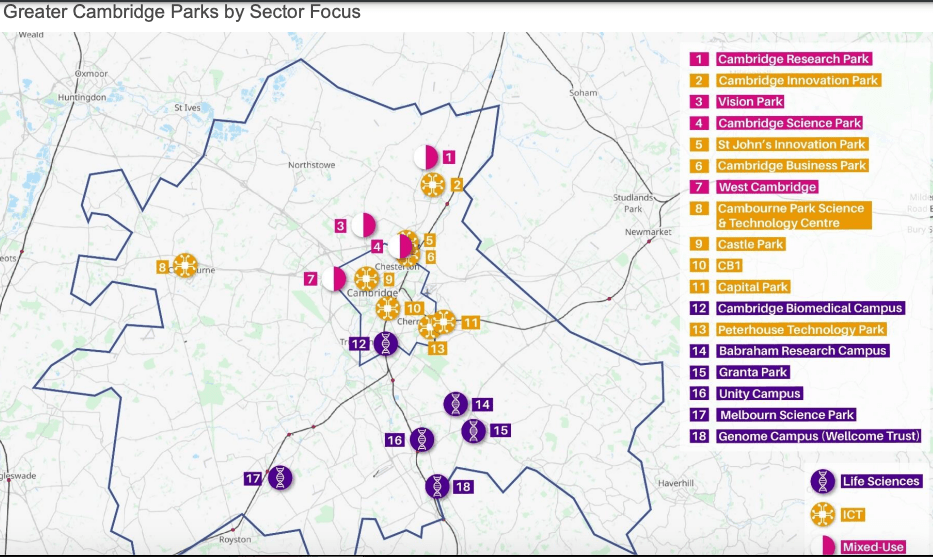
Above – Cambridge and South Cambridgeshire / ‘Greater Cambridge’. P38/41pdf
Taxing the wealth
The report also lists some of the firms with the highest headcounts. (That’s not the same as the most profitable). The report separates life sciences (which tents to be Biotech research and technology more than anything else), from Information and Communication Technologies.
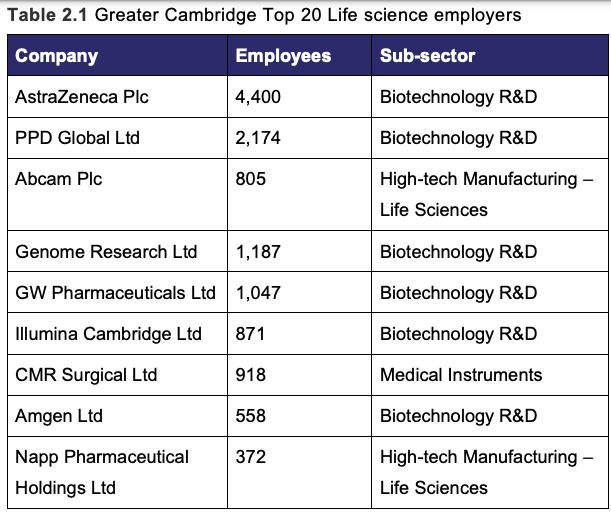
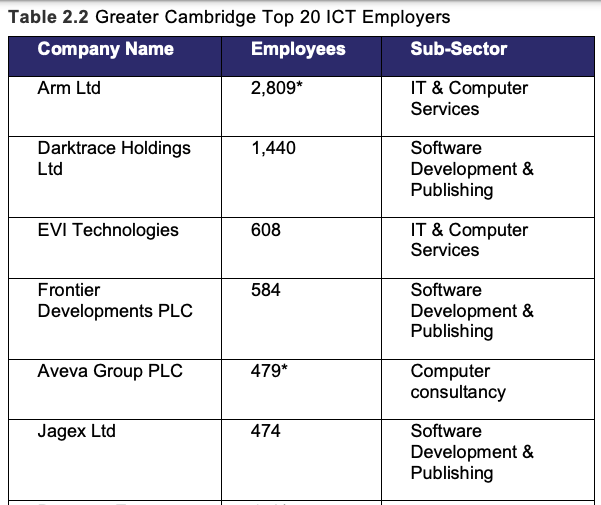
“A reoccurring theme is the importance of integrated ‘places’ that provide the technical premises and facilities but also offer amenity, clustering and connectivity.”
Above – Iceni for GCSP (2024) p3 / p6 pdf
The problem is our municipal governance structures simply do not allow local councils to create those integrated places because they lack:
- The legal powers (due to successive centralising measures and laws enacted by successive parliaments)
- The finances (due to successive Chancellors of the Exchequer not allocating enough funding (or revenue-raising powers))
- The local policy-making capacity (chancellors and ministers again)
This brings me back to Rob Cowan’s excellent book on essential urban design
When we start with what Cambridge needs, We are due an update to the Cambridge & South Cambridgeshire Indoor Leisure Facilities Strategy because councillors told me in response to a public question ***ages ago***. That will allow councillors and residents to compare what we have with what we need – not just for residents within city-and-district, but also the sorts of facilities that Cambridge needs if it is to serve as a regional centre – which in the grand scheme of things is what it is and has been for decades.
Mr Cowan gives us a guide on the sort of things settlements (villages, towns, cities) of different sizes can expect to have given the number of people within a given catchment. Note that these catchments will be affected by transport accessibility.
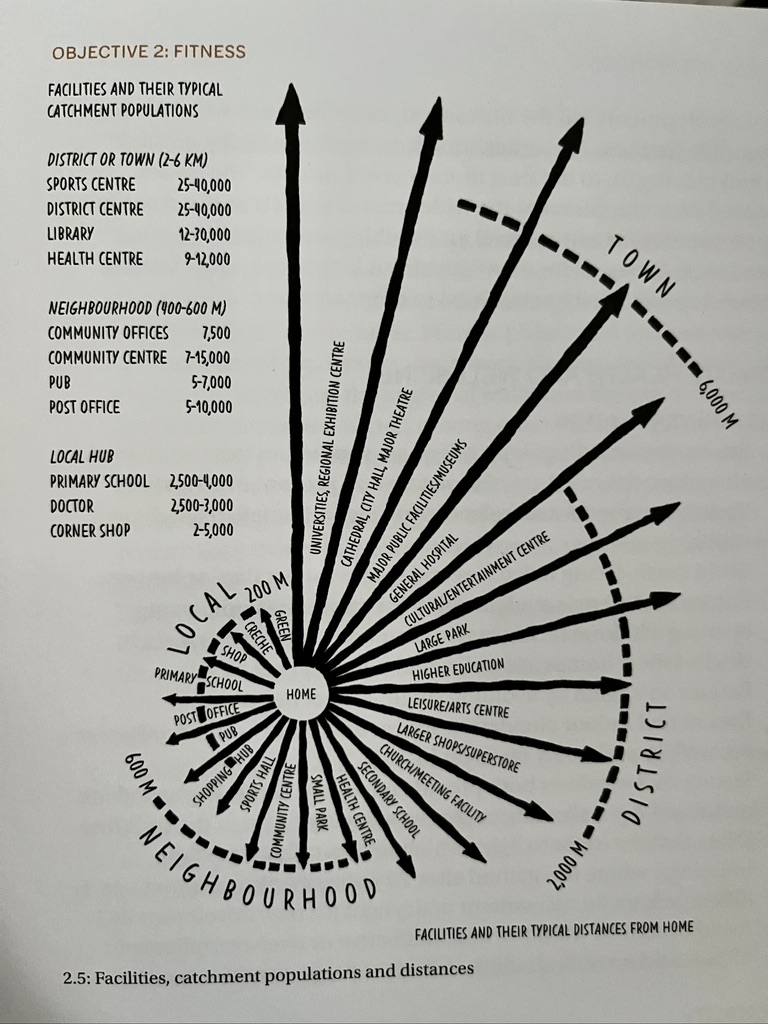
Above – by Rob Cowan – what would one of these be like for Cambridge in terms of what we have, what we need, and what we would like? (And how might these differ if different age groups and communities were invited to come up with their suggestions?)
TASK: “Here’s a map of Cambridge and South Cambridgeshire District. What would you have built, where, and why?”
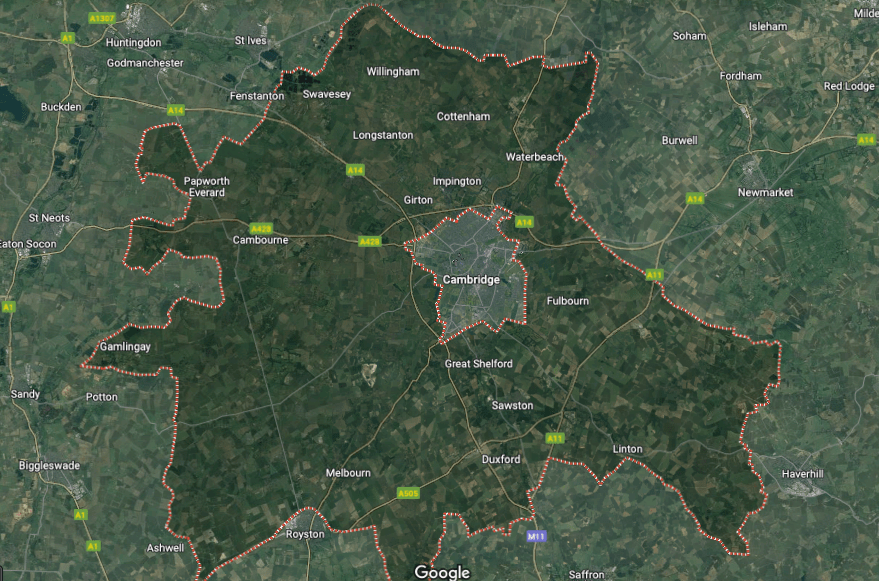
Above – from G-Maps here. A better alternative would be to pick a radius and force the issue on redrawing local government boundaries
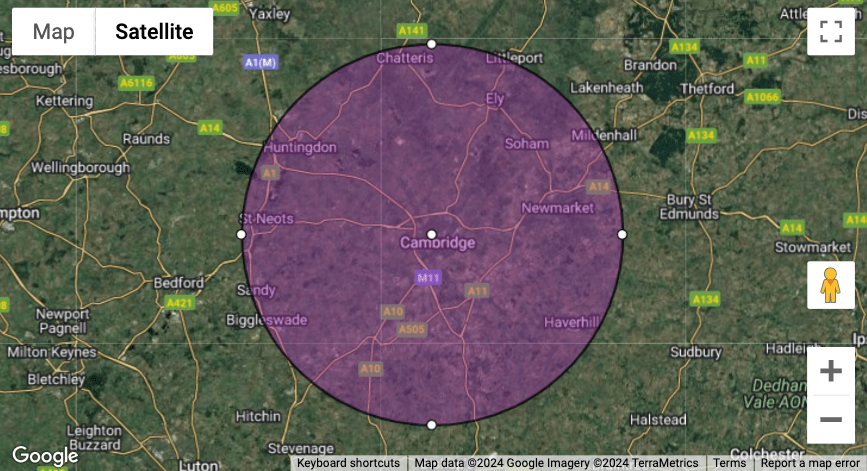
Above – from Map Developers’ draw circle tool here (You can play with different size circles)
Note Lichfields tried to identify ‘social infrastructure’ near Addenbrooke’s.
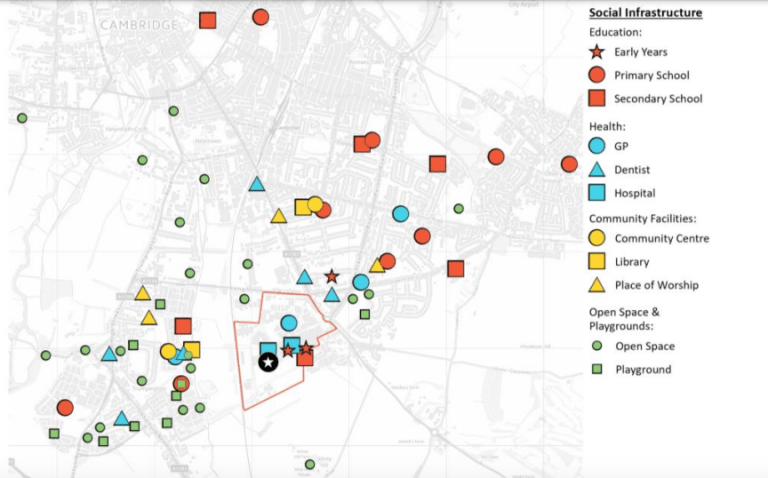
Above – what Lichfields said was social infrastructure is contested by others
CUH-NHS directors discussed moves towards ‘preventative healthcare’ and more things being delivered ‘in the community’ rather than at Addenbrooke’s.
Which I’m fine with – but it’s far outside of their control and influence under the current structures. And they need to be open about this and acknowledge that this requires not only both system and structural changes, but they also have to lobby for it too.
Which is why I threw in a question about whether they had talked to the Combined Authority about adult education and lifelong learning given that a critical mass of us had last studied science at school before the year 2000.
If they are serious about moving towards prevention (and I believe they are because of the chronic pressures on their services), then they need to break out of their cultural silos ‘It’s either for us to do, or it’s for someone else to do and we’ll assume they are getting on with it’. Which is ***sooo public sector pre-2000s***. My point is that while they might ask the Combined Authority about lifelong learning, how will they follow it up?
One suggestion could be to follow the Derbyshire WEA in the 1960s and come up with their own idea for an adult education centre that for starters meets the objectives of prevention-based healthcare. Now, that does not mean building a box with seminar rooms in for adults to be passive learners school-style and be force-fed science by a lecturer. If you want the public involved, make whatever it is you are providing:
- Accessible
- by transport
- by costs (or lack of)
- by opening times
- by information – easy for your target audience to know it exists
- by culture – make it inclusive rather than exclusive
- Desireable
- A service that people want to use
- A place where people want and choose to be
- A place for people to ‘grow’ and feel a sense of satisfaction in using over the longer term
These match some of the recommendations that came out of the report by the Institute for Employment Studies on long term worklessness – one that turns decades of ‘punishment-based policy-making’ on its head. The joke being that if you want poor people to work harder, pay them less but if you want a rich person to work harder, you pay them more because ‘you won’t be able to recruit the talent’.
One of the biggest cultural change recommendations is separating the job-searching from social security functions. Furthermore, it finally deals with the ‘shove anyone into any vacancy to tick a box’ way of thinking which is incredibly off-putting for employers who want the best people for the jobs – not least because of the expense that recruiting people incurs in time and money.
Competing interests for a fixed area of land
The Iceni report looked at supply and demand.
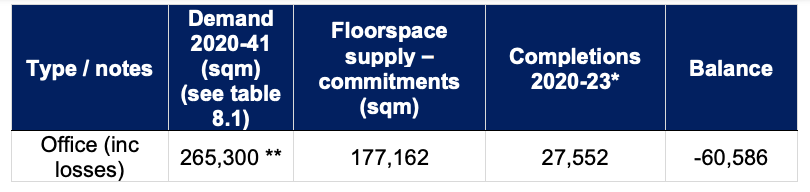
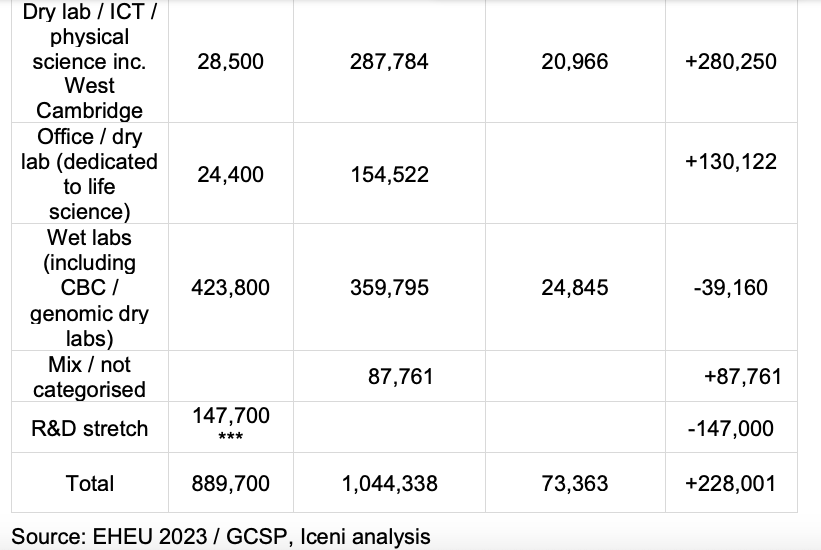
Above – Icenei for GCSP (2024) from p109 ono
Note floorspace is not the same as geographical area of land because of the storeys of buildings. At the same time, note that tall buildings puts limits on what land nearby can be used as. At the most extreme, it must be really awful being a tree at St Andrew Undershaft in the City of London. (Don’t assume that simply summing up the area of ‘pocket parks’ will have the same impact as a single large open public park)
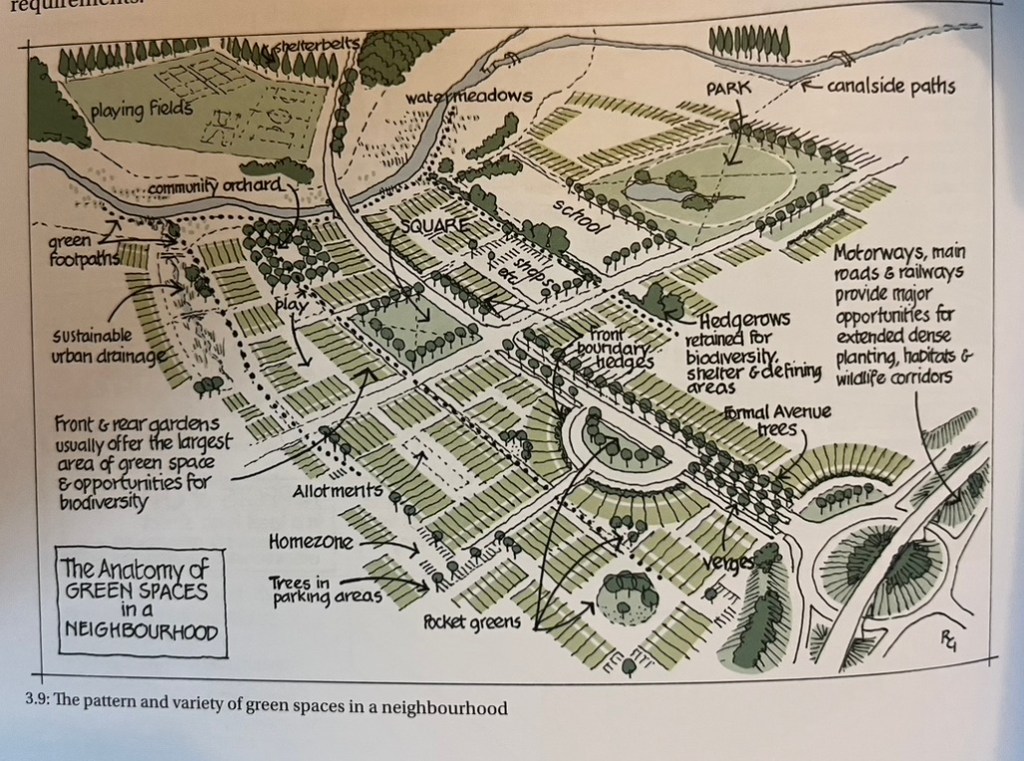
Above – Rob Cowan (2021) – what sort of ‘Green Spaces’ will be designated and how accessible will they be?
On the sets of plans I’ve scrutinised of late, I’m not seeing the integration of the developments or the people within them with our wider city. I’m not seeing the significant improvements in public transport services. I’m not seeing the significant new facilities that we have a right to expect from the expansion of our city and the huge sums of wealth we’re told that are being generated.
While the report sets out the demand/supply for the sci-tech sectors, cities are more than just the functions of a single or a couple of economic sectors. What are their requirements? Is there an under-supply of arts studio space? Is there an under-supply of indoor sports facilities and playground space? Is there an under-supply of…and so on and so on. We know there is an undersupply of council housing:
“There is a recognised need for more council housing across the city. As of August
2024, there were 2,928 households in need of Affordable Homes across the city”
Above – Cambridge City Council Housing Scrutiny Committee 17 Sept 2024, – Agenda Item 13, p11.
Who should take priority in our city? The sci-tech parks or the people in housing need? (Of which I’m one of the ‘hidden homeless’)
NHS Trust directors call for more public involvement in their work – and more members too
I’m a member of the CUH-NHS Trust – and you can become one too! There are around 8,000 of us if memory serves me correct, which is less than 2% of the catchment area. But then what percentage of the population keep in touch with what their local councils do? (Find out who your councillors are -> https://www.writetothem.com/) Furthermore, how do levels of knowledge of council functions vary by things like tenure of housing (council rent, private rent, owner-mortgage, owner-outright, student etc) through to occupation, income, health, level of formal education, and so on. As I mentioned in previous blogposts, if your council is your landlord, chances are you know far more about council systems and processes (not least because you are subject to more of them as a condition of your tenancy agreement) than someone who owns their property outright and has little interaction other than bin collection.
This brings us back to systems and structures. In times gone by, health, education, and local public services used to fall within the umbrella of council oversight – such as how Leicester demonstrated in 1939 below.

Above – have a browse through the Leicester Civic Guide 1939-40 (written just over a decade after the UK brought in universal equal suffrage – its aim being to help educate its citizens on democracy, how to use their vote, and what their tax revenue is spent on)
Could Cambridge produce such a guide under the current mess of a structure containing multiple service providers and contracted out services? What might have made sense to the economic theorists of the 1970s and 1980s in terms of ‘efficiencies’ has resulted in a picture that is far more confusing and time-consuming for the resident when it comes to trying to hold power to account. (Or was that the point?!?!)
Which is why having been through an exercise of working out what services are needed for our city, and deciding where might be suitable to locate them (such as building a second urban centre for Cambridge as I suggest here), we’d need to undertake a more difficult following exercise: Working out what structures, systems, powers, and cultures we need to put in place to make things happen. Otherwise we end up with another generation of expensively-procured reports that sit in shelves (digital or real) gathering dust.
A reminder: Not everything needs to be in Cambridge
I wrote how ministers could negotiate with the people of Bedford and Northampton about their towns becoming designated ‘landing points’ for expanding Cambridge firms that become too big for further growth. I followed it up in the face of Michael Gove’s ‘build beautiful’ call combined with his Case for Cambridge highlighting how the existing riverside retail-park use of some of the land in the two county towns could be reimagined as places that could be redeveloped along the architectural lines promoted by Create Streets as alternatives to the tourist photos of Cambridge seen in the brochures but which in reality are off-limits to most.
The Newtowns Taskforce
You may have seen the announcement in the news. Tempsford was identified by the previous government, but some urban thinkers and policy makers made the case of building around existing transport corridors – ideally picking out existing under-used rural railway stations as sites for newtowns. When Cambridge Biomedical Campus published their housing needs report earlier this year here I suggested a couple of small stations (eg Dullingham and Kennett) east of Cambridge – noting the challenge of building communities rather than dormitory towns for ‘Cambridge overspill’ that, as with Monaco resided the people needed to keep a place functioning but who were priced out of that very place at the same time. I don’t want to see my home town becoming a playground for the rich.
And after all that…my head hurts!
If you are interested in the longer term future of Cambridge, and on what happens at the local democracy meetings where decisions are made, feel free to:
- Follow me on BSky <- A critical mass of public policy people seem to have moved here
- Like my Facebook page
- Consider a small donation to help fund my continued research and reporting on local democracy in and around Cambridge.
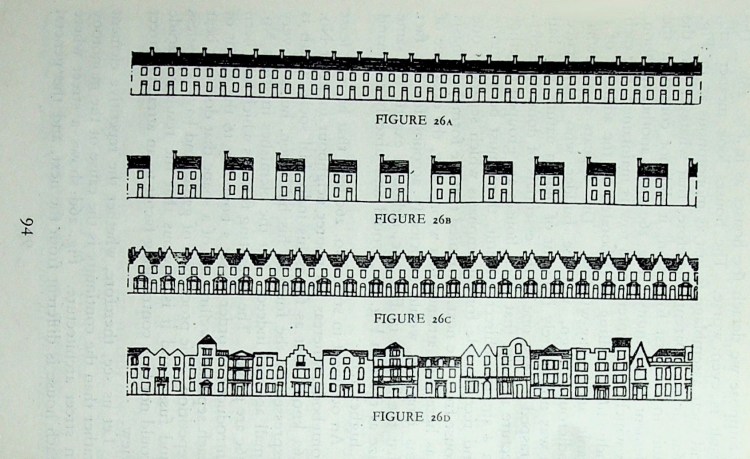
Below – Do buildings have good manners or bad manners? Have a browse. It’s from 1944. How do we avoid monotony as Cambridge expands?


 The Cambridge Town Owl