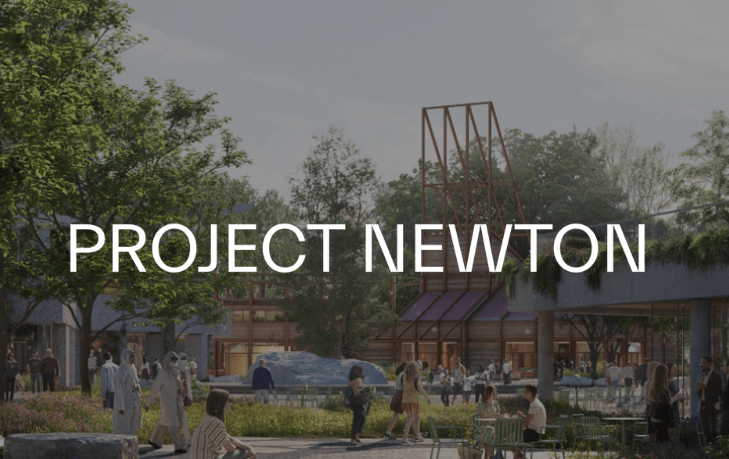
It’s very rare for a local council to commission a formal legal opinion from a senior barrister, but that it what they did prior to approving this controversial application which I last wrote about a few weeks ago here
TL/DR? See BBC Cambridgeshire here, and see https://cherryhintoninnovation.co.uk/ by the developer
For those of you who want the details:
- Planning Committee Item 4 – the Officer’s Report is 180 pages long (but summarises several of the things I comment on below)
- The Planning Application supporting documents – all 600 of them, with the commissioned reports being extensive in themselves.
“What was the planning opinion?”
See item 7 of the meeting papers here, concerning the use of planning conditions regarding land contamination – a very controversial issue locally (and understandably so). Basically the stance of the Environment Agency appeared to be that a separate planning application would be needed as planning conditions alone would not be enough to mitigate the risks of pollution and contamination. The developer and the city council wanted to test this, so instructed senior barristers to write formal legal opinions – the result of which said that it could be done with just planning conditions – of which there are several on this alone.
“Therefore, a number of planning conditions are being recommended by officers to control the risks of groundwater and air pollution at every stage of development (including test stage and future operational stages). These include: Nos. 41, 46, 47, 48, 49, 50, 51, 52, 53, 54, 55, 56, 57 and 58. The scope and wording of these planning conditions have been developed in consultation with technical input from the City Environmental Health Team and EA”
Above – Item 7 Amendment Sheet report, p2.
As for the development itself?
It’s huge (and explains why I think town planning functions should be cost-recovering from developers. Especially for large applications like this.
Such is the size of the speculative bubble that it’s now economical for developers to buy up old landfill sites and build huge metal frames around them for buildings to sit on top of. (Originally I thought it involved excavating huge volumes of decaying and potentially hazardous waste and finding somewhere else to dump it all).
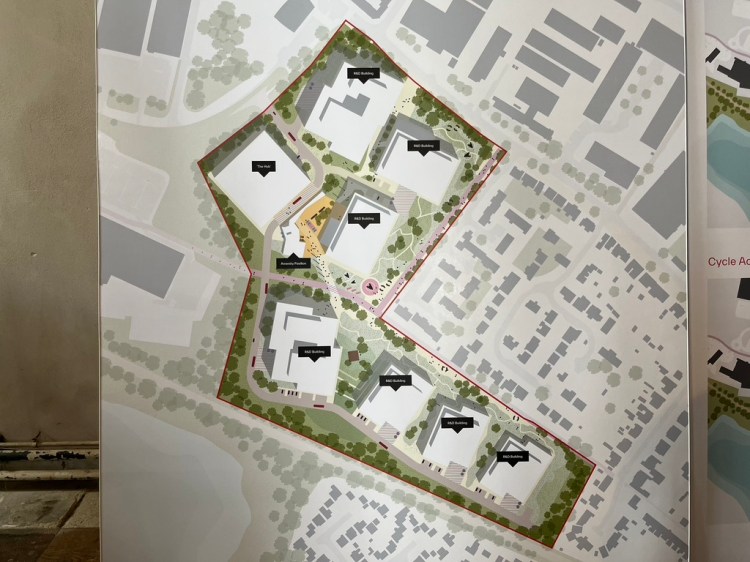
This has been a gruelling application for local residents to deal with following the refusal of a previous application to turn this inaccessible site into a lorry park. I wrote about the sci-tech application in previous blogposts:
- The announcement of the new development in Oct 2022
- Scrutiny by residents in March 2023 at *very short notice* (where I moaned to the architects about how ‘orrible spreadsheet architecture was!)
- More emerging proposals following that consultation – summer 2023
- The submission of the application which had nearly 400 documents attached in December 2023, and had 600 documents by the time the Planning Committee of Cambridge City Council examined it.
It’s that final one from December 2023 above that I go into the longer term history – including what part of the area looked like in the olden days.
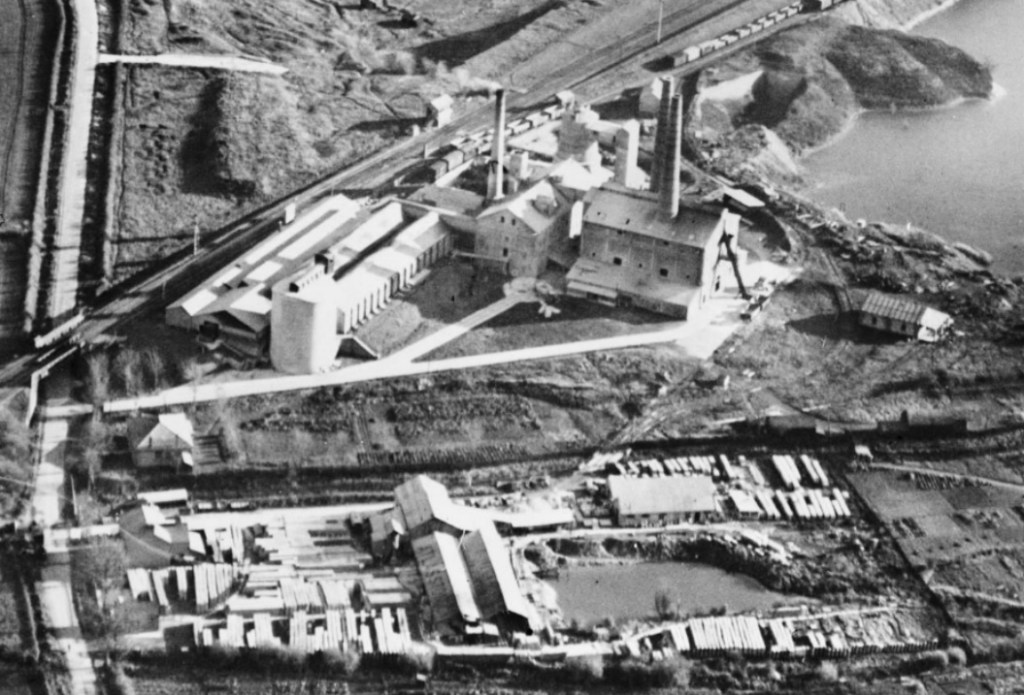
Above – from EPW025477 – Cambridge 1928 from Britain from Above – a detail of Coldham’s Lane (the road on the left running top to bottom)
I opposed the application on transport grounds
I said they needed to get a suburban or light rail stop built alongside their development as part of a major upgrade to the Cambridge-Newmarket railway line.
Cambridgeshire County Council’s transport team were not happy with the original proposal either.
“It is the view of the Transport Assessment Team that the following would be required to bring the development impact to an acceptable level.
- Significant reduction in car parking provision on the site to discourage car use.
- Significant further car mode share reductions.
- A contribution to allow the delivery of the section of the Fulbourn Greenway scheme
from the site to Brooks Road prior to the occupation of any development. - Further passenger transport enhancements.
- A monitor and mange approach to the phasing of the development.
Above – Cambridgeshire County Council’s Transport Assessment – 01 March 2024
Cambridge Past, Present, and Future in their extensive response also noted the railway line.
“If a development of this scale and intensity is to be contemplated it must be brought forward as part of the wider strategy for Cambridge East. In particular, it is anticipated that new public transport will be developed to service Cambridge East, such as a busway or a new Cambridge East station on the Cambridge to Ipswich line – and these could provide the quality of regional public transport that could justify this type of development in this location. However, in the absence of this type of high-quality public transport within a reasonable walking distance we believe that this application should be refused.”
This was something picked by Rail Future East Anglia who have been campaigning for years to get the Cambridge-Ipswich line upgraded and electrified.

The comments on the lack of rail provision were picked up in the Officer’s report.
“Design and layout does not appear to have considered the potential use and/or upgrade of the railway line running through the site whether it be widening or construction of a Cambridge East railway station that could serve the site”
One suggestion put to the developer – and quoted in the report was to “…provide a new spur off existing railway into Parcel A for a new Cambridge East station” as part of their application.
“There are currently no long-term plans to provide an additional rail link or station into and/or near this part of Cambridge. The Applicant proposes a car driver mode share target of 27% (of all trips) by completion of Phase 4. Achieving this target mode share will be supplemented by the Monitor and Manage strategy which will monitor car driver caps for each phase and ensure any excess car usage is mitigated in the prescribed ways, e.g. Applicant’s own design interventions or financial contributions to strategic travel initiatives where mitigation has not been successful. The Monitor and Manage approach measures are in addition to other commitments made to upgrade and incentivise active travel opportunities.”
Above – Officers’ Report p129
The Cambridgeshire and Peterborough Combined Authority must now step in
They are the organisation responsible for long term transport strategy even though we are on our third one since 2014.
- Cambridgeshire County Council 2014 (Tory minority with UKIP (remember them?) support)
- CPCA Transport Strategy – James Palmer (2020)
- CPCA LTCP – Nik Johnson (2023) with the Greater Cambridge summary document here
That Greater Cambridge summary documents approves the principle of a Cambridge East Station. The problem is that the Greater Cambridge Partnership has made an absolute hash of their City Access project and also of the Cambridge Eastern Access project – which started off with lofty ambitions but now is little more than buslanes and cycle lanes.
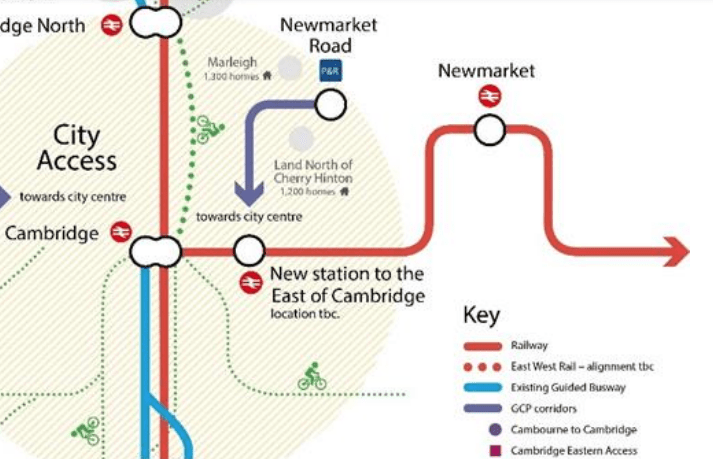
Above – Detail of the Cambridge 2030 ‘vision’ by CPCA Greater Cambridge (2023) p9
The new proposed sci/tech parks should help pay for upgraded rail lines
I wrote the above in a blogpost back in May 2023 here. It included the then latest iteration of the Cambridge Connect Light Rail concept map below

Above – Cambridge Connect is now negotiating with the Department for Transport over the possibility of feasibility funding which the GCP should have, but refused to provide.
With the governance structures clearly broken but with ministers nationally continuing to proceed with combined authorities, what are the options?
Lots of think tanks are writing things about devolution – such as the Institute for Government here. Personally I’d like to see much more critical analysis of both the actions of the previous government in establishing Combined Authorities in principle, and also how they have functioned up till now. I get the sense that too many institutions seem to want to please the new government by being seen to support their proposals – and as a result are dismissing all too easily the shortcomings – such as the purse strings being held in Whitehall.
The one thing the Mayor does not have is a significant budget. That’s why he didn’t run with light rail or metro schemes for Cambridge. With only a four year term, he took what was a pragmatic decision of trying to sort out the basics – i.e. the buses, rather than getting bogged down into something that the Department for Transport were not looking like providing funding for. At the same time, relations between the CPCA and Central Government were not good – that went for both mayors Nik Johnson and James Palmer. Since the general election, the new government has wiped the slate clean and brought in Mayor Nik Johnson and team into closer policy-making circles. (We saw this with the recent buses publicity when the Transport Secretary chose Peterborough as the place to launch the Buses Bill).
With so many sci-tech park developments happening – and with the Beehive Centre development application looming, Nik Johnson could seek powers from ministers to levy a tax on the huge wealth being made from the sector to help fund improvements to the Cambridge-Ipswich line.
The problem with only seeking contributions from developers is that the burden falls on new, rather than existing firms and landowners – even though the latter stand to benefit. Take for example the Fulbourn Tesco if a frequent light rail stop were built serving it and the developments at Capital Park. In the short term this could be in terms of additional customers using the light rail, to the massive increase in the land value that the large supermarket site sits on, much of which is low-value free car parking.
“So…what happens now? Is it ‘spades in the ground’?”
Far from it. There are a list of things that the developers now need to negotiate with Cambridge City Council as part of a Section 106 agreement [Section 106 of the Town and Country Planning Act 1990] on planning obligations associated with the planning permission. You can read the list and details from p131 of the Officer’s report, but to summarise they include:
- Employment & Skills Strategy (jobs and training for local people)
- Community Outreach Strategy (non-employment/jobs benefits to local people)
- Studio workspace (for the arts and non-science sector – diversify the local economy)
- Start-up space
- Public space strategy (to maintain public spaces)
- Meanwhile Use Strategy (to make use of unused parts of the site as part of the phasing of development)
- Cycling/active travel infrastructure
- Travel planning and transport infrastructure contributions
- Public art
Things still to be approved – ‘Reserved Matters’
The Officer’s Report notes there are a host of subsequent ‘reserved matters’ applications that will need to be submitted and approved by the city council. You can see these from para 33.0 / p139 of the Officer’s Report. The phrase ‘Prior to the commencement’ appears ten times in the planning conditions – although some of these are standard clauses in planning permissions. One of the challenges for local residents is keeping up with what those reserved matters are, and being able to scrutinise them and demand improvements so sub-standard things don’t slip through.
As for the transport problems on the eastern section of Coldham’s Lane, without a rail-based system to serve that site and the other sci-tech developments, I fear they are about to get even worse. Hence why I think the CPCA now needs to step in – and drag in Network Rail and the DfT if necessary.
Food for thought?
If you are interested in the longer term future of Cambridge, and on what happens at the local democracy meetings where decisions are made, feel free to:
- Follow me on BSky <- A critical mass of public policy people seem to have moved here
- Like my Facebook page
- Consider a small donation to help fund my continued research and reporting on local democracy in and around Cambridge.
 The Cambridge Town Owl