
Several of you have asked me to pick up on the recent Greater Cambridge Assembly Meeting – noting my position is that the GCP should be abolished (and to get Cambridge Connect Light Rail built)
“As Assembly members, your roll is to scrutinise and question the proposals presented to you. In your report, why is there no mention of the main reason this option for CSETS was selected or that there is any doubt that the wrong decision may have been made?”
…was one of the questions put to the GCP Assembly earlier this month (see my blogpost here). It looks like the GCP will want to plough ahead as normal – as reported in BBC Cambridgeshire here on 14 Sept 2024
I have tabled a question asking the GCP what assessment it has made of the report by Jonathan Roberts Consulting for Rail Future East Anglia of April 2024.
One of the big objections various campaigners had with proceeding with the bus rapid transit proposals were the very low benefit-cost-ratio which according to the early viability study was grim for all three proposals.
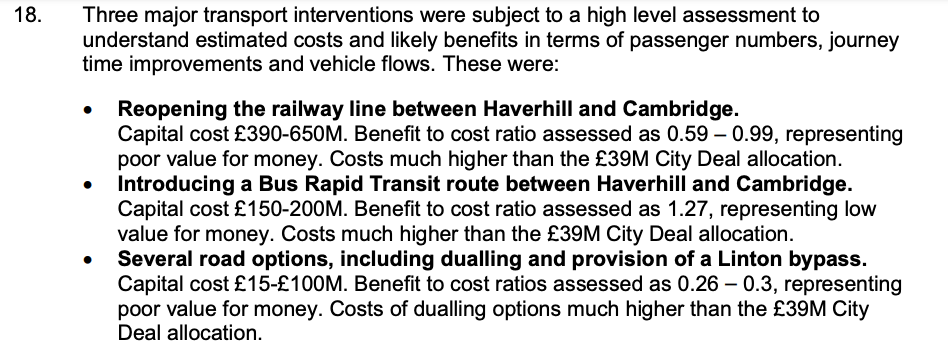
Above – GCP Paper 03 March 2016
The Benefit to Coast Ratio (BCR) in the study is around half than needed to hit the figure of 2.0 needed for the scheme to be considered viable. However, the study only presents a very early analysis of the BCR and there are numerous reasons why it will substantially increase with further study
I cross-referenced this with the Department for Transport, which in 2019 stated:
“The VfM category is derived in the first instance from estimates of a scheme’s benefit cost ratio (BCR). For costs and impacts that can be monetised, the BCR measures how much benefit can be expected for each unit of cost (investment) for example for every £1 invested benefits:
- less than £1 indicate poor VfM
- between £1 and £1.50 indicate low VfM
- between £1.50 and £2 indicate medium VfM
- between £2 and £4 indicate high VfM
- greater than £4 indicate very high VfM”
Above – Value for Money Indicator 2019 – updated Dec 2022, Department for Transport
“Has anyone scrutinised the detail of that original Cambridge – Haverhill feasibility study?”
They did at the time – for example Rail Future in April 2016 here
- ❍ The capital costs have been assumed to be around twice the cost per mile compared to other recent re-openings
- ❍ The capital cost contains a very high figure of 60% for risk and contingency
- ❍ The study assumes an expensive route to the centre of Haverhill; other lower cost options should be studied
- ❍ Passenger growth has been assumed to be low with the figure for 15 years given as 15%, whereas rail travel to Cambridge has seen growth of 25% in the last 5 years alone
- ❍ Haverhill’s population is expected to increase by over 30% by 2025 which again makes the study’s modest 15% increase look very pessimistic
- ❍ The wider economic benefits have not yet been assessed. This typically adds an additional 15% of benefits
- ❍ A figure of 28% for the modal share for rail into Cambridge could be pessimistic as Ely has a figure of 40%
- ❍ Variations of the route could draw in additional passengers, for example a direct connection to the major employment centre at Hinxton Hall along with reduced journey times to Stansted and London (although at the cost of journey times to Cambridge)
- ❍ There are a number of other rail schemes which are due to be delivered in the next 10 years, for example the East West Rail link from Cambridge to Oxford, which will magnify the benefits of the Haverhill scheme. A proposed new station at Addenbrooke’s will provide significant additional journey time benefits to rail passengers from a reopened Haverhill line
Above – you can also explore more in Rail Future East’s magazine of June 2016
The problem is the GCP keep moving around their files so knowing what to look for title-wise and knowing where to find it more than gives the impression that senior figures in the institution do not want the public to see these things, even though there may be other, more plausible reasons for this happening – including simple human error.
“The technical study is called the A1307-Rail-Viability-Technical and was published in 2015 – but the GCP have moved the file (again) so good luck in finding it. This is what campaigners mean by quangos making it difficult for the public to hold them accountable. Over-burdened councillors also don’t have the capacity to hold senior executives to account.”
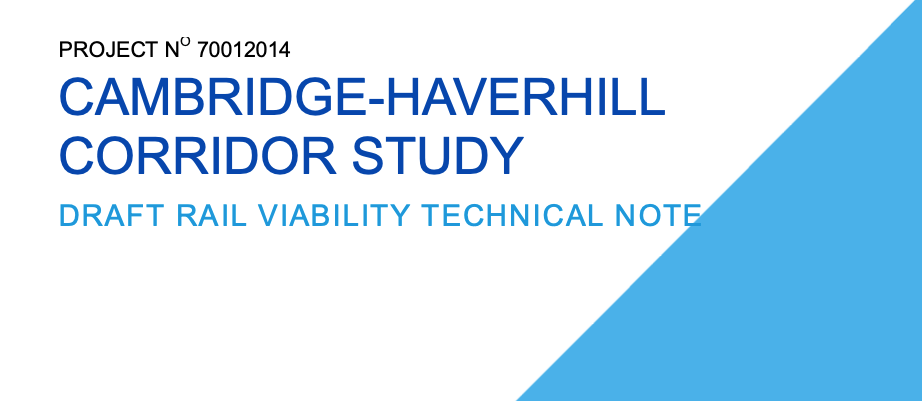
This is the document. I made sure I saved my own copy some time ago.
As with any document of this type, it has to make a whole host of assumptions. What the Greater Cambridge Partnership – then with a Conservative majority on its board – did was to approve a feasibility study that only went from Cambridge North to Haverhill.
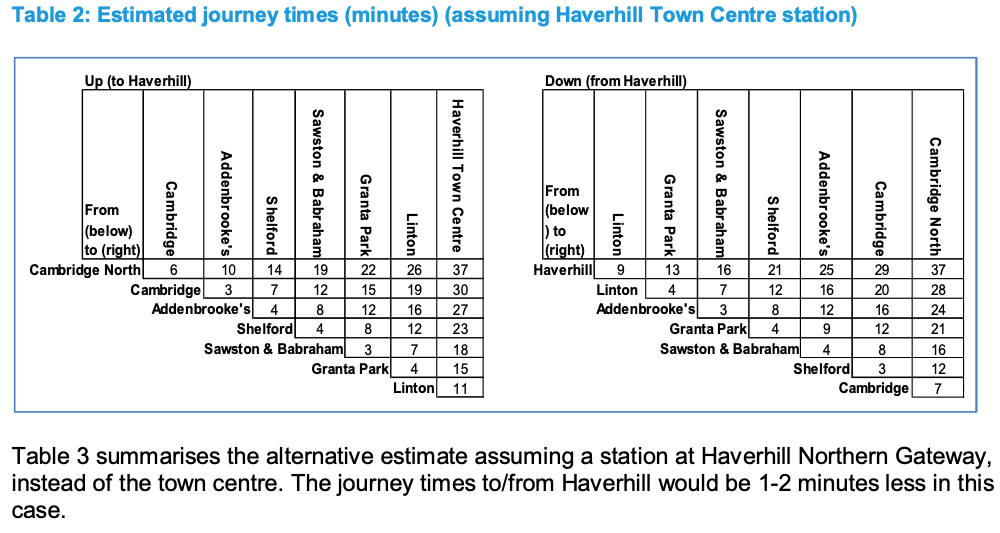
No consideration was given to extending the line to Sudbury, and no consideration was given to the Cambridge Connect proposal that emerged soon after that proposed a light rail link through from Haverhill to the Biomedical Campus through to Cambridge and onwards to Cambourne.
And finally…
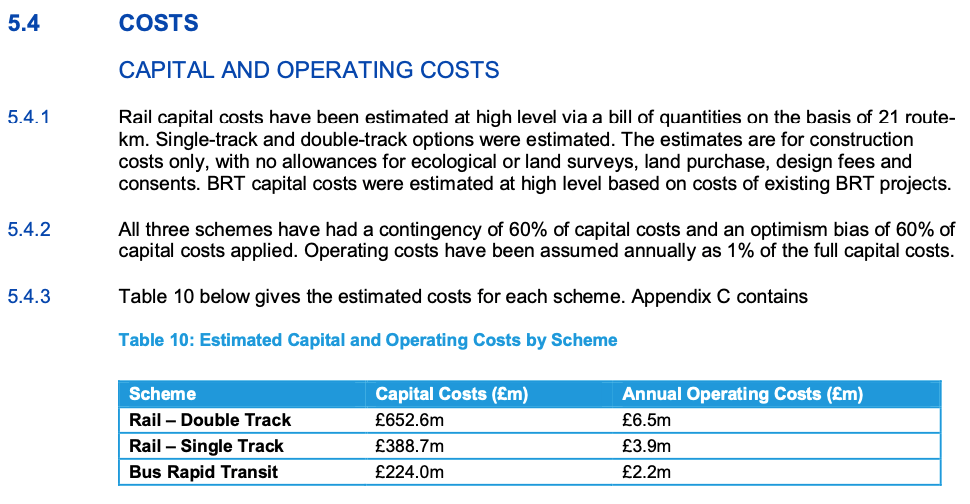
The Rail Haverhill route was discounted in favour of a ‘bus rapid transit’ from Haverhill instead.
The problem is that we’re no longer comparing Rail Haverhill with a Bus Rapid Transit to Haverhill. We’re now comparing it with a much shorter ‘road’ that stops at the A11.

Above – from June 2020 by the GCP meeting papers from p144 here – and also note the significant number of public questions including on CSET asking for the rail option to be re-appraised.
The Greater Cambridge Partnership as an institution gives the impression that they pre-decided what they wanted to do irrespective of what the public and politicians think
The problem is that having followed this all the way through since the beginning, I got the impression that the senior officer teams past and present had a pre-conceived view of what they were going to deliver, and deliver it they would, come what may. It is an institutional culture thing – I’ve been on the other side too! (And I know how annoying people like me can be if you’ve got a public sector project to deliver within deadlines!) This is why I try to avoid making things personal – institutional cultures are really powerful.
It’s not helped by things like this study of infrastructure options from 2015 – predating the consultant’s report on the Rail Haverhill option.

Note no estimates on Rail Haverhill – even though this is stated as a potential option in the Cambridge & South Cambridgeshire Transport Strategy of 2014.
“On the corridor to Haverhill, a High Quality Passenger Transport option could be the
reopening of the railway, with potential for a number of new stations that might include
Sawston, Granta Park and Linton as well as Haverhill itself. Guided Bus options on the
corridor might also use the old rail alignment.”
Above – Cambridge & South Cambs Transport Strategy (2014) p44
A reminder – the concept of busways along with proposals for congestion charging (the latter having collapsed creating a huge problem for the City Access proposals) have their origins back in 2002.
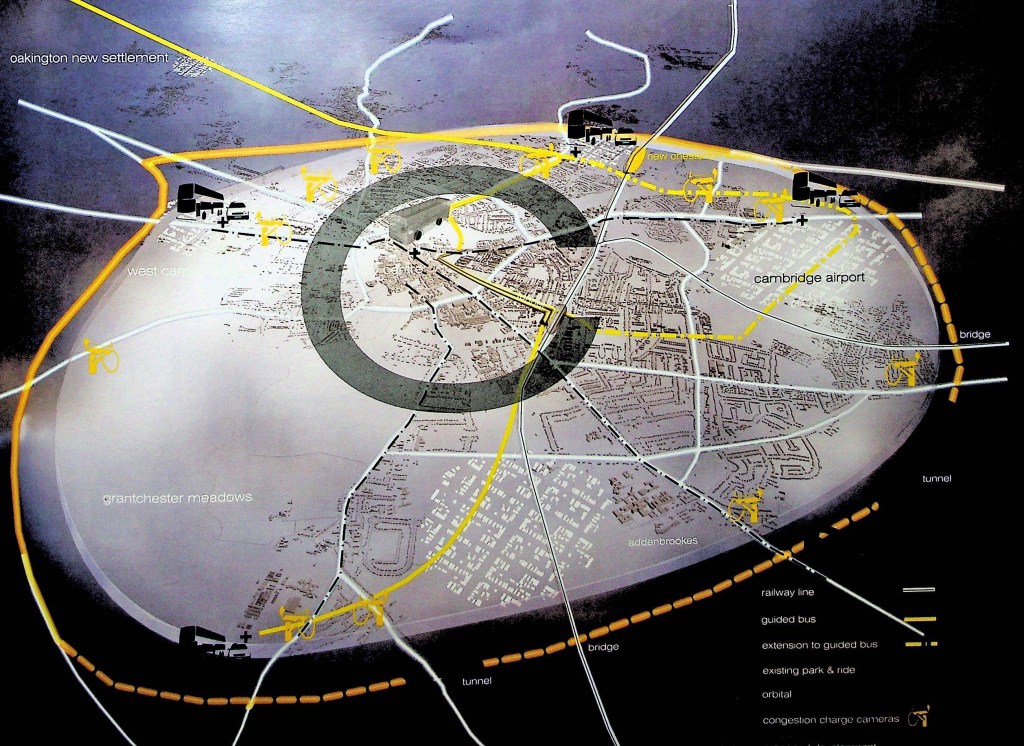
Above – the proposed Congestion Charging Zone from Cambridge Futures 2 – along with the proposed camera locations and the various new underground orbital bus tunnels (and the quite bizarre short one in the city centre!)
“That high level viability report on Rail Haverhill was signed off in November 2015. What’s changed?”
Where would you like to start?
- Brexit?
- The sci-tech developments?
- The climate emergency?
- The Combined Authority and the mayors?
- Michael Gove’s case for Cambridge?
Actually, one big thing is the most recent general election and the proposals that ministers have for the future of Cambridge – city, surrounding district, economic sub-region, and travel to work area. Given the policies of the new government, the bare minimum the GCP should do is to ask ministers what revised assumptions they should use for new viability assessments.
Essentially we’re no longer comparing like-with-like.
“The new public transport route between the A11 at Babraham and Cambridge was approved in principle by the Greater Cambridge Partnership Executive Board in June 2020.”
Above – Consultation on Cambridge South East Transport Better Public Transport and Active Travel
That consultation took place in the middle of a general election campaign, and the work that followed was inevitably hit by the first lockdown of the pandemic.
“Costings for the scheme were updated in line with changes to the design (Design
Freeze 3) and inflation and were submitted to the Executive Board in September The current [outline business case] budget for the CSET scheme is £161m.”
Above – GCP Assembly 12 Sept 2024 Item 9, p9
The missed opportunity for the step change – Summer 2021
Despite the significant concerns the public raised about CSET, the GCP continued as normal. When the electorate gave the politicians the opportunity for a complete change with the ejection of the last remaining Conservatives in May 2021, the political parties chose not to take it – leaving more than a few of us despondent about the state of politics and democracy in our city and county.
As the above-linked blogpost states, the GCP have little to say about what happens to the buses when they hit Cambridge. They still have not addressed this concern from their independent audit of the Cambourne-Cambridge busway plans.

Above – Greater Cambridge Partnership meeting papers 01 July 2021, p385
CSET will only add more buses. What’s the plan?
Given that it has been a decade on since the GCP got going, and given that they are ***ages away*** from getting planning approval for either of the busways, far better to cut their losses and go with Cambridge Connect like they should have done in the first place. And then start an in-depth review of how Cambridge, Cambridgeshire, and the wider economic sub-region is and should be governed. Because so many of these issues date back over half a century and have the broken local government structures created in 1974 at their heart.
Food for thought?
If you are interested in the longer term future of Cambridge, and on what happens at the local democracy meetings where decisions are made, feel free to:
- Follow me on BSky <- A critical mass of public policy people seem to have moved here
- Like my Facebook page
- Consider a small donation to help fund my continued research and reporting on local democracy in and around Cambridge.
 The Cambridge Town Owl