
You can read the refreshed document here – the context being the general election of July 2024 (and some of the recent policy announcements since then)
The first thing to pick up in the refreshed document is the ‘refresh’ section
“What constitutes a successful place in terms of urban design has evolved rapidly in the 21st century. The previous development models that created low density groupings of specific uses linked by car dependant connections, where working and living were done in quite disconnected places, have had their day”
This matters because of the sci-tech and business park developments that sprung up around Cambridge in the late 20th Century. Therefore any future vision for Cambridge more widely has to incorporate the renovation, retrofitting, and improvement of these corporate parks. Which in the grand scheme of things I find to be utterly uninspiring places to be. I learnt that the hard way when I went to a campus-based university at the turn of the millennium thinking it would be some ‘haven’ from all of the negative sides of city living and it turned out that the positives that I missed out on were far greater than the negatives of ‘the bubble’.
Such campuses are exclusive by their very nature rather than inclusive. The problem the CBC and other such developments have is that having designed out diversity by the sheer principle of their developments, how do they mitigate for the negative consequences of it? Can they design diversity back in?
Cambridge Biomedical Campus – the previous vision
The two main previous blogposts I wrote were:
- May 2021 – the plans for a very large expansion
- June 2023 – reviewing the plans two years on
- May 2024 – the CBC Housing Study (estimating how many new homes will be needed to house the workers needed for the campus to ‘succeed’
- Juy 2024 – following a public meeting with CBC
The last one of these focuses in on the lack of engagement in future decision-making not just on the CBC itself, but on the future of Cambridge more widely.
Physical changes proposed in the refresh
“In practice this means blending the wide boulevards and individual buildings set back from the pavements, creating places for cafés and restaurants, civic spaces, and a character that has elements of [a] city quarter as well as [a] commercial centre.”
“They’re ***really not selling this to me*** with such dull architecture and design”
I moaned about ugly buildings on the CBC back in 2023 so I won’t repeat myself (other than to say that they can have spreadsheet architecture ***or*** they can have nice ‘civic spaces’ and things you’d see in nice ‘city quarters’. Not both at the same time. Take your pick. (And if necessary, commission a new team of architects and urban designers that can retrofit out the dull stuff)
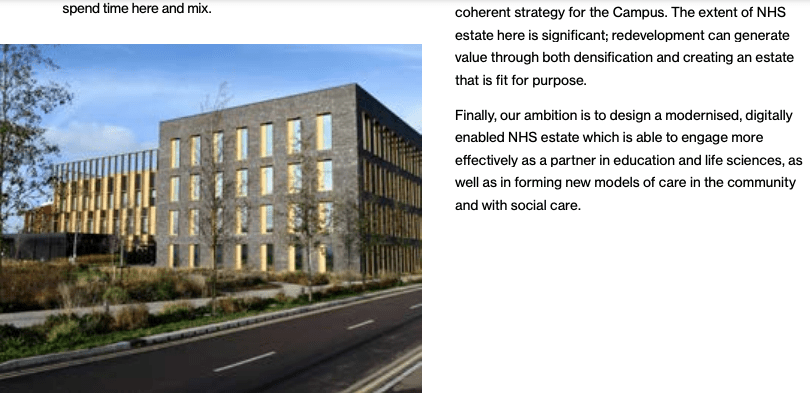

Above – from Humanise, which I featured in a blogpost about how the new architecture amongst other things is leaving me feeling increasingly alienated by, and disconnected from what is my home town
Being honest about what they’ve got wrong – the learning points need highlighting across the built environment industries
“Improving facilities for employees and for visitors is hugely important. It helps to build a clearer character for a place that is presently dominated by large, self-sufficient institutions that can feel disconnected.”
I’d have that statement up in ***big lights*** (well, maybe…not quite) but have it as a prominent statement for any tours of the biomedical campus to state:
- That the institution is aware of what the people who live/work in/around the site have been saying about its shortcomings
- That the institution is willing to act on those shortcomings rather than gaslighting the public and pretending that they do not exist – as is sadly too common in both politics and urban design
You can see the failure of the master planning where the CBC missed the opportunity to create a civic square with Cambridge South Station at its heart.
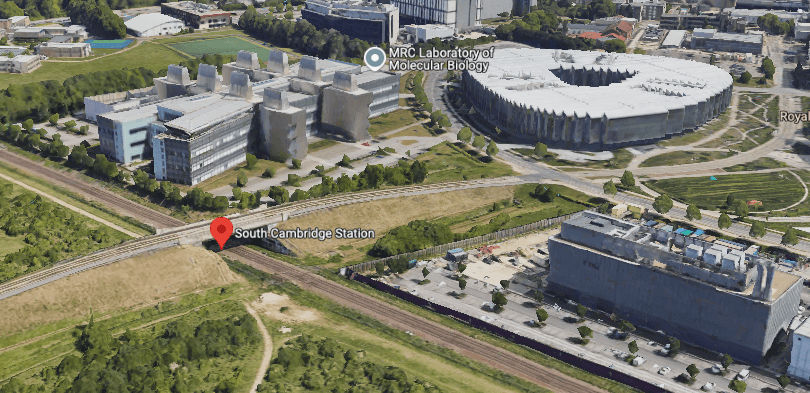
Above – the pre-construction view of Cambridge South Station via G-Maps here. Don’t think those responsible for the development of the campus were not warned about this repeatedly in the years preceding.
I highlighted some of the issues back when the development got planning approval here – or rather pointed everyone to the detailed criticism from Smarter Cambridge Transport which, as with the GCP got ignored completely because the decision-makers had already decided on the big-picture things from the start, reflecting the toxic culture within the transport engineering profession of ignoring community input and ploughing through come-what-may. The history of motorway and dual carriageway construction shows us that.
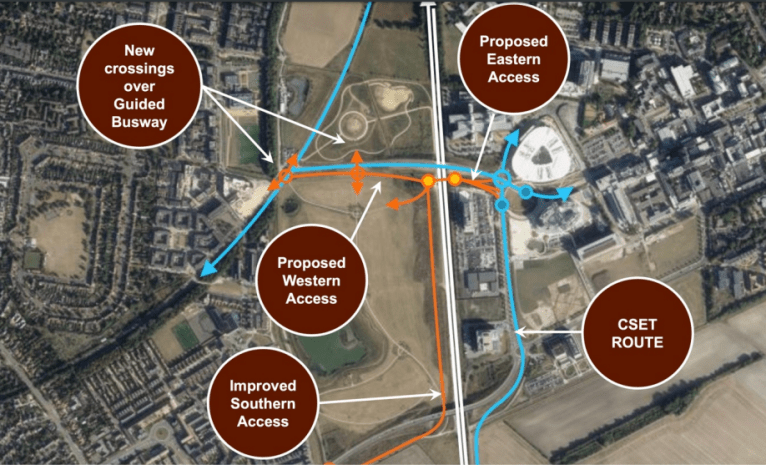
Above – As mentioned in my blogpost on the station design in June 2023, the CSET road for buses
The problem was the lack of sound master-planning and the refusal of those making the decisions to allocate land for a future Cambridge South Station. The way the planning system seems to work is that if a proposal has not been formally submitted, the assumption is that it never will, therefore carry on. This is where the relocation of the Anglian Water Plant at Milton to Honey Hill ran into trouble because no firm application for the redevelopment of the site had been made – hence the flurry of activity to shore up that side at a high level with letters such as this one from Homes England. (I’m happy to be corrected on this one if I’ve misinterpreted it). Ultimately my point is that it should, and could have been so much better than this. The problem was the decision-makers collectively did not embrace a culture of, amongst other things civic pride. Part of that is reflected by Network Rail’s ‘minimum viable design’ rule that doesn’t seem to allow for much in the way of future-proofing or artistic licence – although the Cambridge South Station design could have been a lot worse – as Cambridge North shows with its dull grey lifeless ‘H-block’ design clad in metal to look ‘artistic’ according to scientists/engineers (I think that was the public art justification). One reviewer stated:
“I just take pleasure in the use of the fearsome beauty and cold indifference of mathematics to bring a particular kind of life to a station designed in large part to serve a science park. That feels right to me.”
Above – A Fearsome Beauty in The Beauty of Transport blog, 19 Jan 2022
Going by the comments, there are varying opinions of the station building, while for the hotel behind it, even the consultant presenting it to the Planning Committee could only describe its design as ‘acceptable’. ***I’d like to think that developments in Cambridge should be far, far better than ‘acceptable*** but if that’s the system that ministers have put in place on the back of hard lobbying by the construction industry, money talks and the system will produce results like this. One that was exposed as rotten by the Grenfell Inquiry. (I’m not making allegations of corruption against individuals here – my issues are with systems, structures, and institutions)
“Can things be improved in and around the campus?”
Yes – and that’s also one of the reasons why I continue to campaign for a lifelong learning presence there
You can see the short, medium, and longer term proposals they have from p32 here

My problem with their short-term proposals is that they feel ‘hollow’ and discrete rather than continuous (although some things such as the choir appear to be in it for the longer term). Furthermore, everyone has got to be more imaginative than thinking a couple of yoga classes/courses in a box room counts as ‘community outreach’. It’s such a dull cliche whereas a simple browse through the old course lists for Adult and Community Education in the British Newspaper Archive could spark off a whole host of revived forgotten activities. (Then they need to ask the questions on what buildings and facilities such activities need in order to thrive). For example if you are going to be having social dance classes (for example like the ones run in Queen Edith’s at the Nightingale Pavilion), do you have halls that are large enough for end-of-term/year social events?
Note the medium term strategy talks about working with political representatives. Do CBC staff know the first thing about the powers and responsibilities that our political representatives have? (Note the ***very low*** response rates to recent transport consultations in recent years). Again, hence my point about lifelong learning provision that goes beyond narrow sci-tech vocational skills but goes into science in society, and also provision for the arts and humanities. Note also that the recent planning permission for the Project Newton / Burnside Lakes sci-tech park application, the developers are required to build some art and studio space on site – something that the CBC should consider in order to ensure they don’t create a monoculture of a complex (and also because they might find that such small industries have unexpected benefits being on site. The same goes for suppliers of components and other services).
Does **everything** have to be on the site?
No – and this is something the CBC should look at in terms of its very long term plans. There are limits to growth. The water crisis tells them that. In which case should the CBC be looking at potential ‘spin-off’ sites where firms that become too big for the campus can relocate in a planned and phased manner to pre-agreed sites and settlements? (I’ve suggested Bedford and Northampton as part of massively-improved rail networks and services). At least that way there will be some familiarity between the organisations, and also that the receiving towns can make proper preparations for (and receive up-front funding and support) to prepare for such changes.
Food for thought?
If you are interested in the longer term future of Cambridge, and on what happens at the local democracy meetings where decisions are made, feel free to:
- Follow me on BSky <- A critical mass of public policy people seem to have moved here
- Like my Facebook page
- Consider a small donation to help fund my continued research and reporting on local democracy in and around Cambridge.

 The Cambridge Town Owl