
A new report from the Bennett Institute for Public Policy at Cambridge highlights land value capture – and also refers to Gothenburg’s plan for the future
You can read:
“In a new Bennett Institute report, Thomas Aubrey critiques the government’s reliance on private finance initiatives (PFIs) for infrastructure development and recommends a more integrated approach using development corporations. He argues that by leveraging the Land Value Capture provisions in the Levelling Up and Regeneration Act 2023 (LURA), the UK can finance large-scale infrastructure and housing projects more cost-effectively, without the drawbacks of PFIs.”
“It’s 01:40am”
I know but when you’re on a roll with ADHD you’re on a roll
Talking of expanding towns, have a look at Part 1 of Lewis Keeble’s monster guide that I digitised earlier, published in 1959 (2nd ed.)

Above – see 4-2 onwards (p70 of the pdf here) by Keeble where he challenges the reader to consider what sort of facilities are essential for different sizes of settlements – from large cities to small villages.
Now, back to paying for such facilities: Via central taxation? Big Society? Leave it to the market? Land value capture? Something else?
In the grand scheme of things he said what more than a few of us have said for years: use land value capture mechanisms to help fund the much-needed transport and infrastructure that Cambridge needs – that previous generations of developments have not provided for. This was something that Dr Andy Williams, formerly of Astra Zeneca (and on the various boards involved in the expansion of the city) told the Queen Edith’s Community Forum back in 2023. The problem is how to fill that gap – and also make sure that commercial interests that benefit financially from unearned improvements in the infrastructure are taxed appropriately on any gains they realise from it.
“The Chancellor should exploit LURA 2023 now and work with key stakeholders to develop integrated projects across the country. It seems Michael Gove planned to use the LURA to double the size of Cambridge through a large-scale integrated infrastructure and housing plan”
For those of you who want to go into the policy detail, you can read his full report – noting that the now defunct ‘OxCamArc’ is being used for illustrative purposes as a case study. If it is to come back in any form, it will require a formal statement to Parliament by the Deputy Prime Minister. I can’t see a Labour Government spending huge amounts of taxpayers’ money given the even greater underinvestment in the north of England. I can see the Chancellor Rachel Reeves looking with interest on proposals that – as Thomas Aubrey says in his piece, can potentially keep any debts in the private sector and off of the Government’s balance sheets. Hence the land value taxation model that creates the resource pool on which to spend on infrastructure rather than from general taxation.
The Gothenburg comparisons.
Back in February 2023 the BBC’s Ben Schofield went over to see how the city did congestion charging in the face of the furore in Cambridge over the same policy. (You can read his report here). My criticism of the comparisons – then as now with any UK-continental European comparison is that the UK has a much more centralised system of government – local councils have far fewer, much more narrower revenue-raising bases. They are much more dependent on central government grants as we saw with the flawed Levelling Up policies. (Which were recipes for the wielding of political patronage by ministers to rebellious-minded MPs. i.e. Back the government and you’ll get your funds!)
“Are the geographies comparable?”
One of my issues when people talk about ‘Cambridge’ is they are vague about their geographical definitions. The current city boundaries date back to 1935 and have long since been spilled over by developments such as east Cherry Hinton / Cherry Orchard in the 1980s (I’m old enough to remember it being built), to Marleigh on the other side of the airport, and to Orchard Park north of the city. We are long overdue a refresh.
Given the impact of austerity and pressure from ministers for shared services, Cambridge City and South Cambridgeshire District are more often than not being talked about as ‘Greater Cambridge’ That’s the geographical comparison I made with G-Maps.
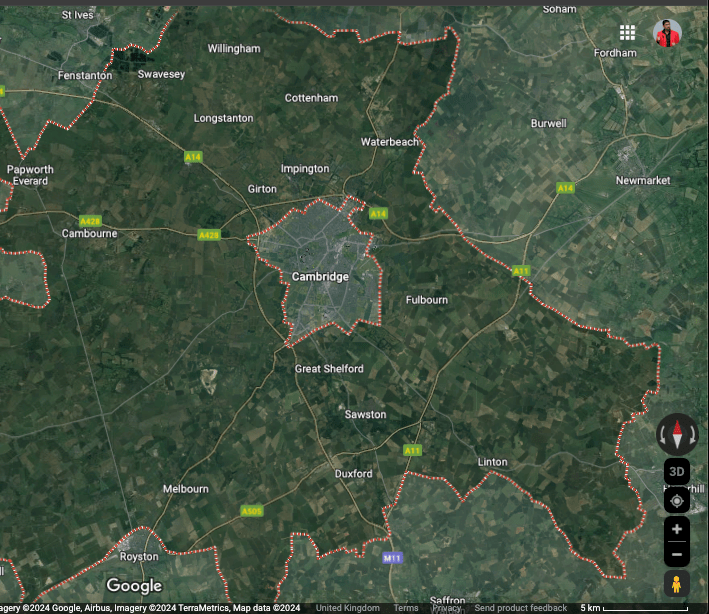
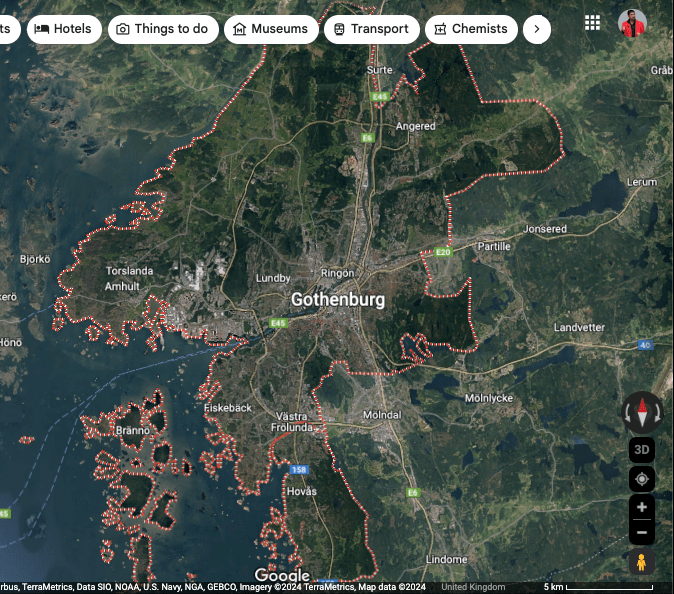
Above – from G-Maps: South Cambs District here, and Gothenburg in Sweden here screengrabbed broadly to the same scale on the map
In Ben Schofield’s report, Cambridge’s population is about a quarter of that of Gothenburg, but as you can clearly see it is within a much smaller geographical area. South Cambridgeshire District’s population on their State of the District Report 2024 here is just over 160,000 people, which basically means over the geographical area has around half of what Gothenburg has.
The reason for looking at the city again is the reference in the Thomas Aubrey’s report to the future strategy for Gothenburg published in 2014 – which conveniently has an English language edition.

Above – Gothenburg 2035 which you can read here
Remember the key issue of Gothenburg having far greater legal and revenue-raising powers independent of central government compared to Cambridge. So for every thing that you read from Gothenburg, ask whether Cambridge’s existing governance structures and individual institutions have the same legal powers – and if not, what do ministers & Parliament need to do to improve things?
Densification – questions asked by Gothenburg’s report
Given Cambridge’s woeful record of infrastructure building (and the time it takes to build it) in the face of growth, these are worth asking of ourselves.
“The aim for the next stage could be to produce a programme that focuses on various types of guidelines at different levels:
- How many homes and business should fit into a given area?
- What is missing and what needs will arise in development? Housing types, childcare, schools, healthcare, etc.
- What density is required to attain the different threshold values regarding daytime and night-time population that are required for a particular supply of services?
- What main structures for city life may not be taken away in building? How can important connections be reinforced – within the city district and with neighbouring areas?
- What demands should and can be made of the management of the central point?
- Are there opportunities to improve public transport by moving bus and tram stops, new bus lines, etc.?
- What needs does the business sector have of this place and what business sector can arise in the area with the right conditions?
- What green areas should be protected and in particular how can shortages be rectified?
- How are sports and recreational needs taken care of?
These city development programmes should be produced in cooperation with
the city district administrations“
Above – Gothenburg 2035 (published 2014) pp57-58
What previous generations got wrong with Cambridge
Apart from ‘Where do I start?’, I’m just going to raise a few things in response to those prompts.
- Post-war Cambridge got the densities wrong, building new housing estates at too low a density to sustain essential services (public and private – eg local shops. Even later generations such as Accordia were unable to make their local shop viable despite the architectural awards)
- We need to undertake a city-and-district-wide exercise to identify what’s missing and where – something that in part will be covered by the looming indoor leisure strategy that’s due to take the place of the current one
- We need to identify what a regional centre should have but does not, and how large those facilities need to be to accommodate future growth. Again it must be done in partnership with the people of city and district the sorts of facilities they would expect our city (or sub-region) that already has over 300,000 people in it – likely to be closer to 400,000 by 2040. Furthermore, we must consider how people from over county boundaries already use Cambridge’s facilities in their day-to-day lives (and have been for generations. Eg residents of the towns of (& villages around) Saffron Walden, Haverhill, and Royston to name but a few
- We need to identify those areas that can be densified – in particular those areas of poor quality housing at the end of their lifetimes (there’s another case study coming up in Cambridge – councils *must* be sensitive to the needs of existing residents), to science parks and business estates designed to assumptions that are now obsolete. The latter being something that the Cambridge Biomedical Campus has publicly stated in their 2024 refresh. Which sets a marker in the ground for all of the other business estates and science parks in/around our city.
- The Greater Cambridge Partnership won’t be here in five years time – we must start planning a post-GCP transport plan that meets the demands of a low-car-use, low carbon-intensive society that will also need to be far more resilient to more intense ‘weather events’ due to our collective failures to prevent climate change.
- We need to designate far more areas of green space for protection and for sports & leisure. This is something the Davidge Report of 1934 picked up on (See image below) as well as identifying what new sports and leisure activities we either can provide for (a roller rink?) or should be providing for having had plans made ***ages ago*** eg the Rowing Lake north of Cambridge.

Above – Davidge’s regional plan for Cambridge p61 – where he also identified areas of green space that should remain undeveloped. (Also, spot the lost railway lines!)
The only other thing off the top of my head I’d add is what level of collective knowledge do residents need to have to shape that future? I asked about lifelong learning centres this time last year to the Combined Authority but didn’t get anywhere with them in the face of existing limitations. (I wrote more about it here). It turned out that Gothenburg was also ahead of Cambridge on this too.

Above – from CTO 03 Oct 2023 – second half
We’ve since had a general election and a change of government, and the next mayoral elections are in just over seven months time – along with the county council elections. Time for a major policy change on lifelong learning?
If you are interested in the longer term future of Cambridge, and on what happens at the local democracy meetings where decisions are made, feel free to:
- Follow me on BSky <- A critical mass of public policy people seem to have moved here
- Like my Facebook page
- Consider a small donation to help fund my continued research and reporting on local democracy in and around Cambridge.

 The Cambridge Town Owl