
As the closest institution to a ‘Civic University’ for our city (it’s rooted in the pre-ARU/APU/AHEI days as CCAT / The Tech), there’s a huge potential civic leadership role for Anglia Ruskin University in Cambridge – one that Cambridge University as an institution could never fulfil because of the competing financial interests of itself and member institutions
You can read the report by the Universities and Colleges Union here which is written in the context of huge cuts to higher education institutions and the large numbers of redundancies and departmental closures across the sector. Also, if you want to know what a civic-minded further/higher education institution in Cambridge used to be like, see the CCAT prospectus from the mid-1950s here.
This quotation struck me as incredibly powerful – and also one that poses a huge challenge for out-of-town campus-based universities (such as the one I went to in 1999-2002)
“At a time when many feel disconnected from democratic processes and alienated from formal politics the need to renew and reinvigorate the civic space is greater now than ever“
The report mentions the Civic University Commission (See https://upp-foundation.org/about-us/civic-university-network/) and a report written by the late Lord Kerslake (one time my permanent secretary at the Department for Communities and Local Government during my final days in the civil service).

Above – Truly Civic – Strengthening the connection between universities and their places
“…we found few examples of a systematic and strategic approach to the civic role, based on an analysis of the needs of the place. Our proposal, that universities need to do this if they want to go beyond civic engagement to become truly civic universities, forms a central recommendation of the report.”
“Our commission found many good examples of civic initiative and engagement. However, this has happened despite, not because, of government incentivisation or pressure”
I found the above quotation on p7 to be unsurprising given it was during the chaos of the post-EU-Ref late 2010s. One of the tests of devolution in England is how much freedom and what incentives can ministers provide for universities and local government. If a push came to a shove, ministers could legislate and impose duties to co-operate on those universities unwilling to work with their local councils. (Similar to the duties in the old Local Government and Public Involvement in Health Act 2007 on Local Strategic Partnerships).
The crisis in adult education
One of the big missed opportunities in Cambridge from my perspective is with adult education and lifelong learning. There are so many things that the sector could be providing and that the wealth generated (Especially from the sci-tech bubble) could be financing. The problem is we do not have the local civic governance structure to enable this.
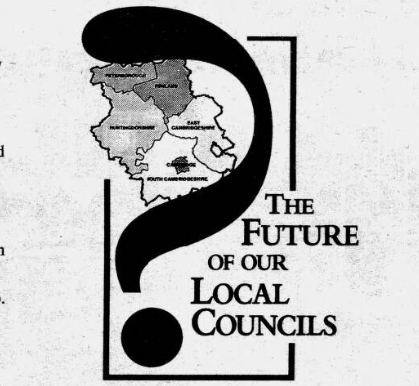
Above – from the Cambridge Evening News in 1994 – its logo on the debate over the revamp of local government in Cambridge which ended with Peterborough Unitary. Could the present debate have a far greater remit?
Not surprisingly, a heavily indebted adult population (mortgages, university-era debts, consumer credit debts etc) mean that few people have the means to self-fund courses and participation. This – on top of multiple caring demands and the lack of affordable childcare means that participation is skewed towards older, more affluent adults. The ‘missing middle’ of adults from their late 20s to late 40s has been painful to observe and live through over the past couple of decades.
Above – Lord Kerslate on the crisis in adult education and the threat to the UK Economy. 19 Oct 2018.
The UPP Foundation also produced a guide on developing civic university agreements – see their publications here. (After downloading it, you’ll need to tweak the name of the file so it has pdf at the end – i.e. remove the apostrophe. Otherwise your computer will think it’s a different file type). The principles it recommends for universities and agreements are:
Place
As a place-based institution we are committed to attaching a high-priority
to the economic, social, environmental, and cultural life of our local communities.
Public
Our civic role will be informed by an evidence-based analysis of the needs of our place, developed collaboratively with local partners and informed by the voice of our local community.
Partnerships
We will collaborate with other universities and anchor institutions and form partnerships to overcome the challenges facing our local communities.
Measurement and Impact
With our partners, we will be clear about what we do and how we measure it, so we can say with confidence what we have achieved – and how we might do better in the future.
Above – from A guide to civic university agreements, UPP Foundation (2019), p9
What would one of these look like if Anglia Ruskin University were to negotiate one of these with the local government sector in Cambridgeshire? What actual changes would people notice?
Given the collegiate nature of the University of Cambridge, it would probably be up to individual institutions within it to negotiate and sign up to a generic agreement – I can see some institutions being far more civic-minded than others, whether because of their current leaders, the culture, and/or the history of civic activism within each one.
Together Culture – Let’s go fly The Kite
This is something that ARU is already involved with and provides for an interesting pilot of how a further or higher education institution can be involved in both the regeneration of, and the recording of the local history of an area.

The work of Together Culture could be the spark that’s needed to enable ARU to develop a civic agreement with local government and other organisations so that it has a much more prominent place in shaping the future of our city – and that its students and researchers become much more involved in scrutinising the proposals that are put forward by local and national policy-makers. Because it’s that sort of work that could make a new generation of young adults and early career researchers aware of policy-making processes, and be a much-needed route into both the civil service and politics generally. And given the state of politics in the UK at the moment, getting more people involved – and more talented people with a greater diversity of life experiences, is much needed.
Food for thought?
If you are interested in the longer term future of Cambridge, and on what happens at the local democracy meetings where decisions are made, feel free to:
- Follow me on BSky <- A critical mass of public policy people seem to have moved here
- Like my Facebook page
- Consider a small donation to help fund my continued research and reporting on local democracy in and around Cambridge.
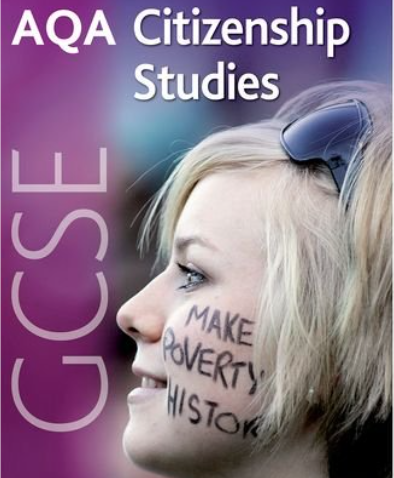
Below: I’d like to see Anglia Ruskin University and Cambridge Regional College running civics/citizenship courses. The latter in particular I’d like to see offering GCSE Citizenship Studies as a free GCSE funded by the Combined Authority – possibly even with a financial incentive for those who don’t have the minimum GCSEs needed to progress onto further education at Level 3.
 The Cambridge Town Owl