Cambridge’s first indoor skate park opened earlier today – I went along to have a look
Cambridge hasn’t had anything like this – not in my time anyway. It’s also been something I’ve been cheering on from afar and chasing after local politicians over (See this from April 2023). I’m not going to claim any credit for actually getting anything done – that was all the work of James, Paul, and their team of fellow volunteers.
***Wow!!! Can we go?***
Yes as it’s now open to the public. At the moment it’s just open for a couple of evenings per week plus a one of the two weekend days for a full day until schedules, timetables, and numbercrunching enable a more planned timetable
Entry prices when open to the public will be:
- £5 session entry
- £30 month unlimited entry
- £25 month unlimited entry (students / concessions)
That compares well with the Cambridge Ice Rink which (inevitably with the higher expense of running the ice-making machines amongst other things) in being less than half the price. Important if you’ve got one of the most economically-deprived wards in Cambridge on your doorstep. Personally I’d like to see any revamp of our public transport system to incorporate leisure attractions, arts venues, and sporting facilities to be core parts of it to enable more people to access them.
The only reason I’ve not been able to go to the ice rink is because the public transport journey is far too convoluted and utterly draining – accounting for traffic, it’s over an hour each way with one change (40 minutes if everything is going smoothly – which in Cambridge it seldom does). Not great if you’ve got CFS/ME. No chance of actually being able to enjoy time on the ice safely, much as from an exercise perspective I’d love to have this as a regular exercise. 15 minutes by bike (fine in normal times, not fine now).
Rather than simply saying ‘Well done for persevering!’, what can our city & county politicians and businesses learn from what the Cam Skate team have achieved?
My photos and video footage don’t really do the place justice – it was ***buzzing*** with people of all ages. Dozens of people from crash-pad-clad youngsters to the veteran older skaters were lined up along the sides of the ramps and half-pipes in one of the warehouses, while in the other much larger warehouse an even greater number of skateboarders (plus a few on quads (rollerskates) and inline skates (rollerblades)) weaved in and out of each other without crashing.
The skating/boarding conventions were instinctive. If you slipped off or lost your footing on any of the ramps or other apparatus, bars and raised surfaces, you simply picked up your skateboard, moved to the side, and walked round back to the end of the section you were on, waiting your turn to go back the other way. And the pace/turnover that the participants moved at meant that you were not waiting for long – most could be back up on their boards/wheels within 60 seconds.
The unexpected mental health benefits of the skatepark
Listening to the positive impact that the community built around the park had created stood in stark contrast to the corporate leisure offerings of more recent decades. A couple talked of some of how some of the people who had faced the worst that life could throw at them were seen smiling for the first time in years. It wasn’t just the activity but also the people, the collective endeavour, and that shared space of their own that had finally come into being.
And yet this is not something that anyone in the medical profession can write a prescription out for.
Which is why one of the areas that really needs developing are the links between primary healthcare (dentists, GPs etc) and local government sports, arts, and leisure provision. In my own case, both the lack of proper healthcare provision over an extended period of time combined with never finding that shared space, collective endeavour or (for want of another term), my tribe as an adult left me in the situation that I’m in. Given my recent stays in hospital, I can understand why in the fragmented societies of ours that there’s this phenomenon of people who find themselves isolated and lonely turning up to hospital because someone there will listen to them. Yet after 15 years of firefighting, local government is in no position to innovate or try anything new. The cuts the last government left Cambridge City Council to deal with in the medium term are being debated at The Guildhall on 30 Sept 2024. It’s grim. Any ‘savings’ made by local councils risk being passed onto the NHS as higher costs.
Why our current economic system – and system of privatising public spaces – will never sit easily with something like this
If anything, the Cambridge Indoor Skatepark stands in complete contrast to the big corporate parks – such as multinational-owned Cambridge Leisure Park. With the latter, if you are not spending money, you are potentially a nuisance and a burden and you need to be moved on. The students at Hills Road SFC can tell you the problems they have (as one did last year) of the attitude of the managing agents of the landowner in the face of the institution not providing nearly enough independent learning facilities for its own students – despite being encouraged and incentivised (financially) to expand by successive governments beyond its ability to support them. As I said in the article, the situation is a symptom of a 30-year-long failure of politics and public policy.
“Why can’t we have something like the indoor skate park in South Cambridge?”
Because…reasons.
Actually, I said to Paul and James that the best thing the councillors could do was to invite representatives of the business community and those that had large land holdings, and let them see the place for itself. For a critical mass of them, the buzz created by the people there will be enough to sell the concept itself. Because the inevitable question of: “How did you do this?” inevitably follows from those that have interests that extend beyond the bottom line. You don’t have to do the hard-sell with people like that. (I can only think of two occasions where I was sold something *very expensive* that I wasn’t intending to buy because the quality of the product sold itself. One of them was my e-bike).
Back in 2018 I wrote about Cambridge needing to have a big discussion about our civic essentials. It seems that the wheel is slowly beginning to turn – with Cambridge Biomedical Campus realising that its tenants want far more than a place to work at. The days of the car-fed edge-of-town business/employment park where people come to work and work only, may be coming to an end. The challenge for the landowners is how to retrofit them – mindful that some of the architecture and urban design doesn’t make for nice places to socialise in.
The other thing to remember is how previously-accessible parks and playgrounds have been long since locked up, with the local community shut out. 30 years ago a group of us would meet up in a local school playground – me being the only one without skates watching them trying out various stunts in the days before the 1996 Education Act made such things aggravated trespass. I’d still like to get my old skates (inline and quads) on again for a rollerskating session but the costs of hiring the space in local facilities are prohibitive. Furthermore, the efforts and resources needed to organise anything are prohibitive for all but the most determined. As Paul and James told me earlier. The state of the roads and pavements after 15 years of austerity don’t make for safe skating surfaces – and neither does the cut-back street cleaning rota. It’s one of the reasons I go on about how local government is financed – because Cambridge should be able to tax the wealth generated here not only to cover the basics that are being missed, but also to pay for the nice-to-haves. But that’s a conversation potentially for any new democratic spaces that educational establishments, colleges, and universities might be willing to open up.
Food for thought?
If you are interested in the longer term future of Cambridge, and on what happens at the local democracy meetings where decisions are made, feel free to:
- Follow me on BSky <- A critical mass of public policy people seem to have moved here
- Like my Facebook page
- Consider a small donation to help fund my continued research and reporting on local democracy in and around Cambridge.
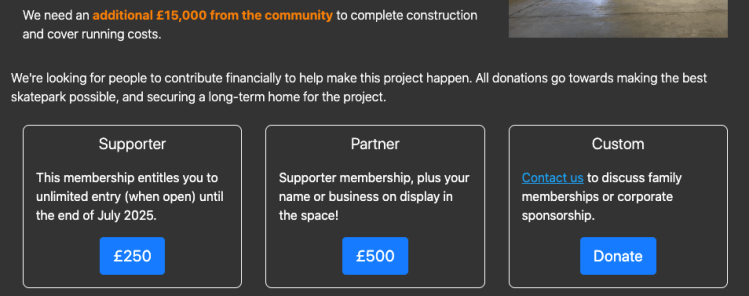
Below – Cam Skate need another £15,000 to complete their project. Click here and scroll to the bottom to make a donation.
 The Cambridge Town Owl