
In a letter to the Chairman of Homes England, the Minister for Housing and Planning, Matthew Pennycook MP name-checked the city as being an example of how other parts of England might ‘deliver’ major infrastructure
If that’s the case, then his officials and the key stakeholders around him are only giving him a partial, rose-tinted picture of the challenges our city, county, and economic sub-region are facing.
You can read the letter here announced earlier (30 Sept 2024)
Cambridge gets a mention in the third of seven priorities the Minister has set for the Government’s executive agency for housing and regeneration. The idea of having such agencies of government is that the ministers set the policies and targets, while the day-to-day running and decision-making is separated from ministers to avoid party-political influences. The minister stated:
“Third, I expect the Agency to continue to support the Department’s work on new towns and other major schemes by providing expertise and advice to the New Towns Taskforce where required and more actively leading place-based delivery.
“The Agency’s valuable experience has already been harnessed to establish and progress work in relation to Greater Cambridge and I believe there is merit in considering how the Cambridge model might serve as a template for establishing other place-specific delivery bodies to advance major schemes, with the team leading on the ground and officials from the Department focused primarily on cross-Whitehall coordination.
“As well as the above, the Agency should continue to support new settlements and urban extensions already in train through your funding programmes.”
“What exactly is the Cambridge model that the Minister speaks of?”
It can’t possibly be the broken structure that many of us have complained about for much of the past decade.
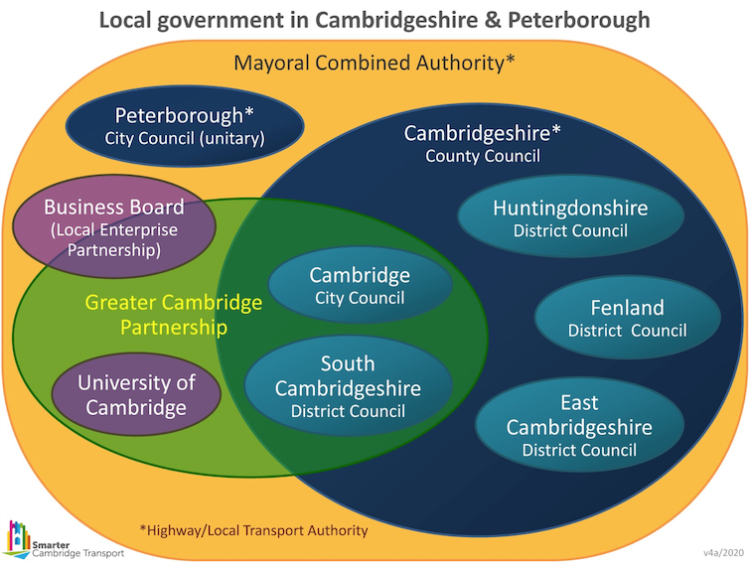
Above – the big mess encapsulated by Smarter Cambridge Transport which disbanded because of the frustrations working with the above (Note the University of Cambridge’s label indicates their seat on the GCP’s Board as a non-voting member)
Furthermore, Cllr Simon Smith (Labour – Castle) announced at this evening’s Strategy and Resources Scrutiny Committee of Cambridge City Council that ministers were not going to come and rescue local government – thus paving the way for even more budget cuts for our main municipal authority that has all the resources and powers of a small market town council.
Above – you can view the full meeting here
If The Minister wants to see how dysfunctional the institutional working relationships have become – in particular the now adversarial relationship between the Greater Cambridge Partnership and far too many communities that started off as willing to be critical friends, he only needs to look at the shambles of the abandoned congestion charging proposals championed by the then Transport Director Peter Blake (who was one of the people featured providing comment from the audience at the front in BBC Look East’s show in Cambridge that I was also in the audience for). The reason I mention this is because only two local councillors – Councillor Elisa Meschini (Labour – King’s Hedges & deputy leader of Cambridgeshire County Council) and Councillor Dr Dave Bagent (Labour – Romsey – then Cambridge City Council’s representative on the GCP Board) went public in the media (broadcast, press, and social) in their support for the proposals. The threatened loss of seats on Cambridge City Council in the run up to the 2023 elections to the Conservatives (who at the time had no seats) was enough to put the GCP off.
“What model could he be talking about then?”
Presumably the one where he saw both Eddington (yuck!) and the Cambridge Biomedical Campus. Given the state of the country at the moment, if you had seen both of those the contrast would be striking, and quite understandably you’d assume that whatever it was that had gotten these built must have been successful at something.
The problem is that looks can be deceiving. The Cambridge Biomedical Campus has already indicated that the model of large sector-themed employment parks where most people drive to work is now a thing of the past. (See my blogpost here). Furthermore, the housing report they commissioned which was published earlier this year showed that its housing need far outstrips what the local development plan – current and emerging, can provide. And yet the Greater Cambridge Partnership has utterly failed to provide any substantial improvement in transport infrastructure for the Cambridge Biomedical Site since the GCP’s creation in 2014. Not a single spade in the ground. This is despite a decade of lobbying the GCP to get the Cambridge-Haverhill line re-opened either as a suburban or light rail line (thus opening up the prospect of Suffolk residents being able to commute by rail to the site and beyond, and also removing a critical mass of road traffic – to the benefit of students going to the sixth form colleges in Cambridge as well).
Questions for your MPs
Because Daniel Zeichner MP (Labour – Cambridge) is a Minister of State at Defra – and of equivalent rank to the Minister for Housing, he cannot ask questions on the floor of the House of Commons anymore because of some outdated convention. (You don’t see the Prime Minister asking Qs of his own ministers about constituency issues). So for those of you who live in the constituencies of:
- South Cambridgeshire,
- St Neots and Mid Cambridgeshire
- Ely and East Cambridgeshire
…this one’s on you. Go to https://www.writetothem.com/, type in your postcode and ask your MP (Pippa Heylings, Ian Sollom, Charlotte Cane – all LibDems) to table a question in Parliament asking the Minister for Housing to publish a statement on what he means by ‘The Cambridge Model’ and what aspects of it are particularly suitable for other areas to adopt.
(Follow-up questions on overhauling local government in the county can wait for another day)
Food for thought?
If you are interested in the longer term future of Cambridge, and on what happens at the local democracy meetings where decisions are made, feel free to:
- Follow me on Twitter
- Like my Facebook page
- Consider a small donation to help fund my continued research and reporting on local democracy in and around Cambridge.

 The Cambridge Town Owl