
At the Greater Cambridge Partnership’s Board Meeting (see the papers here), Board Members voted to approve moving to the next stage for the Cambridge South East Transport project – but not without having addressed issues raised repeatedly by pro-rail/light rail campaigners first
First of all my thanks to Cllr Elisa Meschini (Labour – King’s Hedges), the re-appointed chair of the GCP Board for agreeing to discuss the Rail Haverhill issues and making clear why they are moving forward with the proposals they are – irrespective of what issues I may have with the content. (You can hear/watch her statement on YT here). Please don’t throw brickbats and things at the GCP councillors or officers. Life’s too short.
As I posted on social media just now, I’ve spent the best part of a decade trying to make the case for Rail Haverhill having visited a meeting at Haverhills old town hall a decade ago, and asking one of the first public questions to the then newly-constituted board about the GCP meeting with Suffolk and Essex County Councils about re-opening that line. (You can watch the video here of my question and the officers’ responses). In the grand scheme of things, I have taken this as far as is reasonably possible with the GCP.
I don’t intend on tabling any further questions. It is now for the GCP and Cambridgeshire County Council to make the case to a Planning Inspector who will then assess the application and make a recommendation to the Transport Secretary for a decision.
Dr Andy Williams raises concerns at how ‘over-complex governance structures’ have designed in the delays
There’s an academic thesis waiting to be written by someone on the history and performance of the Greater Cambridge Partnership. Not just as a throw-away remark but because the Ministry of Housing, Communities and Local Government put out a statement yesterday for the New Towns Taskforce stating that the latter wanted to ensure the lessons were learnt about Cambridge’s recent developments. (You can read the press release here).
I could use sensationalist language but Dr Williams said that some of the tone of the press coverage had been over the top, so I’ll refrain for this one and focus on the content of what he said. You can watch his statement to the GCP Board here and judge for yourselves.
“It’s almost ten years ago today that at a shadow GCP board meeting we were discussing a high quality public transport route south of Cambridge. Little did I know that ten years later we would still be discussing it, trying to approve a four-letter acronym.”
Above – paraphrasing Dr Andy Williams (formerly of Astra Zeneca).
He said he found that very difficult to understand – as perhaps do many of us. The response from his former employers in response to the establishment of the GCP was, he said “Well there’s no Cambridge South Train Station” – saying he was then commissioned to go and secure the railway station. That in itself speaks volumes as local politicians had been campaigning for such a station since the late 1980s.

Above – from the late 1980s, the late Paddy Ashdown (then Leader of the Liberal Democrats) with local councillors and supporters campaigning for a new railway station to serve Addenbrooke’s Hospital. Via Aidan van de Weyer.
Why did it take the representative of a multinational corporation to secure government funding for a station that, had it been built earlier, generations of teenagers at Long Road Sixth Form College, and so many patients and families at Addenbrooke’s would have benefited from? That’s not to pass comment on Dr Williams and colleagues or the politicians of the 1990s and 2000s. That’s more a comment on broken governance structures and broken policy-making systems that were not, and still are not joined up.
“Here we are ten years later with Cambridge South Station opening next year, while here we are dealing with acronyms in a governance body”
Above – paraphrasing Dr Andy Williams
Back in 2018, Smarter Cambridge Transport’s Edward Leigh wrote an article stating how the confusing governance structures were harming transport policies and the delivery of large projects. What Dr Williams said earlier reinforced that point. Decisions were not being ‘taken’ at GCP meetings – rather they were, as Dr Williams said, being approved and passed onto yet another committee. Approval at the GCP Assembly, approval at GCP Board, then approval at County Council Full Council to enable major transport works applications (under the Transport and Works Act 1992) to be made to the Secretary of State for Transport.
Remember the Greater Cambridge Partnership’s revamp and vision video of 2018?
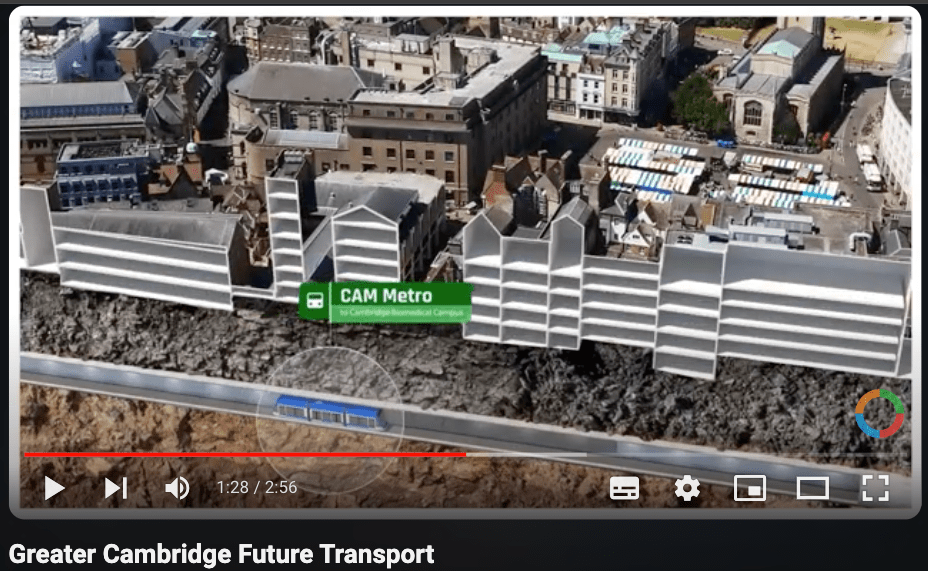
Above – Remember CAM Metro from the GCP’s video here?
Early on in the GCP’s history, Chancellor George Osborne and his ministerial colleagues pushed through the new Combined Authority for Cambridgeshire and Peterborough, but they did not ensure that the GCP was properly integrated into it. Furthermore, the party-political relationship between [Labour-run] Cambridge and Conservative-run Cambridgeshire and the Cambs Districts were toxic. Even within the Conservative Party there were strong differences of opinion between the new CPCA Mayor James Palmer and executive councillors on Cambridgeshire County Council. (While such things are normal in political parties, they become problems if it leads to a breakdown of governance and partnership working, which is what happened here.
Those structures were put under further pressure in 2018 when those not following politics closely woke up after the local elections of 2018 to find the Conservatives had been crushed on South Cambridgeshire District Council – thus creating a three-party split on the GCP Board. It also meant the Liberal Democrats took one of the seats on the GCP Board from the Conservatives. Neither the GCP nor the Combined Authority were designed to function with council leaders from different parties on decision-making committees. During that era, Mayor James Palmer made it clear he wanted something more than ‘just buses’ for Cambridge, and pushed ahead with a proposal for a ‘rail-less metro’ based on as then untested technology.
“It should be noted that, whilst light rail is more expensive than the minimum estimated cost of a system based on rubber-tyred, optically-guided vehicles, the lack of prior knowledge and experience in the industry of building and operating the latter system greatly increases the relative risks in ways that are exceptionally difficult to forecast. ‘Unknown unknowns’ are the Achilles Heel of innovation.”
Above – Smarter Cambridge Transport 20 July 2020
During this time, the GCP had to amend its big transport plans to ensure they aligned with the Mayor’s plans. That was to ensure whatever the GCP came up with for Cambridge aligned with the views of the new CPCA Mayor who took on strategic transport planning roles. Which made things even more confusing because in the same year we had Labour-led Cambridge City Council and Lib-Dem-Led South Cambridgeshire District Council finally getting approval for a joint Greater Cambridge Local Plan, while the Conservatives remained in control of Highways, and of strategic transport planning at County and Combined Authority level.
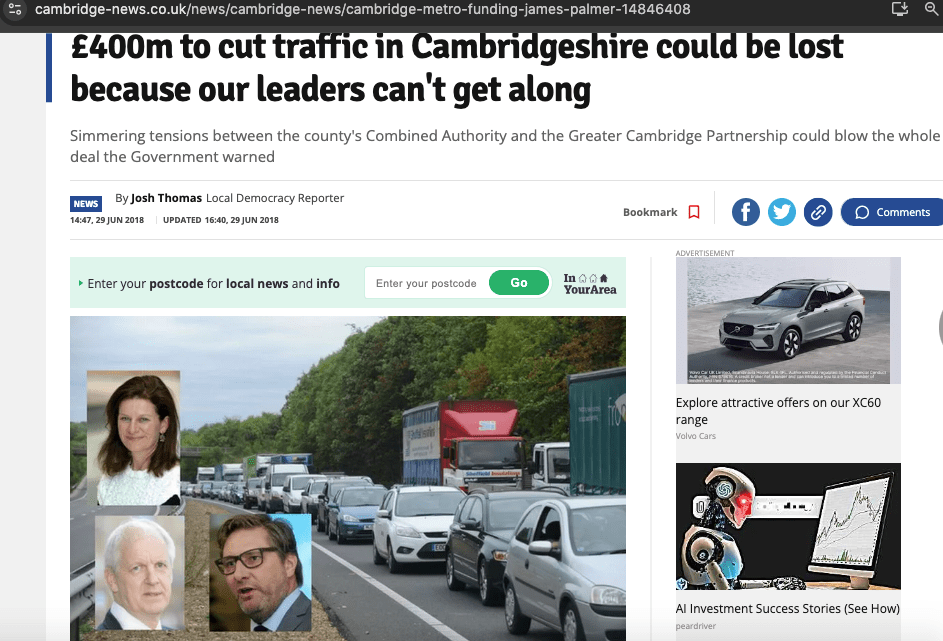
GCP Funding at risk – Minister threatens to pull the plug in 2018
You can read Josh Thomas’s article for the Cambridge News from his LDR days six years ago here.
“So, what’s going to happen next?”
The GCP will have to approach the County Council with a formal request for a Transport and Works Act Order application and hope that the full council votes for it. It will be interesting to see which way the Conservatives vote because the principles of the project were approved before 2018 when they had political control of the GCP. Note that given the successive election defeats in South Cambridgeshire both at local and now general elections, they have every right to say they have changed their policies in the face of electoral ‘feedback’.
At the same time, there still remains a critical mass of local public opinion where the CSET route (Busway / road with signs saying ‘buses only) that are opposed to the proposals.
“When this scheme was last discussed, a year ago, Cambridge Past, Present & Future presented a petition to you, signed by 4,861 people, asking you to listen to public opinion, save the countryside and choose the better value and more environmentally friendly scheme in the A1307 corridor. That petition now stands at over 6,300 signatures.”
Above – Public Question from James Littlewood, Cambridge PPF to GCP Board 02 Sept 2024 (Scroll to foot of the page)
My public question was originally declined, but the Chair intervened at the last moment and said she would be content for the board to hear my question. Because Cambourne is not easy to get to by public transport, and because I had a slot on Cambridge 105 at the same time, I wasn’t able to go. My question was very specific and also non-committal. I didn’t ask why Haverhill Rail had been rejected, I simply asked what assessment the GCP had made of the report written by Jonathan Roberts Consulting, a transport consultant commissioned by Rail Future.

“What happens to that report?”
It’s now up to Rail Future and fellow campaigners to make the case either directly or via local MPs to the Department for Transport (and also the Cambridge Delivery Group) to consider taking on the proposals in a different form. Given the huge housing requirements from the Cambridge Biomedical Campus published earlier this year which a simple Park and Ride (even on a segregated buses-only road) could not hope to sustain, local and central government organisations need to start considering what they want to do post-2030 when the GCP is wound up.
Post-2030 arrangements have to involve a serious discussion and resolution to the governance issues
Which is where the Cambs Unitaries Campaign potentially becomes pivotal. Because at present the structure and systems are not fit for purpose as they are. They will be even less so in 15 years time by which time we will be due another boundary review of parliamentary constituencies that will most likely result in the city being split into two constituencies. (I’m anticipating both the airport and water works sites will have been built out by then unless there has been some monstrous climate catastrophe, which given recent weather and climate changes is becoming an increasing risk).
For those of you who would like to keep track of what’s happening on CSET, best keep in touch via, or join Cambridge Past, Present, and Future.
Food for thought?
If you are interested in the longer term future of Cambridge, and on what happens at the local democracy meetings where decisions are made, feel free to:
- Follow me on BSky <- A critical mass of public policy people seem to have moved here
- Like my Facebook page
- Consider a small donation to help fund my continued research and reporting on local democracy in and around Cambridge.
 The Cambridge Town Owl