
It’s bone-grindingly frustrating trying to find accurate data on the ever-changing housing situation in and around Cambridge. On top of that, the local government structures, alongside laws that govern the property and education sectors do not allow councils to limit the activities that, without restrictions on expansion can harm the greater good of the city.
Cambridge is booming. But you knew that anyway. How long that boom will last for I don’t know. But for a long time both renting and buying homes has been beyond the level of sustainability – which means that for many, someone or something else is absorbing the costs. (Whether that be extended families/inheritance covering deposits, to working extra long hours/additional jobs to help make ends meet at the cost of health/quality of life). In June 2017 Savills was commissioned by the Greater Cambridge Partnership to produce an affordability analysis for the Greater Cambridge area, which you can read here.
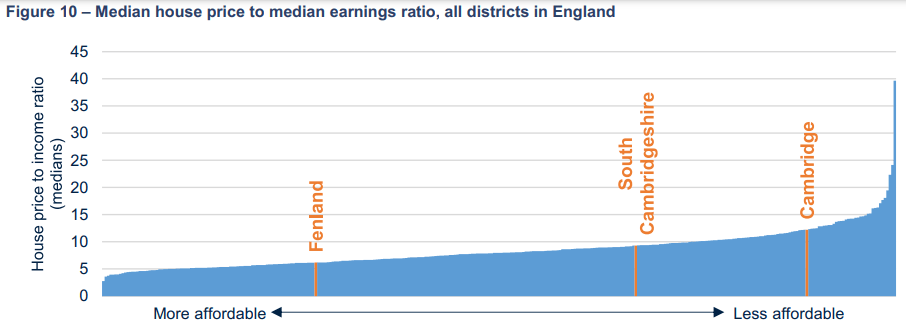
Above – Savills for GCP (2017) p14 / p15-PDF
I’m of the view that radical changes to the systems and structures of the housing market, and of local government, need to be made by central government if Cambridge and other towns/cities facing similar crises are to have a chance in dealing with the problems.
The destabilising impact of out-of-control short-term letting
I have no idea whether the data on this page is accurate or not, but it’s hard to ignore that they highlight that Cambridge’s regulation of such short term letting is “Lenient”

Above – from one of several sites on short term letting
More funding cuts to already barely-existent enforcement functions
Irrespective of which under-resourced part of local public services is responsible, you only have to listen outside every other evening to hear the roar of unlawfully-modified motors being driven often at speeds breaking the speed limit. But then we also know that the courts’ system is also underfunded and that penalties for such offences are more of a business expense than a genuine deterrent even when caught. We also know that Cambridge City Council’s budget outlook is grim – councillors confirming last week to expect more cuts to fill an £11m funding gap.
Cambridge City Council’s motion on short term lettings from 19 October 2023
“This Council further notes that this has had the effect of taking out privately owned and rented property from the market for long term living, and putting it in the market for short term and holiday lets and other temporary use; short-term lets through Airbnb may adversely affect the housing market, reduce the sustainability of communities, be the source of neighbourhood nuisance, and lead to substandard accommodation being offered to visitors;”
“Ask the Leader or Chief Executive to write to local Members of Parliament drawing their attention to this resolution and asking them to support measures to bring forward greater control on the market for short-term letting through the implementation of the measures proposed in the April 2023 consultation Introduction of a use class for short term lets and associated permitted development rights – GOV.UK (www.gov.uk)“
Cambridge City Council Full Council Minutes 19 Oct 2023 – item 23/53/CNLb – Amended motion passed 21-14.
There is a Full Council Meeting on 10 Oct 2024 at Cambridge Guildhall – see the calendar here. If anyone wants to table a public question at that meeting asking for any progress updates, please email democratic services.
The state of private renting in Cambridge
You can see the report from March 2024 here by Cambridge City Council. There is also an ever-growing community of housing activists with the Cambridge Branch of the Acorn Community Union – which most recently exposed the problems at a housing-association-owned property that was built as social housing as part of one of the most loathed developments in Cambridge – The Marque (you can read the ‘warts and all’ review here of what they proposed originally vs what they built)
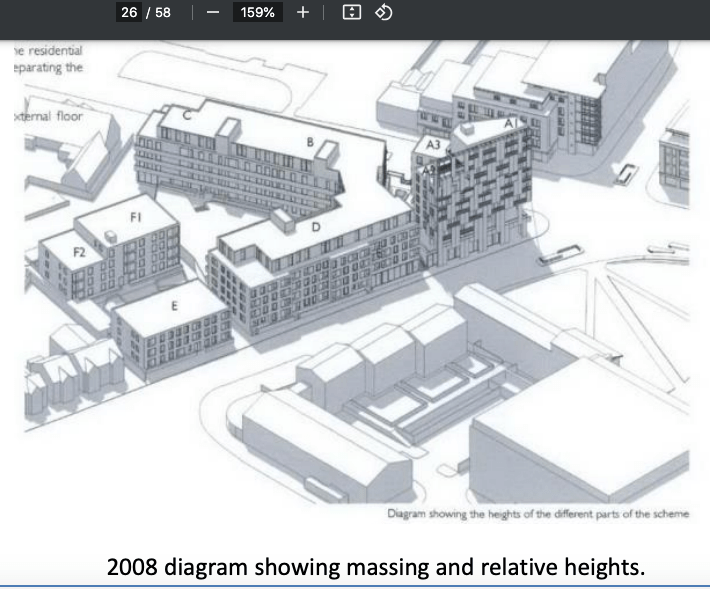
Above – from the Consultant’s Report for Cambridge City Council on The Marque, p26 – Cambridge Acorn are acting on behalf of members resident in building ‘E’
The Annual Monitoring Report for House building in Cambridge & South Cambridgeshire
They may as well merge at this rate. You can read the 311 page report here. If you dare! It’s heavy reading at times, but
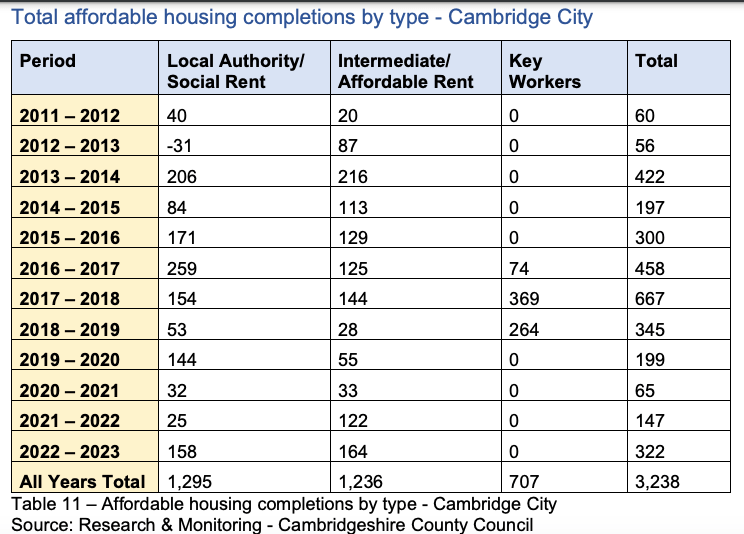
Above – how does this compare with council house sales?
Conversion of homes into student accommodation for the cram college and language school market
I’ve said it before and I’ll say it again: The language students are not the problem. The problem has its roots in poor governance structures imposed by Whitehall and Westminster. If you have political parties that buy the ‘light touch regulation is good’ as a founding principle, don’t be surprised if some people exploit such enforcement regimes. As the Grenfell Tower Inquiry exposed with the construction industry.
Local and regional government do not have the powers to manage the economic balance of their areas. There is little that anyone can do to restrict the expansion of the business activities of individual sectors whose excessive growth ends up damaging the social and economic balance of a settlement. This could be the construction/expansion of the large heavy industrial plant that pollutes the surrounding environment on which the livelihoods of those working in agriculture are dependent. In Cambridge it might be the buying up of houses built for families working in the local economy by large private education corporations or property speculators to let out to students coming to Cambridge from all over the world – mindful of how powerful ‘Brand Cambridge’ is. Perhaps inversely proportional to the powers, strengths, resources, and competencies the city council has with which to manage the and govern/administer the city!
As with the wider ‘how do we manage the tourism industry in Cambridge?’ questions, the same goes for private education functions targeting short-medium term stays. How many is too many? Mindful that the centre of Cambridge with the old colleges is fixed. It cannot grow, and it cannot go anywhere. How do you ‘ration demand’? This question also goes hand-in-hand with building a new urban centre for Cambridge as the city continues to expand. As I stated in this blogpost, such an urban centre needs to have anchor institutions that are independent of The University of Cambridge and also Central Government decisions, while at the same time not being vulnerable to sector-specific economic shocks.
Eight years ago I wrote this about how developers gamed the planning system. Effectively the Cambridge Leisure Park was and is an exercise in wealth extraction where local communities bear the hidden costs. The site is private property where residents are ‘invited to enjoy the facilities’ – but only if you pay for them. Generations of sixth form college students whose one colleges under-provide for independent study spaces (because they are themselves underfunded by the state and given perverse incentives to expand in order to get more funding) have a constant battle with security guards who want ‘non-paying’ students to move on. This was something that came up in conversation again at the Cambridge Playlaws event 2024 just as it did in 2023. But councils have no powers to manage this.
The freeholder – LandSecurities have – as is required by company law, provide maximum value for their shareholders. That means rinsing as much as they possibly can from the site. Accordingly, having a series of small independent outlets does not match that vision. Hence the series of corporate franchises that established themselves there. Apart from being architecturally ugly, the whole place represents a missed opportunity for what could have been a wonderful and much-needed leisure addition. We waited decades to get a bowling alley.
Funding local councils – Local government institutions for Cambridge are unable to tax the wealth generated here to fund even the basic maintenance of the street scene
I’ve covered this on a number of occasions and in the grand scheme of things it would be better for ministers to come up with a system that allows councils whose economies are stronger, to tax that base more so that central funds can be used to support those areas that need it. In Cambridgeshire’s case it would be enabling Cambridge (however you choose to define it) to extract revenue from the wealthier and speculative economic activities to pay for new infrastructure and services so that ministers could allocate central funds to places like March and Wisbech in North Cambridgeshire. Amongst other things it would enable funding for housing and cost-of-living support for those residents in need, while at the same time funding the extra police officers needed to deal with the problems of shop lifting – as the Police and Crime Maps show when you zoom into individual convenience stores.
Whether any of these issues get resolved will depend in part what ministers see the future of local government as: The local institutions where the residents of a local geographical area get together to resolve the issues, solve problems, and even celebrate achievements that bind them all, or whether local government is the administrative arm of central government that does whatever ministers and their civil servants tell them to.
Sue Gray headlines aside, we should find out what ministers really think about devolution when The Chancellor and The Deputy Prime Minister make big policy announcements and table new legislation over the next month or so.
Food for thought?
If you are interested in the longer term future of Cambridge, and on what happens at the local democracy meetings where decisions are made, feel free to:
- Follow me on BSky <- A critical mass of public policy people seem to have moved here
- Like my Facebook page
- Consider a small donation to help fund my continued research and reporting on local democracy in and around Cambridge.
Below, the Joint Strategic Needs Assessment: What are the big issues facing our county? Have a read – for it makes the link between local development planning/town planning and public health/improving our health.

 The Cambridge Town Owl