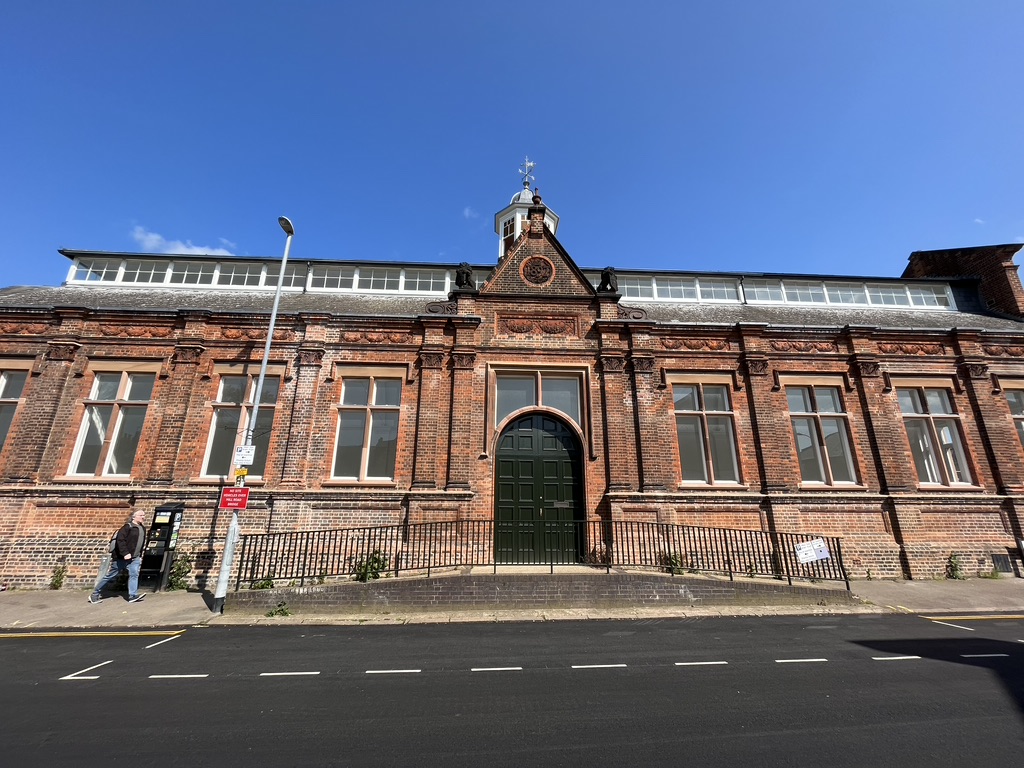
Despite the over 1,300 signatures on the petition to save the library for community use, it looks like Cambridgeshire County Council have agreed to dispose of the old library building that was originally built by Cambridge Borough Council in 1897 at the expense of the rate payers of the era
You can read the meeting papers here
Is history repeating itself again? Perhaps? Had the former Prime Minister Rishi Sunak not called the general election until the autumn, we would have been in a similar situation as in early 1996 when a cash-starved county council run by a Labour and Liberal Democrat coalition was faced with more sell-offs of community assets. According to the Cambridge Evening News of 11 Jan 1996, cuts of £300,000 had to be found. Understandably the people of Mill Road (Petersfield and Romsey) were dead against it
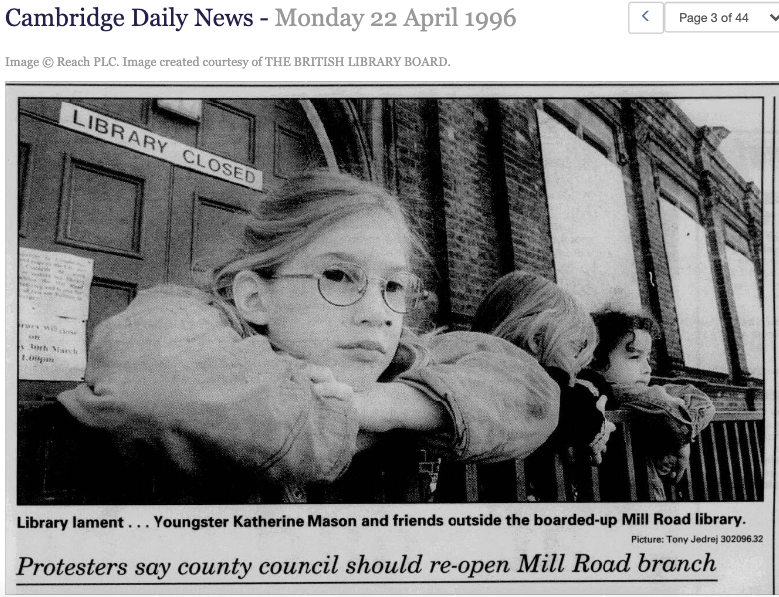
Remember this was a generation that had seen youth services cut to the bone and all opportunities of citizenship and democracy education removed from their curriculum by Margaret Thatcher and John Major’s Governments. It was only after David Blunkett became Education Secretary in 1997 that we saw a renewed drive for democracy education.
The Mill Road Library – opening in 1897
It should have had a wonderful centenary but we missed out on it. I transcribed the newspaper reports from the time on my local history blog, Lost Cambridge as below:
Transfer of ownership from city to county council
It was Sir Edward Heath’s Government that transferred the responsibilities of library services from lower tier (borough/district councils) to upper tier (county councils via S206 of the Local Government Act 1972. Remember, Parliament is the supreme law-making institution in the UK and is thus sovereign. It can legislate for whatever it likes with only two conditions:
- It cannot be bound by the decisions of previous parliaments
- It cannot bind the decisions of future parliaments – all it needs to do is to legislate accoringly
In this case, ministers tabled legislation that contained clauses enabling the transfer of such assets irrespective of who had paid for them in the first place, and Parliament approved it as part of an Act of Parliament. Note that it was an Act of Parliament that provided for the establishment of what we now call Cambridge City Council as a local council in the modern sense – the Municipal Corporations Act 1835. (Which I wrote about in the context of creating the borough’s first police force the following year)
Within three years of Cambridgeshire County Council taking control of the libraries, they threatened to close Mill Road Library
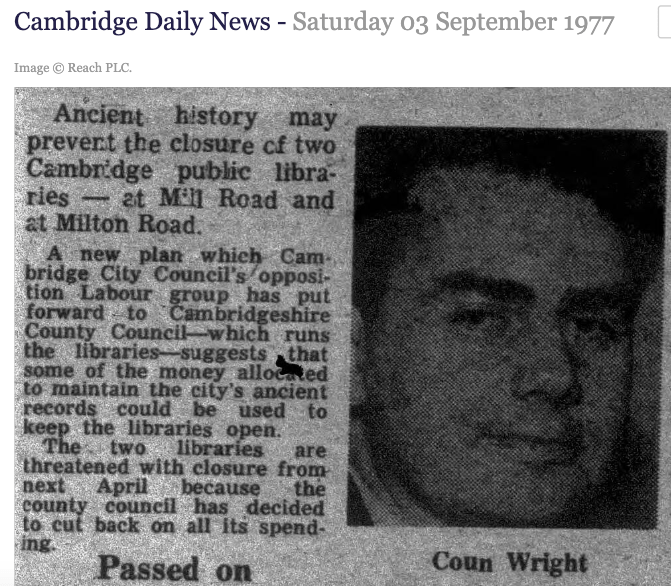
Above – Cambridge Evening News 03 Sept 1977 in the British Newspaper Archive
Just under two decades later, the building was closed as a library. Given the substantial population increase in that part of Cambridge with the construction of the new developments on the old Mill Road Depot and the old Ridgeons site, a properly-empowered unitary council that could tax the wealth made by our city would be able to re-open that library mindful of the rise in the number of council houses on both sites. The Mill Road Library should have been incorporated into the Mill Road Depot / Iron Works development but trying to get a Labour run city council and a then Conservative-run county council to work together proved impossible at the time.
Fast forward to October 2024
“What do the meeting papers say?”
You can read them here – mindful of the ‘commercial in confidence’ scoring of the bids and the people behind them
“They should at least make the bidders’ names public”
That would require an Act of Parliament – much-needed amendments to the Freedom of Information Act 2000. In the meeting papers at paragraph 3.14 of item 4 it states:
“A petition in support of a community acquisition which was started on the 29 September
2024 has been excluded from this report. The Council’s Constitution says that petitions from, or submitted on behalf of a business, or person, where the main purpose of the petition is to influence a forthcoming commercial decision of the Council, or the terms and conditions of a commercial transaction are excluded from consideration under the Council’s Petition Scheme and consequently it is reported here just for information.”
That basically means if the county council were to go against their constitution and allow the petition to be a valid issue in their deliberations, they could get sued. Which is frustrating. I’d be interested to know what the legal basis is for that part of the constitution mindful of the noises governments past and present have been making about community assets. Some of you may want to write to your local MP via https://www.writetothem.com/ and ask them to write to ministers on your behalf asking them to state clearly what their policy is on such community assets, and what changes they suggest local councils make to their constitution to prioritise community bids. (You don’t need to raise this specific case if you live outside Cambridge, it’s the principle that matters – one that you can then share with your county councillors).
The recommendation from council officers:
They state:
“Our recommendation is bidder 1 who had the highest score in all elements, both when independently scored and after moderation meetings. The bid is the highest financial offer and is considerably more than the £700,000 guide price, with evidence of readily available funding, and was considered the most deliverable as it is an unconditional bid. The bidder is strongly motivated to preserve the architectural features of the building and has sufficient resources to do so.
“The proposal is to let to community users in the creative arts, which would not necessarily require planning permission, but given that the bid was unconditional the bidder would take on that risk. The bidder already successfully delivers community focused enterprises in London and offers to complete the sale within 30 days of agreeing Head of Terms. In addition, the bidder agrees in principle to place a restriction against residential use on the property which would keep the community orientated use going forward. This will be included as a condition in the Head of Terms and sale. One of the bidder’s existing community focussed enterprises was visited by the agent and a council officer
“The preferred bidder proposes a community focussed use of the property, without major changes to the space, letting space for the creative arts, dance, music, art, and writing, albeit being fluid and dynamic to react to community demands, so that the enterprise can be self-funding. A sale to bidder 1 allows the Council to proceed towards a financial receipt which will support its service delivery, whilst offering economic, social, and environmental benefits to the local community and in the creative arts.
Given the legal restrictions imposed by Acts of Parliament that county councillors are in, it feels like they have no choice but to accept the officers’ recommendation
Which is why I don’t intend throwing social media brickbats at them if that is what they decide. Ultimately – and as I have said repeatedly over the past decade, our system of local government in England is broken. It remains to be seen what improvements the present government can make to it.
Food for thought?
If you are interested in the longer term future of Cambridge, and on what happens at the local democracy meetings where decisions are made, feel free to:
- Follow me on BSky <- A critical mass of public policy people seem to have moved here
- Like my Facebook page
- Consider a small donation to help fund my continued research and reporting on local democracy in and around Cambridge.
Below, the Joint Strategic Needs Assessment: What are the big issues facing our county? Have a read – for it makes the link between local development planning/town planning and public health/improving our health.

 The Cambridge Town Owl