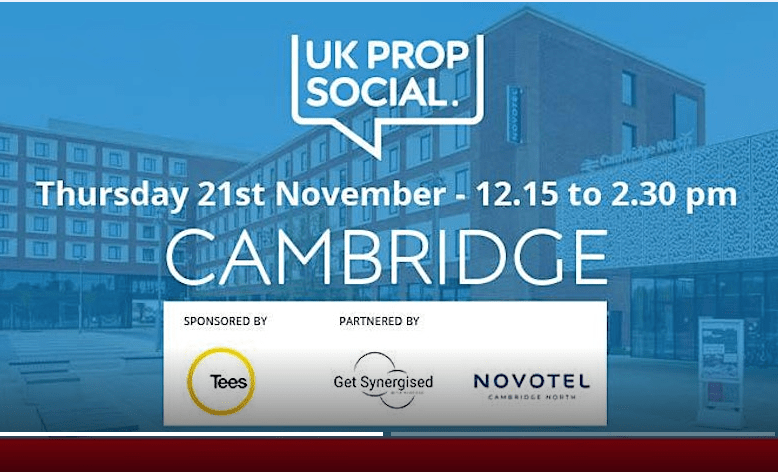
I’m familiar with several of the people who are going to this event so have signed up for it with my local residents’ forum hat on. (Which means I have to behave!)
You can sign up here – and I think it’s important that a critical mass of people who have both ‘lived through’ what Cambridge’s property sector has gotten wrong, as well as suggestions for what it could get right in the future, are there to engage with industry professionals. Not only that, we are seeing some positive case studies finally coming forward, such as the Cam Skate indoor skate park.
The change of government matters – not least because ministers have indicated they are prepared to intervene in the market far more than their predecessors
What this means is that firms will be expected to demonstrate wider social and community benefits than under previous planning regimes. What this actually looks like remains to be seen, but the general consensus in public policy land is that too many of the benefits are accruing with too few, and that this is not sustainable. Furthermore, the construction industry has lost the trust of the public following the exposures at the Grenfell Inquiry. The onus is on them to make positive moves to rebuild it. That doesn’t mean that community groups and charities should not roll over, but rather be willing to listen to them while at the same time putting some very difficult questions to industry on things like environmental sustainability, the water crisis, and the climate emergency – and in particular retrofitting. The final point on retrofitting matters because as the Cambridge Biomedical Campus highlighted, they are now having to retrofit community facilities and leisure facilities onto their site because the model they had previously worked towards – i.e an employment/work campus only, is no longer fit for purpose.
I’ve already done some local history work for the developers of the water works site being vacated by Anglian Water at Milton on the projected called Hartree – named by residents after Cambridge’s first woman mayor, Eva – whose centenary we celebrate this November. As I’ve mentioned to campaigners against the move to Honey Hill, that ultimately is a decision taken by central government. (See the news report on their case to the new Environment Secretary who will have to make the decision as a quasi-judicial function).
With that in mind, I’m particularly interested in what projects the sector can support that can stabilise the local history sector – as back in 2019 Cambridgeshire County Council was already complaining about the huge shortage of public exhibition space. I’m of the view that the Museum of Cambridge should be funded to expand onto the Castle Hill / Old Shire Hall site (as I called for back in 2018 here) to provide permanent exhibition space to complement what many of us still call the Folk Museum – noting that Enid Porter shaped that institution for much of the latter half of the 20th Century. I wouldn’t want to change anything of the old coach inn that the current museum is on. But I think the institution needs and deserves the support of town, gown, and commerce to be housed in facilities, and financially supported in the long term to tell the story of our city – warts and all.
There are already projects up and running that combine local history and redevelopment – which also incorporate historical lessons learnt, such as The Kite
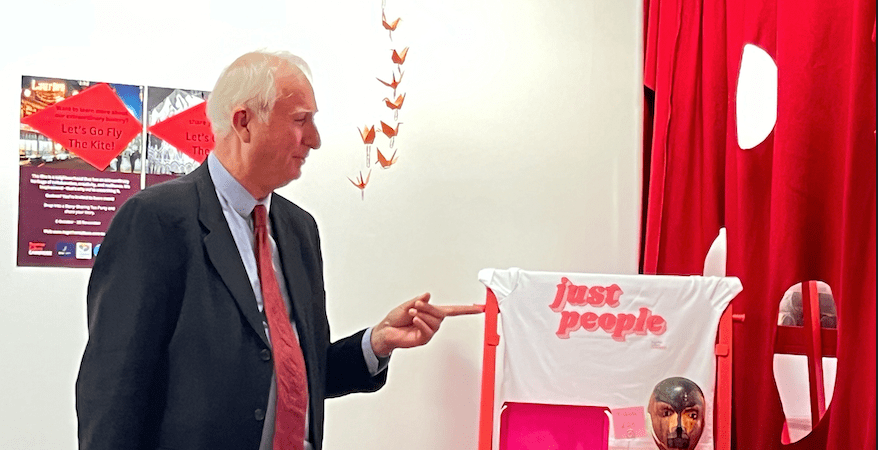
Above – Let’s Go Fly The Kite with Together Culture – Cambridge MP Daniel Zeichner at the launch event
The event is also a chance for community groups and local charities to tell industry professionals with access to policy makers in Whitehall the sorts of improvements Cambridge needs regarding local government
It speaks much more powerfully if different communities and sectors have a consistent and united message to give to central government. As things stand, local government is unable to undertake its basic functions – and things are about to get even worse if nothing changes. We know that Cambridge City Council’s budget outlook is grim – councillors confirming in early October 2024 to expect more cuts to fill an £11m funding gap.
What does that mean for private sector businesses wanting to ‘do the right thing’? It means:
- little council officer capacity to guide both businesses and community groups through the inevitable paperwork required by law to get projects off of the ground
- an over-reliance on unpaid volunteers to undertake routine day-to-day tasks that really should be done by paid staff, such as staffing a community centre
- a lack of corporate memory in a city that has a high population turnover as it is – but how do you put a £value on civic memory and institutional history?
- firms engaging with those areas that have the best networks or those that are most effective at fund-raising, which means resources don’t always go to the places in most need
- it’s harder for individuals within firms that want to make a long term commitment to our city (perhaps because their children are starting school here) to find out the causes they are most interested in
Hence my repeated calls for an overhaul on what revenues local government can raise through a much wider tax base. (The previous Parliament concluded local council finances are unsustainable without radical reform – and that was in 2021, so this is not a local issue)
Could multiple firms get together to push for one much-needed facility – a new lifelong learning centre for adults
I wrote about a couple of case studies back in August 2024 and am of the view that a new large college should be one of three or four anchor institutions that could form a much-needed second urban centre away from the colleges and tourists. (See my blogpost here). Essentially we already have the model on how to do this – 99 years ago Dorothy Enright of the old Cambridge Technical College and School of Arts showed us how, by working with the major employers of the town to design a new generation of courses to train up their staff. I still think the prospectus that followed 30 years later is inspired by combining the vocational with the civic. The problem at the moment is we don’t have an institution that functions like that – the old CCAT which became Anglia Polytechnic and later Anglia Ruskin University (and hiving off its lower tier courses to Cambridge Regional College) having long since switched focus away from lifelong learning.
Creating places where people want to be – not just places to work or be trained at
One of the things that struck some of the business sector visitors to the new Indoor Skate Park on the corner of Henley Road and Coldham’s Lane was that this was a place that people simply wanted ‘to be’ at. The ethos stood in stark contrast to the corporate leisure parks that we’ve become familiar with – privatised public spaces where you are expected to pay or buy something or be suspected of loitering. Hence the Cambridge Playlaws Project funded by Section 106 Money on one very such space.
Above – outside The Junction on Cambridge Leisure Park: ‘Loiter Well’
Also, don’t think the children don’t notice the huge inequalities in our city. They do.
“Some families can’t afford to pay to do fun things in Cambridge and that’s not fair”
Without prompting, one primary-school-aged participant at a previous Playlaws event in 2023 overheard her mum and myself talking about the provision of activities for children and young people – in particular those on low incomes, and spoke out. Furthermore, their generation is not looking towards charity or ‘big society’ to sort things out. We tried that in the 2010s and look where it got us. Furthermore, the public policy direction from the new government is about using politics to do good.
Can firms and employers ensure that their staff know the essentials of how their towns and cities function in order to engage in decisions on their future?
Recall the Armed Forces Covenant which is still in place. What would a civic society one be like that encouraged people to take part in council meetings, public consultations, and even standing for election? Several of Cambridge’s biggest names in local history ran their own well-known businesses. Harold and Cyril Ridgeon, and Kelsey Kerridge to name a handful prominent in the building trade.

Above – built like a giant oak tree (he represented the county at 11 different sports) and with a sports centre named after him: Alderman Kelsey Kerridge who fundraised for the sports centre that bears his name.
There’s also Sir David Robinson who by the time of his death had given away an estimated 95% of his fortune, for which Cambridge has the Rosie Hospital, Robinson College, and the Robinson Theatre at Hills Road Sixth Form College funded by him.

Above – Sir David Robinson – an example to Cambridge businesses everywhere
Sir David’s father, Herbert Robinson was a councillor on Cambridge Borough Council – and was also my late Uncle James’ grandfather. (James married my mother’s late sister Jennifer).
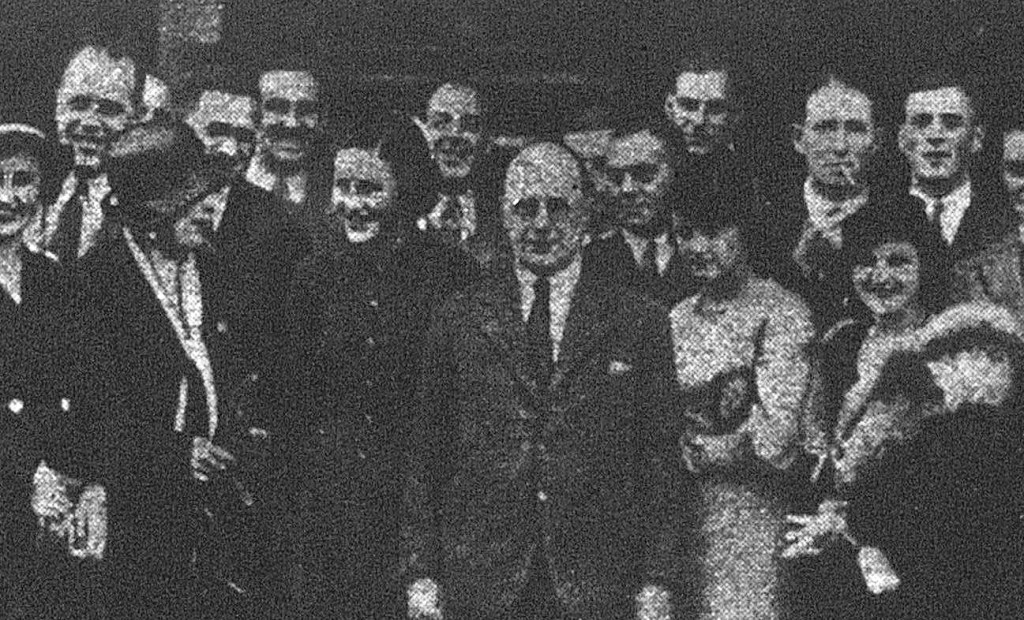
Above – the Cambridge Chronicle 30 Sept 1933 from the Cambridgeshire Collection – detail of Herbert Robinson at the front outside what is now Mandela House, and standing behind him by his left shoulder looks like a young Rosemary – James’s mother, who I met in the mid-late 1980s.
So it’s not just about the money for new facilities and new activities for those that have little in our divided and polarised city, it is also about participating in our local democracy and making the structures and systems work for the people who make up our city – residents and commuters, town, gown and regular visitors too. Because at present very little seems to be functioning well. Overhauling it involves all of us.
Food for thought?
If you are interested in the longer term future of Cambridge, and on what happens at the local democracy meetings where decisions are made, feel free to:
- Follow me on BSky <- A critical mass of public policy people seem to have moved here
- Like my Facebook page
- Consider a small donation to help fund my continued research and reporting on local democracy in and around Cambridge.
Below – have you read the proposed shared ambition from the Combined Authority?
 The Cambridge Town Owl