
According to the timetable it was due to be published by 30th September – but I guess the general election got in the way.
“Two blogposts in a row?”
Yes – and as for the image, I’m convinced that a light rail such as Cambridge Connect propose, is key to having a workable destination management plan and tourism strategy. As mentioned on social media earlier, I was groggy all day but now my brain is functioning even though it’s 11.20pm. I’ve also got this new soothing background music fad on rather than politics on TV which goes from tragedy to farce – or is it the other way around?
The original consultation was here
I can’t recall if I responded to the consultation or not, let alone remember what the questions were. This was around the time the general election was called so I may have been distracted.
“We want your thoughts on how the visitor economy contributes to the health and wellbeing of the city and its residents, as well as the areas you feel should be prioritised in the DMP.”
But then I’m of the view that local government in England does not have the powers to harness the wealth and revenue brought in by tourism to benefit the health and wellbeing of the city and its residents – which is why the industry is out of control.
It’s also worth noting who the ‘partners’ are – as well as the transport authorities being conspicuous by their absence.
“Cambridge City Council is working in partnership with:
- South Cambridgeshire District Council and
- Visit Cambridge partners:
- Cambridge BID,
- King’s College and
- Curating Cambridge
….to develop a new Destination Management Plan (DMP) for Greater Cambridge.“
“Who are Curating Cambridge? I never voted for them!”
“Curating Cambridge Ltd, formerly Fitzwilliam Museum (Enterprises) Ltd, is a
wholly owned subsidiary of the University of Cambridge.“
One of Cambridge University’s commercial arms – linked mainly to its museums, galleries, and the Botanic Gardens.
“Excruciating that the county council and combined authority are not on the list given how essential transport is”
That comes back down to the case for a unitary council as all of this would be incorporated into a single institution and staff could walk down the corridor to grab hold of whoever was responsible to get them on board.
““It will be seen that it would not be in the interest even of economy for the varied work of a local governing council to be done in hired offices in a hole-and-corner way. The council, though itself unpaid, has to employ many officers, clerks etc who require space for their work. For financial reasons alone a central building is more economical, for the rents paid for the offices would in the long run cost more than a town hall. Moreover, it is convenient, and indeed essential, for the various departments of the work – the sewerage, the highways department, etc – to be in close touch with one another.”
Above – Maria Matilda Penstone (1910) Town Study
But hey, what do the olden days people know?
“That reminds me – what happened to the tourist tax?“
I wrote about it back in 2023 here – and it was ultimately rejected back in July 2024 because of the lack of provision for taxing Air BnB properties – something that ministers need to get a grip on re the inconsistencies. Again, councils need greater powers and greater funding to ensure the playing field is levelled and that local communities don’t lose out on family homes that end up being cash cows for a wealthy few. Note tourist taxes have been debated before – in the 1970s and 1990s. I can’t see the situation being resolved unless/until Cambridge Connect light rail is built at which point tourist coaches can be kept out of town (people paying for all-day tourist tickets that function as a tourist tax), at which point you can also bring in a congestion charge alongside a network of pooled mini-e-cars that will do far less damage to the roads.
Tourism and the emerging Greater Cambridge Local Plan
I don’t know how many of you picked up on this, but Q30 of the initial consultation asked:
What approach should the next plan take to supporting or managing tourism in Cambridge and the rural area?
You can read the 68 responses here. The problem I have is that the main solution I propose is not one that falls within the town planning system; rather it involves transport planning and that’s within the gift of the Combined Authority. Again, a fragmented local governance structure makes things much harder and more time consuming. There’s a Ph.D thesis waiting for someone to analyse why Tony Blair’s government separated development planning from transport planning, and whether that approach has been successful or not.
Savills for St John’s College, Cambridge stated the following:
“As a College on the Backs, St John’s College would seek to ensure that the Local Plan makes adequate provision for transport to and from the City centre of the growing numbers of visitors, including regulation of coach movements and parking. Furthermore, active management of the tourist population is likely to be required in years to come to retain the attractive nature of the City Centre as a place to live, work and visit.
“This could include mandatory licensing and regulation of tour guides, clear and co-ordinated signposting of key sites, support to city centre locations in effective tourist management and provision of basic facilities that reflect the needs of the numbers arriving.
“Balancing maintaining the safety and attractiveness of the city centre with the needs of businesses and Colleges operating there will need to be a continued policy theme within the Local Plan. Issues such as the location, nature and management of street barriers (rising or otherwise) are likely to be an on-going source of debate.”
Above – GCSP Q30 p1 (scroll to foot of page)
The University of Cambridge simply pointed to Visit Cambridge and the proposed Destination Management Plan, saying the local plan should be consistent with it.
The South Newnham Neighbourhood Forum picked up on similar issues I have.
“Transport is a key issue here, and outside the remit of the Local Plan. The huge increase in tourism in recent years puts enormous pressure on capacity and resources in a small historic town like Cambridge. Airbnb is an increasing problem in residential areas, and the many new hotels and tourist apartments are prolific users of water, which is now recognised as being in short supply in this region. They also take city centre space that could be used for sustainable housing for local people and have a negative impact on community cohesion.”
Above – GCSP Q30 p2 (scroll to half way down the page)
The RSPB also picked up on public transport serving a much wider area:
“We believe that the guided busway stop and cycle path near the RSPB Fen Drayton reserve is a good example of how local authorities can help support tourism (and access to green space) in the rural areas of Greater Cambridge. We therefore believe the plan should ensure that new public transport infrastructure in the plan area further improves access to nature reserves which service tourists from both within, and outside the area. Greater Cambridge also has the opportunity to deliver a major programme of landscape-scale habitat creation.”
Above – GCSP Q30 p2 (scroll to half way down the page)
Incorporated into a wider light rail network for southern Cambridgeshire, an RSPB stop on a wider map would be publicity in itself and not necessarily require changes of modes or lines.
Cambridge Past, Present and Future highlight the growing population pressures on existing local attractions in what is a more extended response
“Most “tourists” visiting attractions in rural Greater Cambridge will be local people – for example, Wandlebury Country Park has over 60,000 visitors per year almost all drawn from within Greater Cambridge. Rural attractions include places such as
- Wandlebury,
- Wimpole Estate,
- Wicken Fen,
- Anglesey Abbey,
- Denny Abbey and
- Fen Drayton Lakes.
All of these locations are experiencing visitor pressure caused by a rapidly increasing local population, rather than tourists from further afield. Most of these attractions provide quality-of-life benefits to local people. If the Greater Cambridge population continues to grow, then new visitor attractions will need to be created or existing attractions expanded.”
Above – GCSP Q30 p2 (scroll just over half way down the page)
Hence my preference for a Cambridge Great Park incorporating Wandlebury and the Gogs
Interestingly, the Marshalls Group stated:
“Cambridge city centre is currently constrained and there are limitations to the growth of the city in all directions, except to the east. The CPIER recognises that the scale of Cambridge East offers significant scope for housing and commercial development and would allow for the delivery of cultural and sports uses of sub-regional importance. The site offers the potential for a step change in Cambridge’s current cultural offering, with the potential to deliver a refreshed night-time economy, new meanwhile uses, iconic public realm, significant cultural anchors in the east of the city and more. These cultural and sports uses would support tourism in Cambridge whilst still having the advantage of being close to the city centre.”
The airport site matches my vision for a new urban centre
Duxford Imperial War Museum
The huge volumes of visitors for their special events is a huge issue.
“The relatively rural location of IWM Duxford (next to the A505 / M11 junction) means that 96% of visitors arrive by car. This means a high carbon footprint and large area for car parking which could otherwise be landscaped. 2.34 If this is to change, there needs to be support for better links to transport hubs and routes”
Again, this is something for a long term transport solution. Here’s one I made earlier that would have extended the Rail Haverhill proposal down to Saffron Walden and back up through the Wellcome Genome Campus, Duxford IWM, and back via the Cambridge Biomedical Campus.
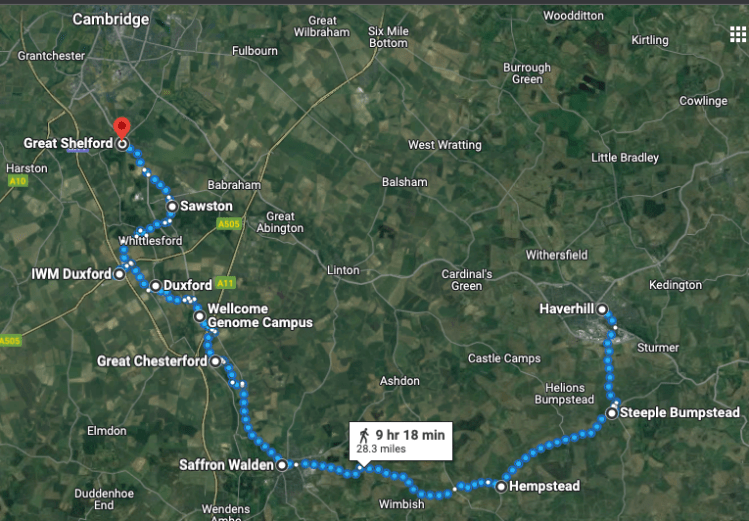
Above – CTO 16 May 2023 – on making a unitary council work for surrounding market towns and villages.
Nice as I think some of the ideas are, our current structure of local government simply does not allow for these to come about. Hence why I think the system needs an overhaul.
Food for thought?
If you are interested in the longer term future of Cambridge, and on what happens at the local democracy meetings where decisions are made, feel free to:
- Follow me on BSky <- A critical mass of public policy people seem to have moved here
- Like my Facebook page
- Consider a small donation to help fund my continued research and reporting on local democracy in and around Cambridge.
Below – the Cambs Unitaries Campaign – do get involved!

 The Cambridge Town Owl