
…mindful that they were imagining a Cambridge in 2065…
Former councillor Sam Davies MBE (now of pastures new) reminded me of the Cambridge 2065 document here. And one particular quotation via this exchange which I’ve highlighted below.

Above – Cambridge 2065 (2014) p40
What makes that quotation from Prof Jeremy Sanders interesting is that when he wrote it he was about to become a member of the Greater Cambridge Partnership Board – and in January 2015 I put this question to him. I can’t say that I’ve been impressed by the actions of the institutions as corporate entities in the decade that has passed – the failure to build the West Cambridge Swimming Pool despite it being a requirement of the planning permission granted for Eddington along with the lobbying that enabled it to avoid having to build council housing (to the fury of Cambridge City Council councillors) shows that the chasm between town and gown in some parts of the latter is as wide as it has ever been minus the physical violence. (See Rowland Parker’s epic for the gory details).
The other thing that stands out with that quotation is that every university on the planet has road-tested the concept of remote teaching.
I’m not going to pretend that Prof Sanders was envisaging a dystopian higher education experience that was a cross between Charlie Brooker’s ‘Black Mirror’ and a requirement to stay in your room. It’s easy to forget how afraid and vulnerable we all were on finding out just how deadly the virus was (and still is) at a time when there was no cure and was no vaccine. At the same time, it reminds us that going to university is about far, far more than the academic learning for which institutions bestow degrees on those that meet the academic (and other) requirements of their courses.
The paragraph that follows though is one that left such a strong impression that people still recall it a decade later.
“Top people from around the world will still want to gather together to meet and discuss their research and ideas. The University’s unique selling point — its USP — will be its convening power, bringing key individuals to Cambridge to experience personal interactions and chemistry despite the large carbon, cost of international travel in an energy-deprived world. At every level, from undergraduate via graduate student, postdoc and sabbatical professor to top executive and world leader, Cambridge will be one of the key venues to come and be seen, and to rub shoulders with the global intellectual elite. If it sounds like an exclusive conference venue, then that may be about right.”
Sanders, J (2014) in Cambridge 2065, p48
Ten years later, how does that read? Not just from a moral standpoint but also given what’s happening in the world right now with:
- Hurricanes Helene and Milton having left a trail of destruction across Florida
- The cost of living crisis – in particular the winter fuel allowance furore
To what extent are the inequalities that the author seems to take for-granted in those sentences, sustainable socially and politically? Furthermore, given some of the rapid advances in renewables, will the fair and equitable distribution of electricity generated from such sources also become an issue in itself?
“Global intellectual elite” – conspiracy theories have been created with less
This for me gets to one of the core tensions of a city like Cambridge. In his piece you get the sense Prof Sanders’ vision for Cambridge is one that is a very exclusive one.

“In addition to the intellectuals and leaders, the University will employ cleaners, catering and other service staff, many of them living in affordable housing owned and provided by the university.”
Sanders, J (2014) in Cambridge 2065, p40
Which makes it sound like some within the University of Cambridge’s upper echelons see us town people as little more than a servant class for an intellectual aristocracy, the lucky few of the former being provided with their university-standard minimalist accommodation in that enclave of Eddington.
Former Vice Chancellor Sir Ivor Jennings would have been furious at such a vision

““We regard Cambridge as part of our inheritance as members of the University. It is our duty to pass it on to our successors improved and not impoverished. It will not be unchanged, because every generation has to build and rebuild.
“This second aim has no direct advantage to the University, and some people may question why we have included it in as a second aim. We do so to give a recognition to the fact that Cambridge is more than a University, it is a City in its own right, and its significance as a regional centre has grown and will continue to grow.
Sir Ivor Jennings in the Cambridge Daily News 01 June 1962 in the Cambridgeshire Collection
“Cambridge is more than a University, it is a City in its own right”
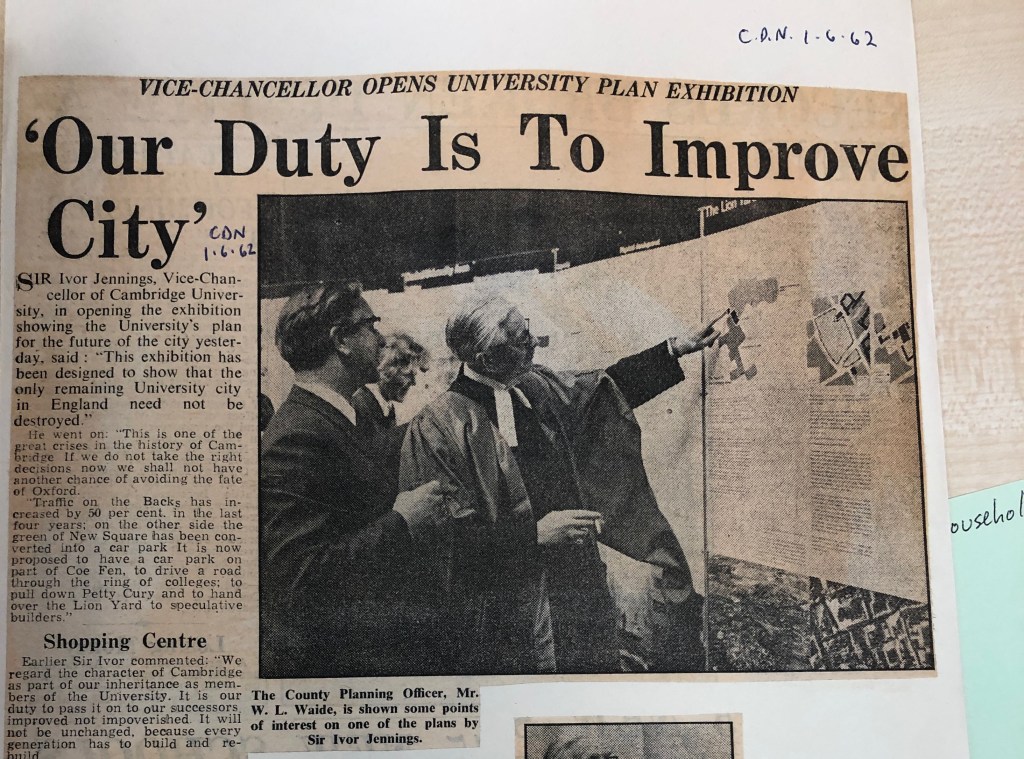
Above – Sir Ivor Jennings in the Cambridge Daily News 01 June 1962 via Mike Petty MBE/Cambs Collection
Influential decision-makers within the University of Cambridge would do well to remember the former Vice-Chancellor’s statement – something sadly not acknowledged (in my opinion) by one of Prof Sanders’ successors at the Academy of Urbanism Conference in 2023 when I put Sir Ivor’s words to him at the opening Cambridge Union event. As I noted at the time, the colleges and the University are separate entities when it suits, them, but also one and the same when it comes to big positive press releases. (Note a similar point applies to Parliament and The Government – think of the MPs’ expenses scandal or any other constitutional issue when a minister says ‘That’s for Parliament to decide’ – like there are no such things as whips.
“Is Prof Sanders’ perspective on the city a future vision, or a warning?”
“The polarisation already visible in 2015 between an intellectual and financial leadership and workers who provide manual services will continue to grow. Service workers will mainly live further out, commuting into Cambridge via fast mass transit from hubs such as Wisbech, Alconbury or Haverhill, although many of the University’s lowest-paid staff will be living nearby in affordable housing that it owns.”
“They will be providing service to the intellectuals and leaders in business and the University, and also servicing the world-wide tourist trade who come to look at the traditional colleges as living history. However, most of the technicians, secretaries, accountants, taxi and bus drivers and other mid-level support staff will have gone, replaced by machines with artificial intelligence at levels we can barely begin to predict.”
Sanders, J (2014) in Cambridge 2065, p41
The power relationships in the piece are striking – and expose one of the biggest tensions that our city faces
Are we to become an inclusive city or an exclusive city?
This was the question I asked in this earlier blogpost. In the vision that Prof Sanders outlined in 2014 I get the sense he’s writing about a vision of an exclusive city. That does not sit easily with the party in power since 2014 – Cambridge Labour Party, whose vision is One City Fair For All.
That then brings us to the issue of democratic accountability.
How do you ensure that the students, researchers, and academics within universities have the intellectual freedom of academia while at the same time ensuring that the institutions don’t become oppressive forces in themselves, overriding the democratic will of the people? Hence my question back in 2015 to Prof Sanders at the then City Deal Board (chaired by Lewis Herbert, then Leader of Cambridge City Council and also one of my local ward councillors) about the University of Cambridge’s civic responsibilities to the people of our city regarding the former’s future investment decisions that affect us all.
“Do all of the writers have exactly the same opinions as they did back in 2014?”
Only if they were frozen in suspended animation and missed out on the past decades-worth of events in the world. Of course not – we live and learn. It’s what we do. And predicting the future – especially the long term future, is a very difficult thing to do accurately. I tried it in September 2017 and by December 2019 the whole scenario had imploded with the result of the general election.
The stage that we’re at now as a city, county, and economic sub-region is one where we have to start drawing things on maps and designating plots of land for specific shared functions.
I wrote about this in a blogpost about a second urban centre on the Cambridge Airport site, similar to what Prof John Parry Lewis proposed in his eastern option in 1974. (See the fun and games he had with local government half a century ago here)
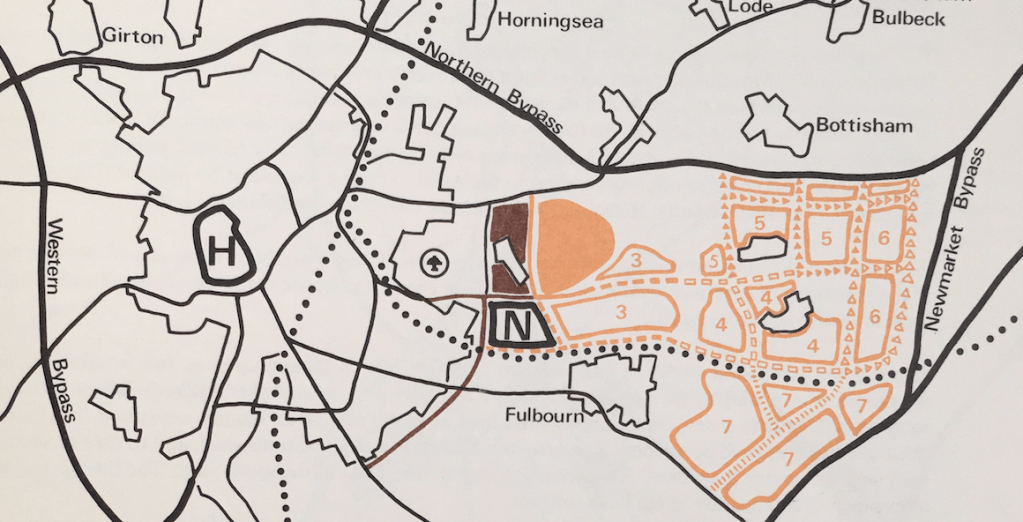
Above – John Parry Lewis (1974) Cambridge Sub-Regional Plan Vol 1, p71
I have got to the stage where I’ve assumed the University of Cambridge *as an institution* is going to be a blocker in the short-medium term so best to build a new urban centre away from its colleges and buildings and start afresh around some new long term anchor civic institutions, including a new City Hall for an empowered municipal council.
“It is a moral advantage for the town hall to be such as every citizen can look at with admiration and satisfaction. It is everyone’s hall; it is the home of the “city fathers” – the guardians of the good town. If a poor citizen can speak with pride of “our town hall” this alone shows that it has an uplifting influence in his life which is morally valuable. To build a stately and magnificent town hall is not a waste of public money.”
Above – M.M. Penstone (1910) Town Study in Lost Cambridge 06 Oct 2024.
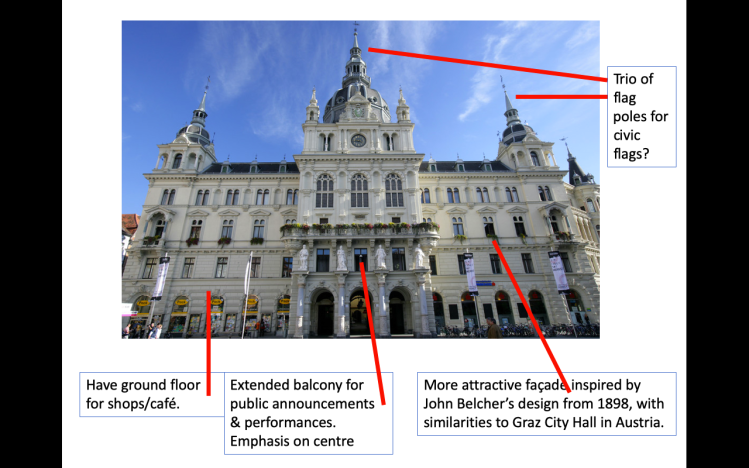
Above – My vision for a new city hall for Cambridge is inspired by Graz City Hall in Austria
As I mentioned in my call for a second urban centre, I identified the southern end of the Cambridge Airport site as a place for a new civic square served by the existing Cambridge-Newmarket Railway Line to create a grand station entrance and travel hub that spills out onto the square with a grand city hall on the opposite side. To the west is a new lifelong learning college that at the back spills out onto Coldham’s Common, and to the east is a new concert hall that spills out onto what can become a new mixed retail and entertainment quarter away from the University of Cambridge’s colleges and also residential areas. Interestingly, the Cambridge & Peterborough Independent Economic Review of 2018 spotted this observation from Marshall’s Airport:
“Cambridge city centre is currently constrained and there are limitations to the growth of the city in all directions, except to the east. The CPIER recognises that the scale of Cambridge East offers significant scope for housing and commercial development and would allow for the delivery of cultural and sports uses of sub-regional importance.
Above – the Marshall Group to GCSP Q30 p2 – Emerging Local Plan 2031-40 Consultation
One of the things that regularly comes up at discussions I have with people at Together Culture in Cambridge (do pop in – it’s on Fitzroy Street opposite Waitrose) is the need for Cambridge to invest in facilities that reflect its status as a regional centre. With a population likely to be closer to 200,000 by 2040 (assuming we’ve not been zapped in a climate catastrophe) we will need those things that similar sized cities have – accounting also for the tourism trade that wants to see the ancient colleges. Ironically the other place where such conversations will also be taking place from November 2024 is the Cambridge Room – a project sponsored by Cambridge University’s Department for Architecture. (Do sign up to their email newsletter too)
See you in a future discussion some time?
If you are interested in the longer term future of Cambridge, and on what happens at the local democracy meetings where decisions are made, feel free to:
- Follow me on BSky <- A critical mass of public policy people seem to have moved here
- Like my Facebook page
- Consider a small donation to help fund my continued research and reporting on local democracy in and around Cambridge.
 The Cambridge Town Owl