Fortunately I wasn’t the only person who provided feedback to the Cambridge Civic Quarter proposals. Because if my ideas were adopted without anyone making any improvements, the laws of unintended consequences would have a field day!
TL/DR? See https://cambridgecivicquarter.co.uk/
Above – Waterford Whispers on crazy old dude who reads planning applications
The consultation analysis – what did the people say?
You can see the press release here. To summarise it further:
- Make Market Square safer, more accessible, and decide on permanent or movable street stalls
- Make the Corn Exchange a better venue (Esp acoustics) inside than it currently is (but not at the expense of its historical character)
- Diversify what can be hosted by the guildhall
Cambridge City Council states:
“A report that sets out the concept design proposals for the Corn Exchange, Guildhall, Market Square and surrounding public spaces will be published ahead of the council’s Strategy and Resources Scrutiny Committee in November.”
Above – from https://cambridgecivicquarter.co.uk/
“How did we get to here?”
See the following:
- Jan 2024: Cambridge Civic Quarter – make or break for Cambridge City Council
- Feb 2024: How can Cambridge call for the creation of one civic quarter while another civic quarter is sold off?
- May 2024: Cambridge Civic Quarter launches
“How many people participated/engaged?”
This many
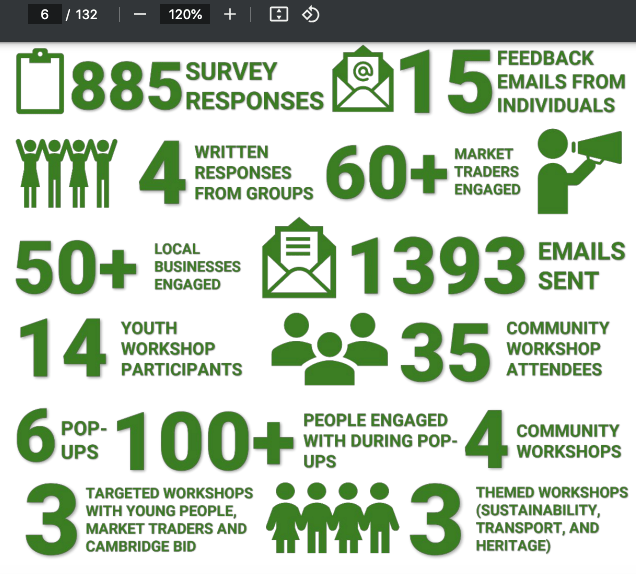
Above – p6 of the feedback report
Creating something in time for Florence Ada Keynes’ centenary as Mayor of Cambridge
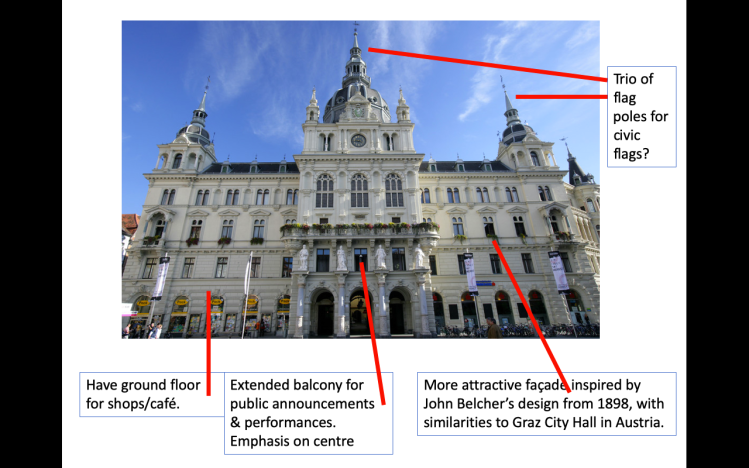
Above – inspiration from Graz City Hall in Austria (which I visited back in the mid-2000s) that provide for a nice template of what a revamped guildhall front could be like – simply built in front of the existing frontage.
The one big barrier to all of this is the lack of a coherent vision for the future of local government
…whether in Cambridge, Cambridgeshire, and whatever region/sub-region we’re meant to be in
We know that Cambridge City Council’s budget outlook is grim – councillors confirming in early October 2024 to expect more cuts to fill an £11m funding gap. Yet at the same time ministers expect more growth – one that will inevitably increase the pressures on council budgets. As Cllr Dr Dave Baigent (Labour – Romsey) told the Leader of Cambridge City Council, Cllr Mike Davey (Labour – Petersfield), something’s got to give. (See the video exchange here – Cllr Davey has confirmed this is continually raised with ministers and civil servants).
“Is this city actually talking to Government to fill the [£11million budget] gap?”
Above – Cllr Dave Baigent to Cllr Mike Davey, Cambridge City Council S&R Committee Mon 30 Sept 2024
“So…what is the future vision for Cambridge – gap or no gap?”
That’s part of the problem – we have to wait and see what ministers have planned for us. Once that’s clear, then we can start picking out the things that will be conditional to that vision. For example a ‘big growth vision’ will require new, secure water resources – lest the taps in the gleaming new science labs run dry.
Another issue is local governance structure. A system and structure of governance for a county town with the population of 100,000 people as formed in 1974 by Sir Edward Health’s Government cannot be suitable for a city with double that number of residents, eight times the number of tourists, and far greater numbers of commuters using the city as a regional centre.
What Cambridge City Council said about a second urban centre
I followed this up with a written public question to full council – I was going to speak in person but after seeing another nine PQs lined up, I asked for mine to be pulled as there’s only half an hour for PQs at each meeting. It linked to this blogpost and asked if the council had got to the stage of designating which bits of land were needed for future public services, and also potentially a second urban centre.
Cllr Katie Thornburrow (Labour – Petersfield) responded
What an excellent question, that goes to the heart of the long term planning process we’re currently undertaking as we develop the new Joint Local Development Plan for the City and South Cambridgeshire. And, as you may know the Councils have already recognized the role that the Cambridge Airport site could play in the future of the City having safeguarded the site for future development in the 2018 Local Plans and now, in the First Proposals, made a proposed allocation for a new District in the City to be created.
However, the world has changed since the 1970’s, [A hat-tip to John Parry Lewis’s controverial study of the Cambridge sub-region recommending Cambridge expand to 200,000 people by the year 2000] when home working probably meant piece work in the textile industry and home deliveries were limited to milk and Davenports beer. Rather than thinking about a second urban centre, we are moving to what is called a ‘polycentric’ or multi-nodal model with a variety of key districts that have different characteristics, overlapping and connected with a well-developed transport infrastructure.
Although this model is normally applied to large cities, we can see how it might work in Cambridge too. As we look at the development of Marshall’s ,the Shared Planning Service is already seeking to understand its potential to accommodate homes and jobs, along with the services and facilities that support the internalizing of trips to avoid putting unnecessary pressure on the road network, one of the ways to ensure the district can be successful in its own right
This is not simple. As we continue to explore these issues in the local plan process, we know we need to understand what this means for future infrastructure, particularly for leisure. We are continuing to gather evidence on provision of cultural infrastructure that will, we hope, inform our conversation with communities on these issues as we progress the Local Plan process through the next couple of years. In the meantime, thank you for your question.
This reminds me of the choice Cambridge faced in the late 1990s.

Above – from Lost Cambridge – The ghost of Cambridge Futures past – 1997-2003
The options Cambridge faced were a presented as an ‘either-or’ choice at the time, but the reality has been (bar the first one) a little bit of each.
Note “…we are moving to what is called a ‘polycentric’ or multi-nodal model with a variety of key districts that have different characteristics, overlapping and connected with a well-developed transport infrastructure.”
Now compare it to what geography teacher Rob Gamesby wrote on his guide about post-modern cities at https://www.coolgeography.co.uk/advanced/New_urban_landscapes.php
“Features and Characteristics of post-modern Western Cities: [include] Urban Structure – High Tech Corridors and post suburban developments such as edge cities. They also have a multi-nodal structure which is chaotic.“
Is what Cllr Thornburrow describing in her quotation an observation or a policy choice? To what extent does the law empower local councils to make any meaningful choice given how tightly defined and controlled development planning is in law and national policy? Remember how local government in Cambridge has very few powers to control the numbers of tourists – something that made for a mini-hit piece in a couple of ReachPLC publications. There is a story to be researched and written up, but that ain’t it. Not that the corporation concerned is interested in quality of content when their target is for each reporter to produce eight pieces of content per day.
My case for a second urban centre is based on the reality that is Cambridge’s function as a regional centre for residents in surrounding towns and villages
Hence Rob Cowan’s book on essentials of urban design – which I wrote about here, is recommended reading. A multi-nodal city aimed at minimising car-based internal trip generation is all well and good, but it won’t deal with the growing expectations that people will have for a city that is no longer that compact ‘University City’ that we’d like to think it is. It has been a victim of its own success – as well as a victim of other competitor cities with great universities not standing still. Perhaps that was the choice: Keep Cambridge as it was physically, and turn it into a cross between a living museum and a theme park for tourists within fixed boundaries, or remove the Holford-Wright-era restrictions and let the city grow. Either way, the governance structures have not kept up.
The lifelong learning centre and large concert hall as regional facilities and anchor institutions
We’re beyond the stage of being able to locate the latter in the city centre as former Cambridge University Vice Chancellor Sir Ivor Jennings called for back in 1962. Hence suggesting having the two proposed institutions as being anchor institutions to build independent retail and a night life quarter nearby on the Marshall’s Airport Site – away from university colleges and residential areas alike. [You could even relocate the police station to that area to march misbehaving thugs into the cells for the night, and locate the courts there so they can be hauled before magistrates in the morning!]
On a more serious point, ministers so far have not demonstrated any positive vision for local government. This is reflected in the talk of continued budget cuts and no additional means for councils to raise money – especially in areas that need taxation powers to release the pressure caused by bubbles such as the property bubble in Cambridge. The proposals for old Shire Hall and the Guildhall don’t make any provision for a buzzing local government sector. That so many key decisions from transport to public health are taken in places like Huntingdon and Alconbury make statements about Cambridge being ‘The World’s Greatest Small City’ sound embarrassing.
All that those who promote such slogans are doing is revealing their sectors’ collective ignorance of the state of local government in and around our city. (Along with the desire of those same sectors to make more money out of ‘brand Cambridge’). We are not nearly as good as those slogans say we are, and we are not nearly as great as we could become. And that greatness won’t come by reaching out ahead of everyone else (or what we believe to be the competition), but instead it will come from raising up those around us [especially geographically] that are struggling. That is what great cities should be doing. Cambridge isn’t doing that. Yet.
Food for thought?
If you are interested in the longer term future of Cambridge, and on what happens at the local democracy meetings where decisions are made, feel free to:
- Follow me on BSky <- A critical mass of public policy people seem to have moved here
- Like my Facebook page
- Consider a small donation to help fund my continued research and reporting on local democracy in and around Cambridge.
Below – bedtime reading: Scenario planning for the future of the UK’s towns and cities (2024)

 The Cambridge Town Owl