Those working full-time on climate campaigning in public policy circles now need to start turning solid policies into draft legislation for very specific issues and industries
This is one of the reasons why I go on about Citizenship Education. Anyone with the most basic understanding of law and politics would have read the first clause would have spotted a major issue.
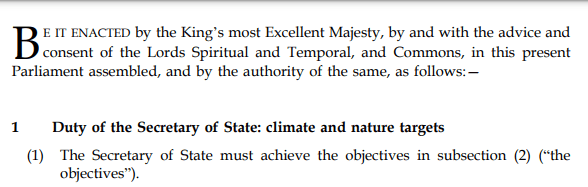
Above – Climate and Nature Bill (from the previous Parliament – re-introduced today)
There is *nothing* in the draft legislation that indicates what happens in the case of non-compliance.
Therefore as it stands, it’s meaningless.
Note this is not the sort of legislation that would create criminal offences. It’s a piece of proposed public administrative law that sets out what institutions should be doing. In this case, the office holder that is the Secretary of State responsible for Climate Change issues (in our case currently Ed Miliband – who held a similar role in Gordon Brown’s Government so is more than familiar with the issues) is the one with the new duties imposed on them.
Those duties on their own don’t amount up to much:
- Direct civil servants to draft a strategy that the Secretary of State must sign off and present to Parliament within a specific time period
- For that strategy to have certain contents within them
- For that strategy to have specific aims and objectives
- Establish a climate assembly
- Work with other named bodies, groups, and devolved legislatures
Additionally, there’s the standard clause about expenditure on achieving the aims coming from the public purse, and for the strategy to be put to an affirmative vote in Parliament.
That’s not the sort of legislation that will have big polluters or those with high personal environmental footprints (celebrities and businesspeople with private jets/yachts etc) too concerned. Furthermore, it’s a backbench members’ bill so unless the Government chooses to give it parliamentary time, it won’t proceed.
Much of what is in the Bill can be achieved through policy statements rather than changes in the law
This is often the case with Private Members Bills. If your only tool is a mallett then there’s little else you can do except to thwack stuff with it. Part of the learning curve – especially for the recently-elected MPs is to learn all the means and ways of influencing public policy that do not involve tabling new legislation.
But then Parliament is performative theatre as much as anything else. Introducing a bill into Parliament (First Reading) is an example of this. Here’s Ros Savage re-introducing the Climate and Nature Bill into Parliament for its First Reading – which as it was unopposed means that Parliament has authorised the publication of the draft Bill, and has also confirmed the Second Reading (Where MPs debate whether they accept the principles of the draft legislation) set for Friday 24th January 2025. Describing it as ‘performative theatre’ is not to demean the process. It serves a very important function of transparency of decision-making. The public can see the draft legislation being introduced. If they wanted to, the whole thing could be done by email.
In terms of the contents of the Climate and Nature Bill, if the Energy Secretary or the Prime Minister wanted to, they could simply make an oral statement to the House of Commons stating that the Government would adopt the demands contained within the Bill as Government Policy and would update the House accordingly on how things were progressing.
That campaigners have felt the need to turn it into legislation reflects both the failures of previous parliaments and governments to take the climate emergency seriously, and also the lack of trust in the institutions that they will either deliver on what they promise, or come up with proposals that reflect the seriousness of the situation.
Note the big brand supporters and what they can do next

You can see the various charities, campaign groups, trade unions, and businesses that support the proposed legislation at https://www.zerohour.uk/supporters/
Several of the institutions in the link above are large enough to have their own full time public policy staff and paid lobbyists. It’s not just big business that have them – large charities have adopted similar tactics, hence why some of their chiefs have telephone number salaries. It means [on paper at least] they can attract influential people who might otherwise only work in the private sector to work for ‘good causes’ instead. Whether this is actually the case in real life (noting that to incentivise the rich you give them more pay and perks, while to incentivise the poor you do the opposite), is the subject for Ph.D theses in business schools everywhere.
Different groups can form alliances to draft new policies – and with them, proposed new legislation to underpin them.
For example teaching unions could get together with civic organisations to draft policies and legislation on establishing new community learning centres for people to learn about more sustainable ways of living, and educating people on how to make changes to the homes they live in to reduce things like wasteful fuel consumption.
Transport unions could get together with engineering organisations, transport campaign groups and passenger groups to draft policies and legislation on establishing new light rail networks powered by renewables
Not all policies and actions will need new laws behind them. Furthermore, some of the changes in law that are needed won’t necessarily be climate-related. Some of them might sound quite innocuous or niche issues – a new Local Government Finance Bill to give councils more powers to tax and penalise polluting activities is one example. One of the big challenges councils have is they are told they are responsible for reducing the carbon emissions within their areas.
But they have neither the legal powers nor resources to do so. Furthermore, local government has zero policy capacity (due to austerity) to make use of powers they do have – such as the Power of General Competence (S1 Localism Act 2011) – because trying to work out what things could be done using that power requires a specialist staffing unit within a council to research and report back on what can be done. If you are a local council struggling to meet your existing legal duties because of lack of resources, there is no way you’ll have the capacity to spare any staff to go off and do policy research irrespective of how beneficial it might be in the longer term.
Which is why things like reversing austerity in local government, and also reversing austerity in enforcement functions of those responsible for upholding environmental law (alongside the funding crisis in our courts) means that some of the actions needed to deal with the climate emergency can sound far-removed from the front line. (Who’d have thought the crisis in the criminal justice system might have a knock-on impact on the climate emergency and how polluting firms behave?)
So…let’s start seeing some specifics in different policy areas and have them brought together and thrashed out to ensure a properly co-ordinated and sequenced approach.
Food for thought?
If you are interested in the longer term future of Cambridge, and on what happens at the local democracy meetings where decisions are made, feel free to:
- Follow me on BSky <- A critical mass of public policy people seem to have moved here
- Like my Facebook page
- Consider a small donation to help fund my continued research and reporting on local democracy in and around Cambridge.
I have also written various previous articles that are climate-related including:
- Lauren MacDonald’s masterclass on how our political and economic systems are failing in the climate emergency
- Linking responses to the climate emergency & other big issues with adult education
- The [previous] Government’s slow piecemeal approach to the climate emergency isn’t working
- Why Cambridge’s climate resilience forums need democracy-in-action resources to go with them
- What is Town’s offer to Cambridge’s undergraduate students when it comes to community and climate action?
- Rhiannon Osborne [who has now moved onto new places] gives Cambridgeshire a much-needed Climate crisis masterclass
 The Cambridge Town Owl