
The GCP Assembly met on 16 October 2024 and as Mal Schofield, a former Conservator of the Cam highlighted, not only have the City Access issues not gone away, but a significant amount of time has passed, along which further changes to the city and to governments have happened. Have events overtaken the GCP?
See the meeting papers here – and scroll to the end for the public questions. Note the controversial points on the Waterbeach proposals too.
Take the Waterbeach Busway and the question from Cambridge Past, Present and Future
“When the option of bus lanes adjacent to the A10 was considered, the poor performing section was on the approach to the A14 roundabout. This is because of the delays caused by the traffic lights at the roundabout and queuing traffic.… [but now the scheme has changed significantly] Therefore, before you make a decision to proceed with building a £110m road through open countryside please explain why there has not been a reassessment of the bus lane option along the A10 to Butt Lane.”
The point being why not have a cheaper bus lane that ends in a diversion away from the bit that causes the congestion.

Above – from the slide presentation for agenda item 8 – Waterbeach busway.
Why build an expensive busway (thick red line) rather than a much less-expensive bus lanes along the existing A10 (pinky-beige to the right of it) when both routes could make use of the blue road (Butt way) which then connects to the existing guided busway and bridge under the A14?
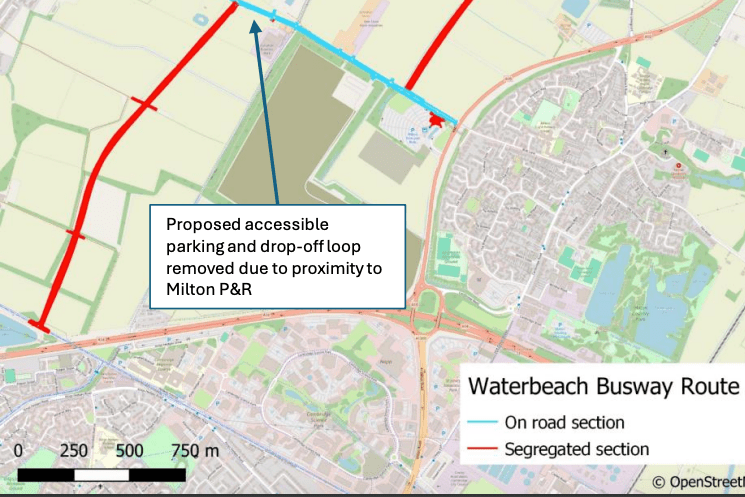
Above – note the bottom left where the thick red line ends – See GMaps here – that’s where the proposed Waterbeach Busway joins the existing Cambridge-St Ives Guided Busway.
But as you all know, there is a problem. A big problem.
***What happens to all of the busway buses when they hit the city centre?***
This remains an outstanding and ignored/unresolved issue. Because the GCP is working on busway and P&R schemes covering:
- Cambourne-Cambridge (West of the city)
- Waterbeach busway (North of the city)
- Cambridge CSET (South-East of the city)
- Cambridge SW Travel Hub (South-West of the city)
The Eastern Access project has to all intents and purposes been abandoned – with little more than resurfacing of roads and painting of a buslane and cycle-lane or two.
Mr Schofield in particular asked about “…The final City destination of Park and Ride buses and their use of the finite space in the City Centre narrow streets.”
“What is the GCP for again?”
Always useful to have a reminder. One of the main programmes of work for the GCP is their Sustainable Transport Programme for Cambridge – the landing page is here.
“[The Cambridge South West Travel Hub [i.e. Park & Ride]] is one of the key parts of the Greater Cambridge Partnership’s (GCP) sustainable transport programme”
Mr Schofield invited the GCP Assembly to consider past history. I wrote about the Cambridge Eastern Access history here in Sept 2024, noting the deprioritisation of what was previously hoped to have been some sort of CAM Metro underground link from the airport site to somewhere in the City Centre. Since May 2024 the diagram looks like the detail below.

Above – Cambridge Sustainable Transport – vision 2030 from May 2024’s iteration (Click & scroll down)
“The buses will join the existing bus network”
This is the repeated answer from the Transport Director – now acting Chief Executive of the GCP Peter Blake.
The problem is the GCP has not commissioned any assessment of the cumulative impact of the additional buses on traffic in the city centre.
If we look at the key of the 2030 vision as of May 2024, we can see that the various different busways all funnel into the ‘City centre bus routes’. (indicated by the thick broken green lines)

***Good luck getting all of those buses down Hills Road and Milton Road!***
And if they are all electric buses, the extra weight of the batteries will inevitably churn up the road surface requiring extra repairs.
“They should have considered trams instead”
We did try. (For those of you interested in modern trams, see https://uktram.org/)
“The beige flag from AMEY Consulting’s independent review on the lack of evidence for city access remains an issue.
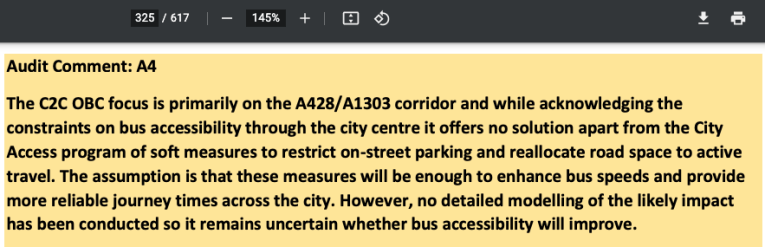
“[The CBC proposals offer] no solution apart from the City Access program of soft measures to restrict on-street parking and reallocate road space to active travel. The assumption is that these measures will be enough to enhance bus speeds and provide more reliable journey times across the city. However, no detailed modelling of the likely impact has been conducted so it remains uncertain whether bus accessibility will improve.
“The OBC [Outline Business Case] recognises the need to access the fringe employment site at the Science Park and Cambridge BioMedical Campus and proposes a pattern of orbital bus services to serve these sites. from the Park and Ride sites at Madingley Road and Scotland Farm via the M11 and A428 as well as connections in the City Centre. These constraints remain valid for the C2C scheme and only weak remedies are proffered at this stage.”
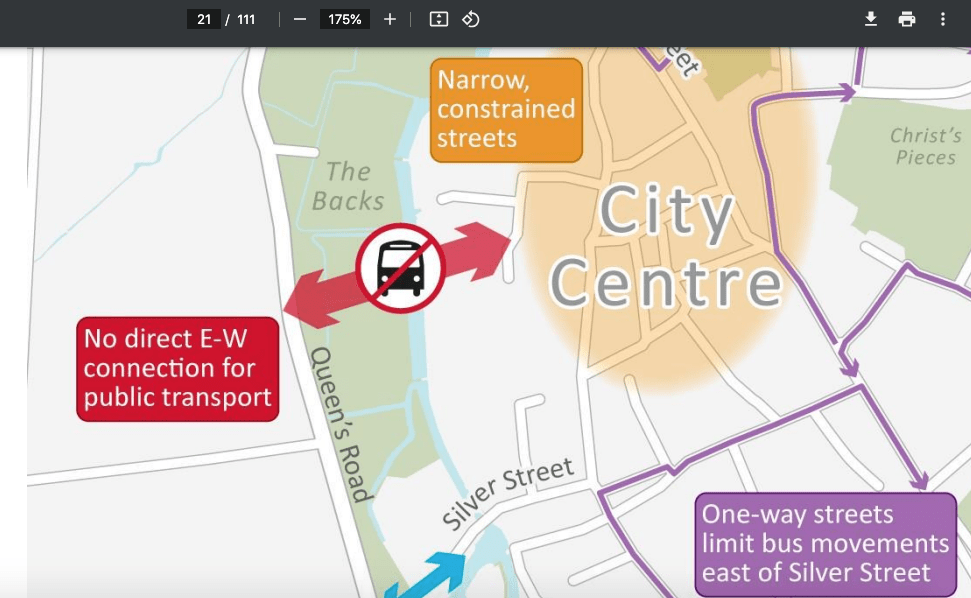
Above – just incase you missed it first time around… p21 of the Independent Audit of the C2C Busway 2021
It’s now 2025. The GCP has to start planning for how it will wind down. The problem is that they have barely progressed in dealing with what should have been the core challenge for Cambridge:
The last mile of journeys. That is the root of so many of the delays.
And that was what the Cambridge City Access element of the GCP’s programme was meant to deal with. Have a look at their landing page at https://www.greatercambridge.org.uk/sustainable-transport-programme/city-access-programme
Is there anything in there that looks remotely like the GCP has found a solution and is now building / delivering it? Sadly not.
It’s strange to think that the early route options did not involve going through the city centre

Above – from the West of Cambridge to CBC Busway Feasibility Study of 2017from p23 here
A year before that, the Cambridge Access Capacity Study was presented to the GCP Board and Assembly – see the page here and the link at the bottom.
- better bus services and expanded usage of Park and Rides;
- better pedestrian and cycling infrastructure;
- better streetscape and public realm;
- peak congestion control points in the weekday morning and evening peak periods;
- a workplace parking levy;
- on-street parking controls (including residents’ parking)
- smart technology;
- travel planning.
Above from June 2016 – progress update?
The University of Cambridge dons did not like the workplace parking levy so that was zapped in place of the infamous congestion charge. Now we have neither.
Smarter Cambridge Transport made the case for the parking levy here – the revenues of which should have helped financed a light rail (in my opinion – along with the tourism tax on day-trippers).
“We are trapped in a circular argument of people objecting to paying new taxes until there is better public transport, and local authorities having no money to improve public transport without raising new taxes. Phasing in a WPL is possibly the only way to break this deadlock.”
Above – Smarter Cambridge Transport – Dec 2019
This is not the first time a Workplace Parking Levy has been shelved.
“While the fact that new road surfacing material in the County consists of 10% recycled tyres warranted a press release, the Cabinet’s decision last December to shelve proposals to charge for workplace car parking apparently did not.”
Above – CamCycle August/September 2003
Two years earlier, the Census 2001 recorded Cambridge’s population at just over 108,000 people. That’s within Cambridge City Council’s boundary last extended in 1935. The Census 2021 within those same boundaries that number was over 145,000. Three years and lots of completed housing developments later, that figure is probably over 150,000 as Marleigh, The Ironworks & Cromwell Road off Mill Road, Springstead (north Cherry Hinton, Clay Farm, and Eddington have started filling out significantly.
The forgotten proposals for pedestrians
Remember this from nearly a decade ago? (Three months left and counting.)
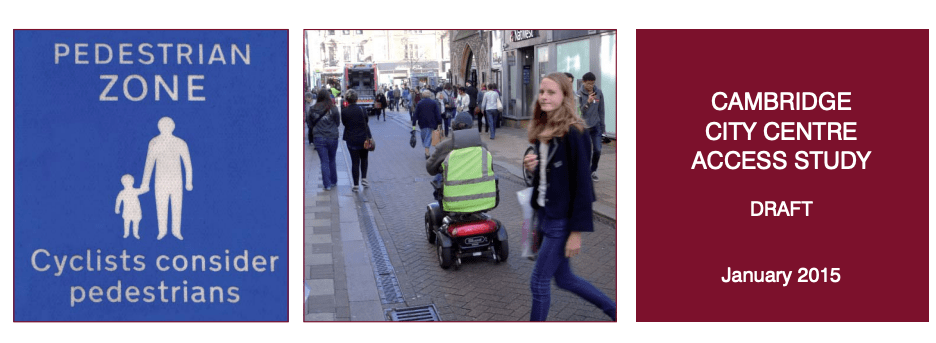
Above – Cambridge City Centre Access Study – January 2015
What happened to the recommendations?
- Raise awareness of the issues arising from A- boards and similar forms of advertising on pavements to secure their removal;
- Remove inconsiderately parked and abandoned cycles;
- Remove damaged and redundant highway signs and poles;
- Review locations where on-street trade refuse bins are reducing pavement width and are an eyesore with a view to their removal, relocation or screening;
- Repair and replace damaged / loose/uneven paving and areas where puddles form in wet weather;
- Review all junctions without tactile crossings to assess whether their installation would be beneficial;
- Enforce the licensing of tables and chairs on the pavement and street trading pitches to ensure they do not ‘overspill’ outside their permitted area and create difficulties for pedestrians; and
- Enforce vehicle and cycling restrictions.
- Undertake a comprehensive audit of all highway signs with a view to removing or where essential reducing the number and size wherever practicable;
- Review locations of street furniture and relocate where appropriate; and
- Repair / replace damaged seats, bollards etc.
Above – recommendations from Cambridge Access Study (2015) p44
What killed the above? Austerity. Probably. Because these are all day-to-day functions of a local council. Anything that involves maintenance or enforcement is not something that would come out of a programme budget like the GCP. Capital programmes generally involve creating or improving an asset. Revenue programmes generally do no. Once a greenway/cyclepath has been completed, you have a new route that provides an alternative for people to use instead of their cars, and/or reducing the conflict between cyclists and motorists (thus improving the safety of the former). After five years of enforcement there’s little to stop potential/would-be law-breakers from slipping back into old ways if that enforcement function is not maintained.
Anyway, they have decided to pursue the options they have chosen. Up to them to respond to further issues as they arise. In the meantime, we wait for the Chancellor’s Autumn Statement on 30th October 2024 and whether she will allocate feasibility funding to Cambridge Connect Light Rail.
If you are interested in the longer term future of Cambridge, and on what happens at the local democracy meetings where decisions are made, feel free to:
- Follow me on BSky <- A critical mass of public policy people seem to have moved here (and we could do with more local Cambridge/Cambs people on there!)
- Like my Facebook page
- Consider a small donation to help fund my continued research and reporting on local democracy in and around Cambridge.

 The Cambridge Town Owl