
You can read them in the papers for the Environmental and Sustainable Communities Committee papers here – and given that Transport is on the list, I’m tempted to throw in a Q about light rail infrastructure in a post-GCP age given that the controversial partnership winds up in just over five years time
But before we do, something more positive from the world of politics
For over a decade I had been calling on politicians to provide regular, routine updates on what they were doing as part of their roles as elected representatives. For example every week providing a simple update of:
- who they had met,
- the number of pieces of casework they had dealt with,
- the number of emails they had received,
- the places they visited,
- the letters they had sent to ministers and people in decision-making positions
We seem to have reached a critical mass of politicians in local and national politics doing this so it would be bad form for me not to highlight some of the examples of those that had taken the lead on this.
Answers with Alex – Cllr Dr Alexandra Bulat (Labour – Abbey Division)
You can watch Dr Bulat’s latest video commentary here

Above – Dr Bulat responds to issues raised by constituents and correspondents – starting with the Skills budgets which have been in the news recently
For the Conservatives, Alicia Kearns has been putting out weekly video updates on her social media account such as this from 13th Oct. Or rather it looks like a video but actually it’s a series of photographs put together with text written on top – which makes it much faster and easier to produce. (Not least because no audio is needed).
South Cambridgeshire MP Pippa Heylings (LibDems) has also been busy in the House
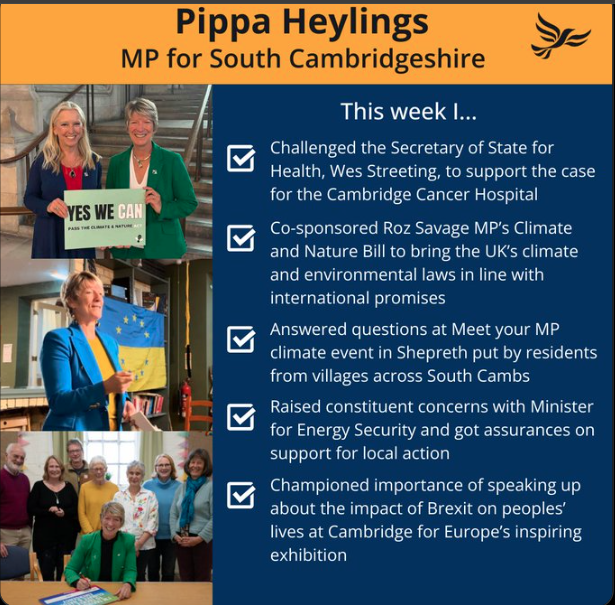
Above – from Pippa Heylings MP here where she was also guest speaker at the opening of the Cambridge leg of Madeleina Kay’s Brexiles exhibition with Cambridge For Europe.
Again, keeping it simple with a few bullet points, a trio of photographs, all on a single slide. Keeping with a simple, regular format increases the familiarity for those residents that otherwise do not follow politics closely.
The growing role of Cambridge’s ‘second MP’
Such are the changing geographical boundaries that the revamped South Cambridgeshire constituency now contains two Cambridge City Council wards (Cherry Hinton, joining Queen Edith’s) meaning that the role of current and future MPs for South Cambridgeshire will become more important for the future of both city and county. Furthermore, because the Prime Minister appointed Cambridge MP Daniel Zeichner a Minister of State at Defra (Minister for Agriculture), there are a host of parliamentary restrictions (which are in the process of being reviewed) that prevent him from speaking on the floor of the Commons on constituency issues. Furthermore, he is bound by the convention of Collective Responsibility of Government. There’s no point in contacting him asking to vote against the Government on any issue *unless you understand that you are asking him to resign from the Government and sit on the back benches*. (The way the UK system of government works is that around 100 MPs have to be prepared to take on ministerial office – we don’t have a system that separates legislature from executive as the USA does). It would require political parties at the next general election to include major constitutional overhauls in their manifestos to change this. That didn’t happen for the 2024 general election.
Cambridgeshire County Council video meeting summaries
Cambridgeshire County Council have also started publishing short video summaries on their social media accounts – see Cllr Alex Beckett (Libdems – Queen Ediths) who chairs the Highways and Transport Committee as he summarises the decisions councillors made on new local highway improvement schemes – see the papers here.
All of these things matter because in an era of declining local news coverage, this is one of the few methods that local elected representatives have to remind residents that local democracy still exists, providing essential public services that we only notice when they are not provided. Such as bin collection. (Ask anyone who lives in a council area that has had a refuse workers’ strike in recent years).
While it’s not the ‘magic wand’ action that will single-handedly result in the huge increased in trust in local politics, and the massive rise in political literacy, it’s one of the routine actions that our communities need, if only because each post/publication/video results in someone other than me becoming vaguely aware that local politicians are making the effort, and when an issue mentioned is one of interest, the public know where to find out more.
Hopefully the Combined Authority will be putting out similar videos to the county council – not least because of the growing status ministers (and the media) seem to be putting on them and their mayors. Which reminds me – there’s some important infrastructure things in the Environment and Sustainable Communities Committee papers just published.
Cambridgeshire & Peterborough’s water, electricity, and transport issues
See the meeting papers here and note the Director’s Highlight Report at item 8. This is the ‘What has happened recently in this local policy area, and what do councillors on the committee need to know about before possibly voting on the issues concerned’ item.
One of the items in the papers is a bit of a monster – hence it contains a full report (App A) and a slide pack (App B) at item 11.

Above – monster report on the county’s infrastructure at item 11
Take your pick from 17 pages worth of slides or 150+ pages of report writing.
TLDR? Previous governments and privatised utilities have not invested or maintained critical infrastructure – especially on transport, water, and electricity. These are now limiting factors in proposals for growing the economies of both Cambridge and Peterborough’s economic sub-regions.
Back in May 2024, UK Power Networks produced this plan for three new electricity substations for Cambridge.
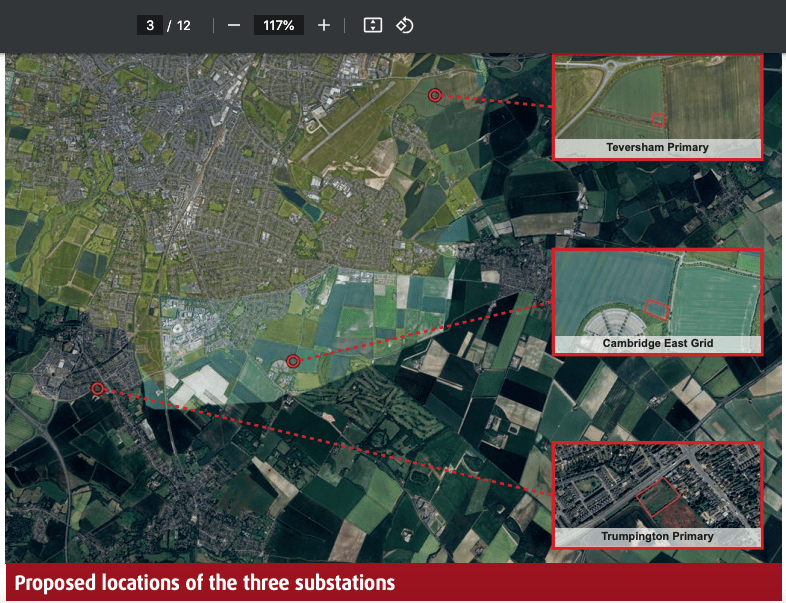
Above – Cambridge East Grid (2024) p3
This is because it became clear that the existing power infrastructure was already over capacity and needs urgent upgrades – see this report. Furthermore, one of the most at risks areas for a power outage is… Newnham, Cambridge.
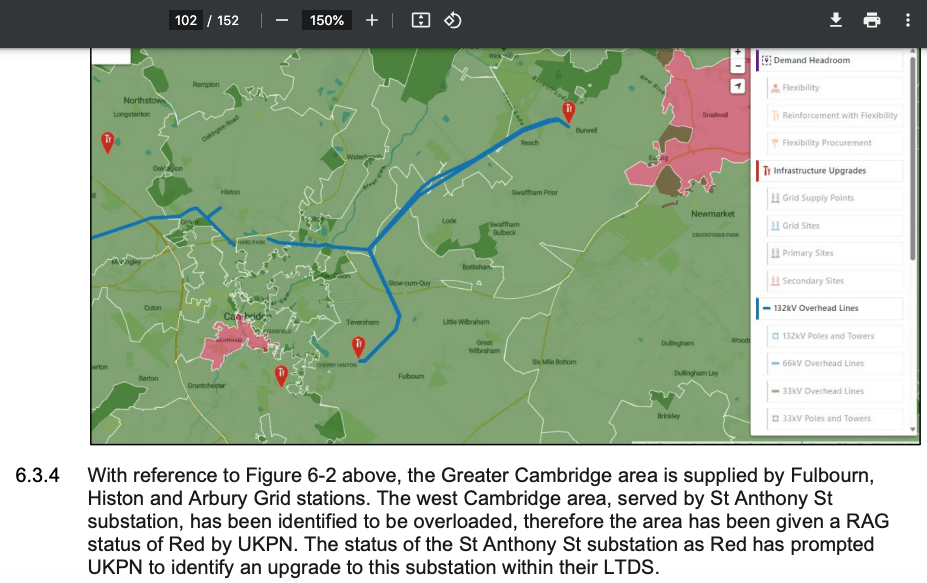
Above – CPCA E&SC Item 11 App A p102

Above – CPCA E&SC Item 11 App A p102
Hence why work is being carried out now/this year.
If the upgrades do not progress…
In Cambridge’s case, we run the risks of approving all of these sci-tech developments where the lights won’t switch on and water won’t come out of the taps if we carry on as normal allowing privatised utilities to use water and electricity companies as cash cows. Which creates a big challenge for ministers. And lots of grovelling by previous ministers who privatised the utilities and kept them privatised as successive firms asset-stripped the utility companies, loaded them with debt, paid handsome sums to splendid chaps on the board and walked away. They’re only squealing now because the new government is threatening to mess up their business models by not allowing said firms to increase bills by inflation-busting amounts. Hence headlines about firms like Thames Water’s parent company going bust.
The bit that I’m interested in is transport connectivity
Not least because of the concession on slide 14 of the slide pack that the GCP really screwed up over their ‘Making Connections’ policy scheme which (in my opinion) senior transport executives assumed that the politicians would get everything rubber-stamped for them and refused repeatedly to listen to huge concerns not just from campaigners but from residents generally. It was only when things became an electoral threat that the councillors finally put their foot down – but by then the reputational damage was done.

Above: “There is a significant gap in Greater Cambridge left by Making Connections not progressing, with other solutions urgently required to prevent this becoming a barrier to Emerging Local Plan growth.“
Don’t blame me – I voted for the light rail proposals!
(Actually, I went further than that and took it to the ballot box in 2023 where I didn’t ask anyone to vote for me – I just treated it as an information session on local democracy and a discussion on the future of our city. But 261 people – nearly 10% of the electorate ignored my call and voted for me anyway!)
“‘Other solutions urgently required…’ that sounds ominous”
How many people have picked it up?
“Maybe CPCA officers read the blogpost on the problems of the Cambridge City Access scheme not having gone away?”
For those of you wondering, it refers to a comment by auditors that carried out the independent report on the still-as-yet-not-signed-off Cambourne-Cambridge busway, and the decade-old-question of what happens to the buses when they hit Grange Road. Because at the moment the plan is for the buses to get stuck in traffic – something the GCP’s proposals were meant to avoid. The failures to deal with that were highlighted by the auditors and repeatedly ignored by senior transport officers on the GCP.
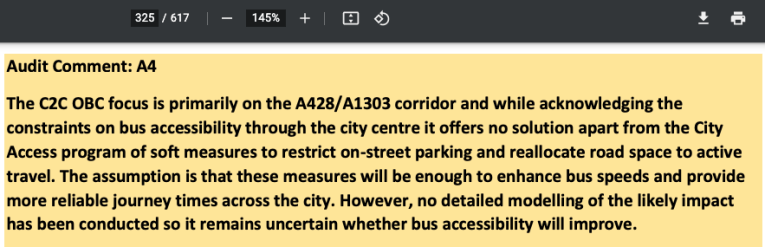
What’s striking is that officers on the Combined Authority have now called them out on it.
Let’s go to the full report of the Combined Authority to see what the detail says.

Above – does the Greater Cambridge Transport Strategy cover this?
See Cambridge Past, Present, and Future’s statement on Greater Cambridge Transport as they set out what any transport plan/strategy needs to cover – and the challenges it needs to resolve.
“The Greater Cambridge Partnership’s (GCP) Making Connections programme was a potential solution to this with the aim of reducing traffic volumes within the city by 15% on a 2017 base, but this is not now progressing. This creates a significant gap, given its potential to alleviate congestion in and around Cambridge and contribute to a significant improvement of the public transport network. The CPCA is leading work with the local authorities and GCP to explore solutions to this via the emerging Greater Cambridge Transport Strategy”
Above – CPCA E & SC Cttee papers 25 Oct 2024, Item 11 App A p7 / p12 pdf
The Combined Authority has taken control of Cambridge City Access from the Greater Cambridge Partnership
Which means it falls within the remit of the Executive Director of Place & Connectivity, Judith Barker who wrote/signed off the report to the Committee. (See item 11 and click on the 136kb PDF as that states who was the senior director who signed off the report, and who will present it – in this case Cllr Bridget Smith (LibDems – Gamlingay), the leader of South Cambridgeshire District Council. My general view which I formed during my civil service days is that anyone who is at a senior civil service grade or equivalent, and certainly anyone on a salary of over £100,000 per year should see it as their duty to speak in public forums and be held accountable by elected representatives and be willing to take questions from the public at public meetings – and provide clear, truthful, and substantive answers to questions put to them. That’s not insinuating anything – it’s simply a restatement of the Nolan Principles of Standards in Public Life. (Principles 1.4 and 1.6 in particular).
“Anything on the busways?”
They don’t call them ‘busways’. It’ must be a corporate style guide thing. The report states further down.
“Beyond this, GCP is progressing well with the Greenways programme and the development of high-quality public transport routes (CSETS, Cambourne to Cambridge, Cambridge Eastern Access, Waterbeach to Cambridge North)
***Stop laughing! This is a serious matter!***
The last set of papers for the CSETS scheme presented to the GCP Assembly on 16 October 2024 (four days ago) on p27 of the Agenda Documents Pack had that RAG-rated as *Red*. I also think that the C2C busway and the controversy over the orchard amongst other things means that the amber rating is ‘generous’ to say the least.

Above – GCP Assembly 16 Oct 2024, p27 of the agenda documents pack
Note that Amber or even Red risks don’t mean everything’s doomed. Much of it is in relation to target dates. In the case of the C2C project they can make a reasonable case that the project was hit by the pandemic – a once-in-a-century disaster. Even so, they should at least have spades in the ground – but for reasons Dr Andy Williams told the GCP board last time around, they do not because of utterly broken structures. It’s fine for them to say the risks remain red but are under control, but for them to say their projects for roads with signs by the side of them saying ‘buses only’ are ‘progressing well’ is simply wrong.
“Of the strategic non-infrastructure measures noted above, the falling away of Making
Connections creates a significant gap given its potential to alleviate congestion in and around Cambridge and contribute to a significant improvement to the public transport network. It is understood that alternative solutions are to be explored through the preparation of a Greater Cambridge Transport Strategy (GCTS) which is informing the preparation of the emerging Greater Cambridge Local Plan.”
“Hang on – I thought we already had a Greater Cambridge Transport Strategy as part of the LTCP?!?”
Not this one – this is a ***new*** one because it says so in the CPCA Forward Plan of 01 October 2024 – about three weeks ago.
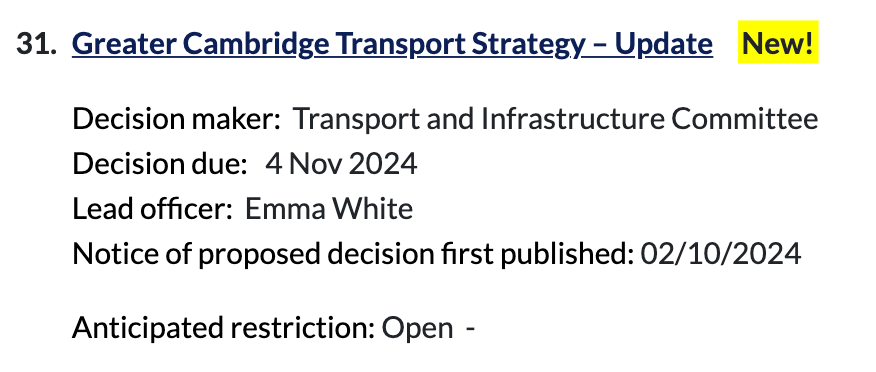
“Why the change?”
Probably the new government coming in and the conversations that the Mayor and officials have had with the Deputy Prime Minister, Transport Secretary, and senior civil servants. In which case I’d cut them some slack. Not least because the Greater Cambridge element of the LTCP acknowledged that the collapse of the road user charging/congestion charging proposals had come to a catastrophic end.

Time for public questions?
Feel free to send them into the Combined Authority via their webpage here
These could include questions on whether a future Greater Cambridge Transport Plan will consider light rail mindful of the ambitions of the new government and the looming mayoral elections in six months time. It will be up to individual candidates for the mayoralty if they want to propose a light rail solution for Greater Cambridge.
If you miss out on the Environment and Sustainable Communities Committee deadline, feel free to table similar light rail (or other) questions to:
- Transport and Infrastructure Committee (04 November 2024)
- Combined Authority Board (13 November 2024)
…or if you are still following the GCP closely, their Board meeting on 07 November 2024 which unlike the other two will be at The Guildhall in Cambridge
If you are interested in the longer term future of Cambridge, and on what happens at the local democracy meetings where decisions are made, feel free to:
- Follow me on BSky <- A critical mass of public policy people seem to have moved here (and we could do with more local Cambridge/Cambs people on there!)
- Like my Facebook page
- Consider a small donation to help fund my continued research and reporting on local democracy in and around Cambridge.

 The Cambridge Town Owl