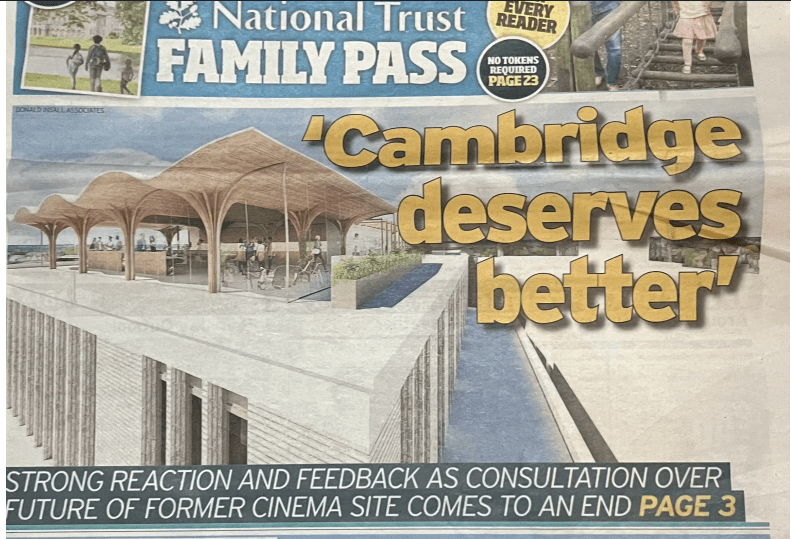
I hope we can discuss this and learn how to achieve a more aesthetically-pleasing set of buildings in the future when the Cambridge Room opens.
I wrote about the Cambridge Room here and, like the Cherry Hinton Library and Hub, it’s due to open in November 2024.
Recall back in 2017 the Federation of Cambridge Residents’ Association’s video with presentations from a variety of speakers on the theme of Cambridge Deserves Better. How well has it aged?
““Ugly-ugly-ugly! Oi-oi-oi!” Trying to separate a desire for more beautiful buildings from politically-inspired culture wars“
The biggest challenge for me in all of this is the artificial divide created by the culture wars where progressive politics seems to have found itself lumped in with the bland block designs while those calling for ‘bringing back beauty’ within the Conservative Right also seem to be in favour of a whole host of more controversial social policies altogether. To put it mildly.
One of the ‘picture postcard’ scenes that often comes up in debates about gentle density is this one on King’s Parade which I took during the summer of 2020 between the two lockdowns.
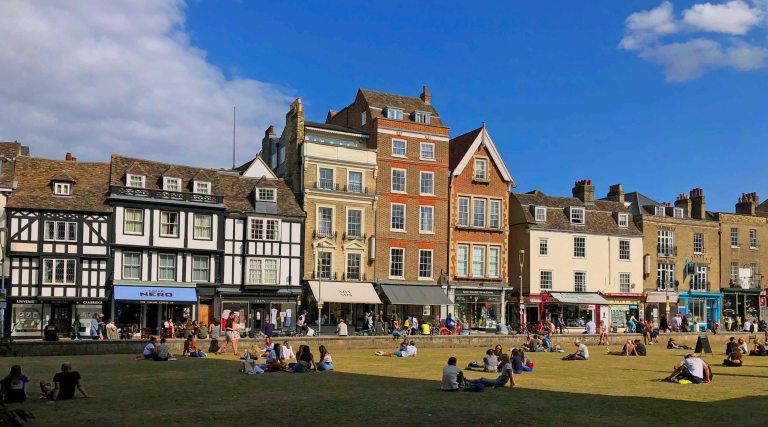
Above – King’s Parade (Antony Carpen, Aug 2020)
Unlike the residential and business developments of today being promoted by the University of Cambridge and its colleges, you’ve got the variety in the different styles of building – as if each one was designed by a different architect for a different smallholder. This was something that former South Cambridgeshire MP Heidi Allen often mentioned in conversation in the mid-2010s about how large plots of land should not be handed over/sold off to large developers, but rather broken up into much smaller plots for local builders and local architects to come up with their own designs, and enable competition to do its thing. Because otherwise we get the faux ‘luxury’ of Eddington.

Above – Ugglington’s Worse than 1980s Communism visions of housing in Cambridge
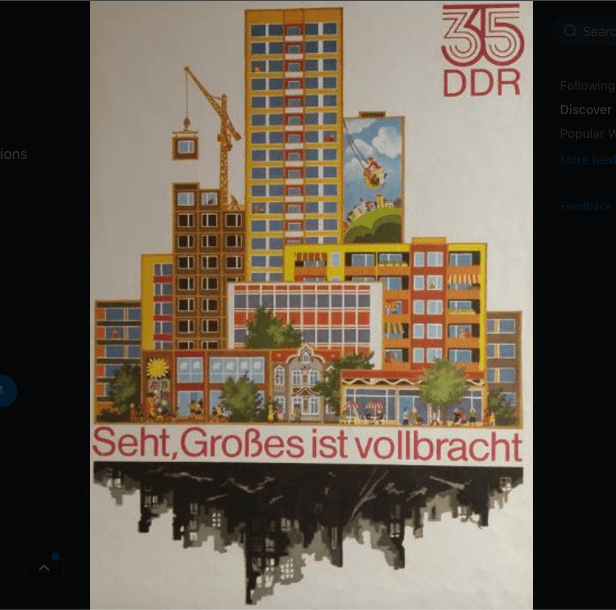
Above – Klaus Bernsdorf’s propaganda poster for the 35th anniversary of the old East Germany which has far more colour and variety in it than many of the CGIs of new housing developments proposed for (and since built in) Cambridge
Learning from the past.
I mentioned Trystan Edwards’ book in this earlier blogpost which reminds us that monotony is not a new thing. Furthermore, given the housing crises of the interwar and post-war era, expediency and cost-efficiency meant less variety and standardised-and-easily-repeated construction patterns were the norm.
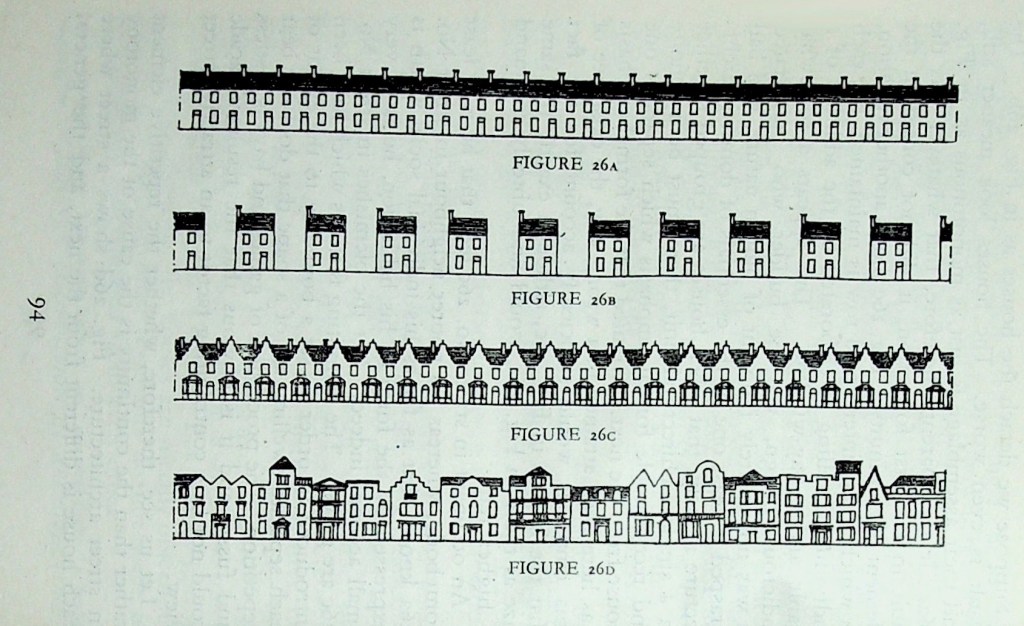
Above – Trystan Edwards (1944) p94 complaining about ‘the bugbear of monotony’ with housing developments
That’s not to say it was better in Victorian times. You only have to look at the rows of cramped terraces and picture them without the modern day sanitation & heating, combined with smoke pouring out of the chimneys to imagine how grim life could be.
Growth of AI and vector imaging to illustrate old urban design concepts
We’ve seen the AI-generated images of Create Streets’s vision of Cambridge which understandably tries to set a new ‘mood’ that is different to what has been and is being created currently by the big developers. Hence sticking my nose in now to the edge-of-Cambridge Community Forums calling for things like more imaginative designs, more variation, looking at new research such as that of Cleo Valentine, and also trying to get developers to commit to post-occupancy evaluation commissioning and publication. (These are public forums – anyone can take part).
The more basic vector images that we’re seeing more of offer some more straight-forward takes of how even the most basic levels of variation and detailing can make for a much more interesting street scene than what current architects are producing.
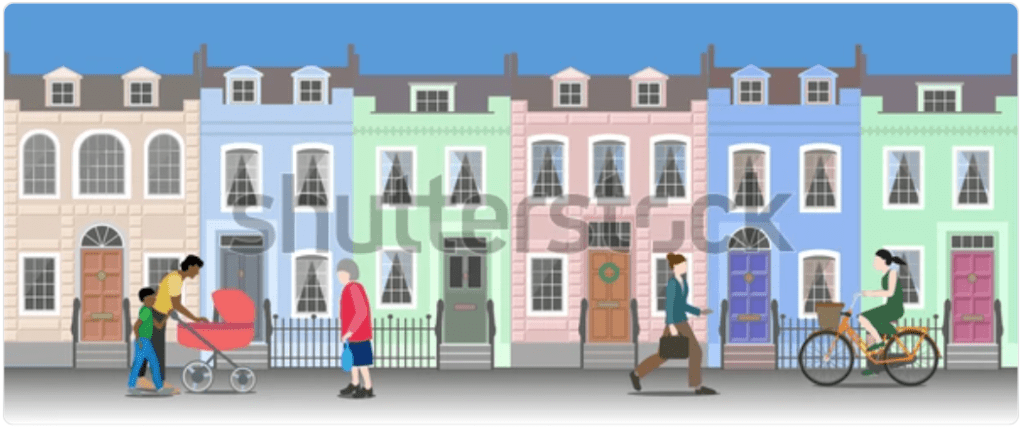
Above – from Shutterstock here – see other examples from them here, and on modern multi-storey examples here
Complaining about bland, ugly design does not mean no housing should be built
In the NIMBY vs YIMBY culture wars the accusations that the former use the criticism of ‘ugly designs’ as a means of blocking *all development* inevitably get thrown. Which is one of the reasons why I go for demanding something better than what the developers come up with.

Above – some of the better building designs in the foreground at Eddington (proposed for their expansion)
The stuff behind it I despise with a passion! I compared that with one tweet showing seaside housing in Copenhagen.
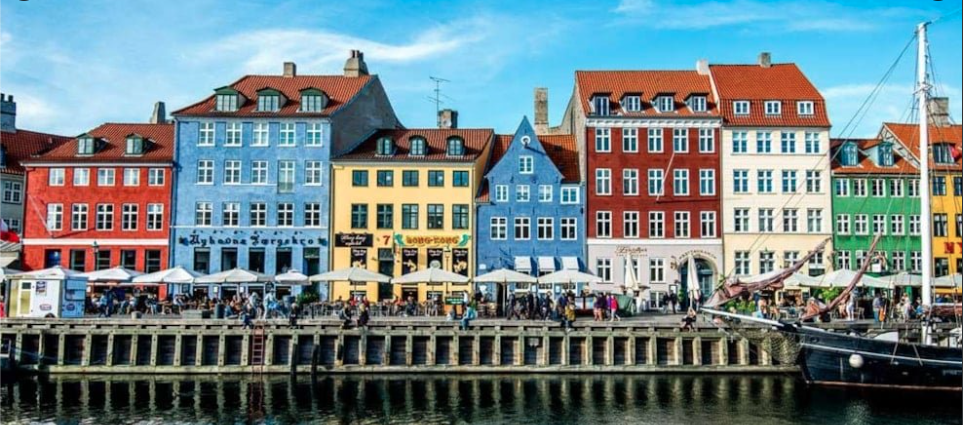
Above – I asked in this tweet if we could have this in Cambridge!
What we often see is something like below from 2017
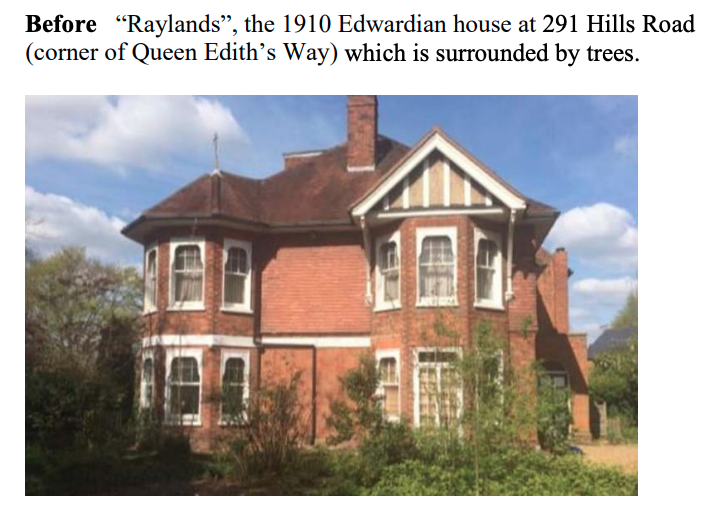

Above – from Chris Rand’s old Queen Edith’s blog back in 2017 – in the end the developers were ‘persuaded’ not to use grey bricks.
While I could understand the economic and housing pressures that incentivised the replacement of a detached house with 15 flats, the soulless grey ugliness of the design was simply a red flag to local residents.
This reflects the wider problem with how Cambridge is changing: no one is planning or co-ordinating it. Parliament & ministers have not empowered anyone to make sure this is done in a manner where the wealth is not extracted from the city. They have not ensured that what is happening to our city is being done with the active participation of the people of our city – residents, commuters, students, and even regular visitors.
I hope we start having some collective discussions and come up with new, better, more imaginative ideas for residential building design that designs out problems rather than designing them in. Thinking the dark-clad homes in South Cambridge that bake in the summer.
Food for thought?
If you are interested in the longer term future of Cambridge, and on what happens at the local democracy meetings where decisions are made, feel free to:
- Follow me on BSky <- A critical mass of public policy people seem to have moved here (and we could do with more local Cambridge/Cambs people on there!)
- Like my Facebook page
- Consider a small donation to help fund my continued research and reporting on local democracy in and around Cambridge.

 The Cambridge Town Owl