All the more important given the consultation on the review of the curriculum and exams systems – adults, you need to read this. (And feel free to discuss it with any children and young people too)
The results of the Cambridgeshire Youth Survey – sample of around 1,000 young people aged 11-19 had some striking findings, ones which will be formally published soon. The one that stood out:

Above – Access to affordable nutritious food was identified as the most pressing health issue in the Cambs Youth Survey
Just ponder on that for the moment. (And if you are so inclined, https://www.writetothem.com/)
The Cambridgeshire Youth Panel.
You can find out more about the youth panel here – something that really came of age during the lockdowns when so much teaching moved online only for the county to discover that so entrenched were inequalities across our county that someone had to step up to ensure all children had laptops to facilitate distance learning. Hence the Cambs Digital Partnership.
I never had the chance to let rip about the failures of 1990s schooling to the adults and decision-makers of the era. A trio of young women from the CYP were provided with that opportunity – and they unleashed a barrage of expertly-targeted verbal missiles against those responsible for their experiences, and they did not miss. Good.
And for the Education Secretaries and Prime Ministers that appointed them? Shame on you!
What chance did the children and teenagers have when between 2018-23 the Conservatives were getting through Education Secretaries at a rate of over one per year? Their party only has themselves to blame for the minuscule political talent puddle of politicians their parliamentary party had – some of those listed should never have been let near parliamentary politics, let alone ministerial office. Things weren’t any better during my years at school in Cambridge in the mid-1990s. By the time I got to my GCSEs in the mid-1990s I utterly loathed the place and was properly hyper-focused on passing the exams and moving on – to the extent in my crazed mind I viewed the whole thing as an extended episode of WWII.
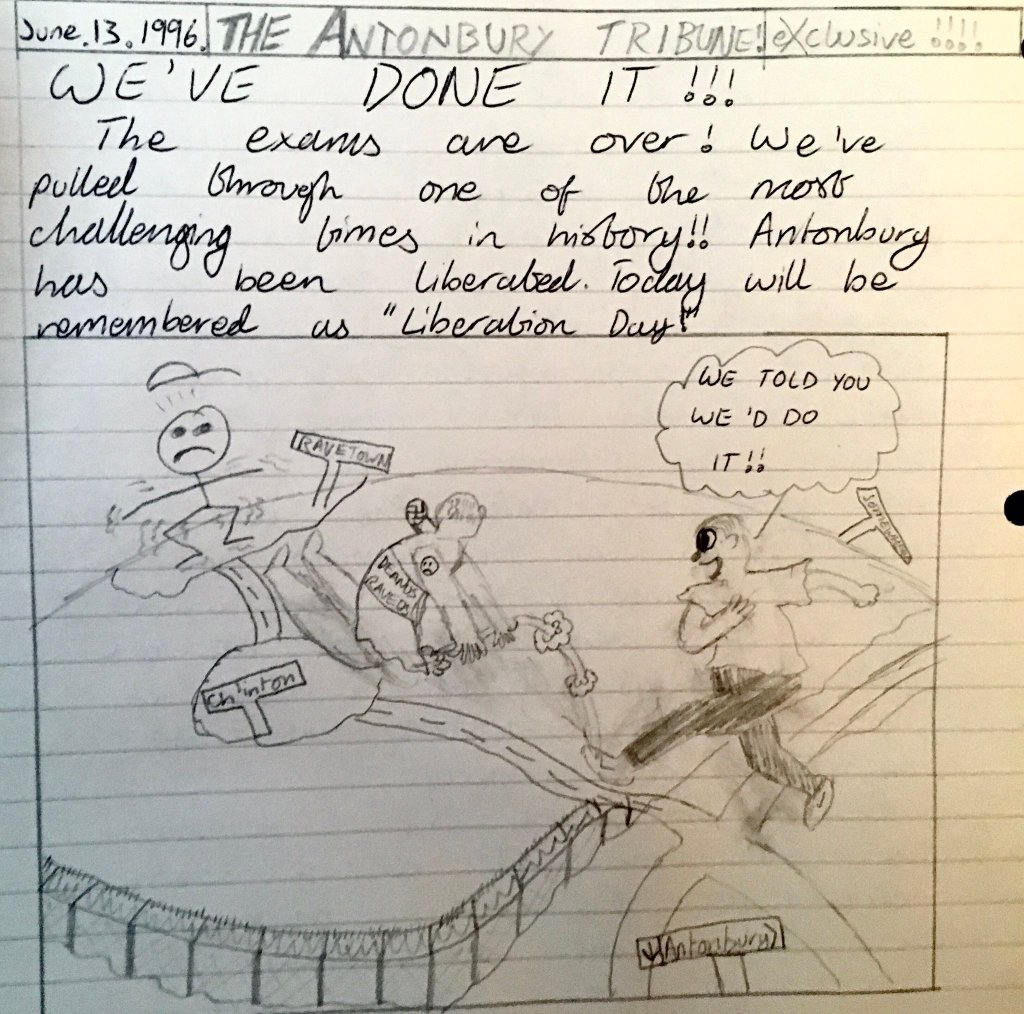
Above – from my manuscript diaries treating the completion of my final exam (and at the same time getting rid of troublemakers from my existence) as the equivalent of the Allies kicking Rommel out of Africa in WWII.
What none of us at the time realised was just how unfit-for-purpose the content of those examinations were for preparing us for life. Which is why:
- I still have a burning chip on my shoulder over those days, and
- Finding it incredibly cathartic to hear a new generation of teenagers getting up on a public platform and absolutely shredding the entire education system and its failure to prepare school leavers for the real world outside.
What made it all the more powerful was that the trio of young women speaking managed to weave pure rage with disarming humour..
Above – a response to my Q on whether they felt they were taught enough about politics and democracy mindful that on 15 October 2024 Ministers confirmed that they would be legislating for Votes at 16 to be in place in time for the next general election. I asked the audience of adults how many of them were aware of that press release and only a handful of them were. Which spoke volumes.
The long term damage of poor and unengaging teaching – and irrelevant content
This was a reminder to those of us with policy backgrounds that simply making something compulsory in schools, or offering evening classes and workshops is not ‘job done’ – anything but.
One of the students reminded me of the importance of 1-2-1 outreach and small group work. In her case it was one of the Cambs Digital Partnership workers going that extra step to ensure she had a laptop to do school work on during lockdown. Had it been in a large assembly, she said she’d have taken in some of the information for about five minutes then forgotten about it.
One reason why their testimony resonated so much with me is because I can pinpoint the several points in time where a competent and passionate advocate for a subject, an activity, or an opportunity could have made positive – even life-changing impacts on (for want of another term) my destiny. That I boomeranged back to my home-town (despite trying to leave permanently – twice) massively amplifies the sense of missed opportunities. Hence years ago having resolved to ensure this and future generations don’t have to go through what my generation went through.
One of the charity representatives at Engage Cambridge was an old classmate from my early secondary school days who I had not seen for *years*. In talking through our experiences of the early-mid 1990s, it’s clear we were both failed by the institutions and systems concerned. Which is why I’m still furious now about what former Tory Education Secretary from the 1990s, Baroness Shephard said in the Lords last week. I hate being gaslit at the best of times – and especially when it’s from the floor of one of the chambers of Parliament. Unless there’s an apology from her for her failings in ministerial office, she’s in no position to state how important citizenship teaching is when over the three years she was education secretary we learnt *nothing* about the essentials of parliament, government, and local councils.
The statement by Phil Priestley in his opening remarks was all the more striking because he reminded the audience of adults that most of us had lived through the 2000s when central and local government was investing in both new buildings/facilities and in services at community and neighbourhood level. The teenagers in front of us had only ever experienced cuts and austerity – just as my generation had in our mid-late teens in the 1990s.
It wasn’t just me who was struck by the power of the words from the young women
There were a handful of postgraduate researchers from Cambridge University and Anglia Ruskin University who told me afterwards how powerful the messages were from the youth panelists – and how more opportunities for young people to speak out *and be listened to by the institutions* was now an imperative for Cambridge’s influential organisations and public decision-making institutions.
Forcing developers to engage meaningfully with communities and young people early so they incorporate their needs into their designs
When it came to a final group-work session on figuring out how community organisations can respond to the survey results of over 1,000 teenagers from across Cambridgeshire, our table looked at provision of community spaces. Not being able to STFU I asked how many of the people on our table had responded recently to a major consultation on a planning application where any of us had made the case for providing public/community space aimed primarily at young people. No one raised their hands. When I put the same question to the room in the feedback session, still no hands.
“There’s your answer”
I remarked in response to why there were so few suitable places and spaces for young people. We’re failing collectively on the basics. Why are we failing? Because none of us ever went through a process of learning about the essentials of town planning, let alone how to respond to applications, or even why responding to such consultations in big numbers could be important.
At the same time I noted that it’s made all the more harder when people put in the effort (at their own expense and in their own time) only to be ignored by decision-makers – whether corporate developers or whether institutions such as the Greater Cambridge Partnership.
Which is why something has got to give.
Hence my statement at the end that familiarising more of our population with how politics functions and malfunctions locally and nationally has to be part of the solution if we are able to hold our elected representatives accountable.
Food for thought?
If you are interested in the longer term future of Cambridge, and on what happens at the local democracy meetings where decisions are made, feel free to:
- Follow me on BSky <- A critical mass of public policy people seem to have moved here (and we could do with more local Cambridge/Cambs people on there!)
- Like my Facebook page
- Consider a small donation to help fund my continued research and reporting on local democracy in and around Cambridge.

 The Cambridge Town Owl