…only to face yet another hurdle – reinforcing the point made by Dr Andy Williams, formerly of Astra Zeneca, about the impact of overly-complex governance structures on big transport projects
You can see the meeting papers here – it’s item 6 of Cambridgeshire County Council’s full council meeting. You can also see the Cambridge News write up here.
I’m not going to lose too much sleep over this because the GCP doubled-down on the project earlier this year vs Rail Haverhill and Cambridge Connect Light Rail and whatever gets built will not be nearly enough to deal with the additional growth that both the previous Conservative Government wanted, and whatever the new Labour Government has lined up for our city and county.
13 pages of public questions to county councillors
You can read the text at item no.4
Note this was not the pile-on that it could have been. The fact that the heads of Cambridge Ahead and the Cambridge University Hospitals NHS Trust both tabled public questions effectively in support of the CSET Busway shows that institutions recognise the risk to the proposals in the up-and-coming application to the Transport Secretary, and are making their support known early on. (This is not *Ooh – conspiracy!* – this is normal for local institutions in support of a large infrastructure project to want to make representations).
With the county council elections looming, it’ll inevitably become party-political
All three main parties are going to struggle to account for their actions in the run up to the county council elections in six months time regarding controversial Greater Cambridge Partnership Schemes because The Conservatives controlled the GCP between 2014-18 and were thus responsible Party-politically for the commissioning of all of the projects. All three parties had a voting seat on the GCP between 2018-21, so bear joint responsibility for the continuation of those large projects. And Labour and Liberal Democrats bear the joint responsibility from 2021 onwards when the electorate gave them an opportunity to change direction. Therefore I’m not reading too much into the Conservative’s amendment other than an acknowledgement that their predecessor members on both former GCP Boards and Assemblies were wrong. [And their candidates should beg/plead/grovel in front of the electorate acknowledging their wrongness for ever and ever and ever… …then again] (You can tell I’ve just watched Victoria Derbyshire make mincemeat out of one of the Tory leadership candidates on Newsnight just now…)
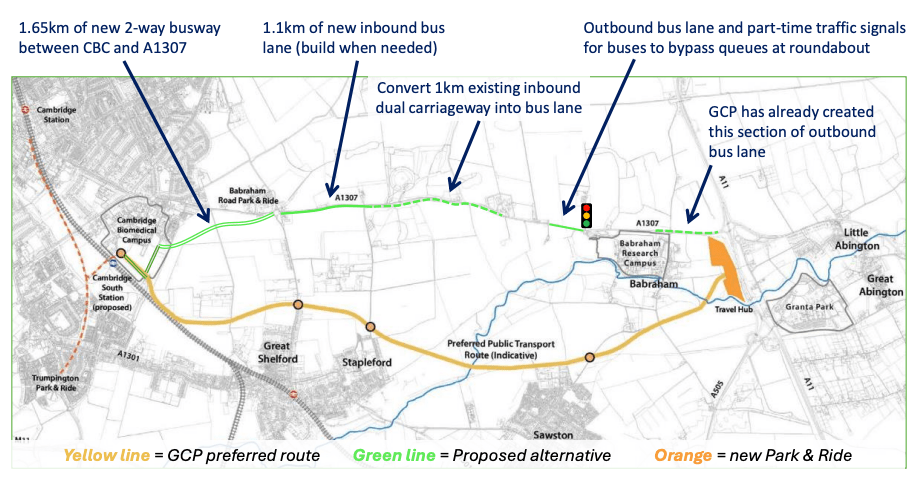
Above – Conservative amendments at item 06
Note at the same time it also means they can all take credit for the successes such as the Abbey-Chesterton railway bridge and the Chisholm Trail.
Furthermore, Central Government signed off the gateway review of 2019, judging the GCP a success – you can read the documents here. The second gateway review is due shortly – you can read the paper on what will be assessed here.
The County Council’s application to the Transport Secretary for a Transport and Works Act Order for planning permission
From a legal, governance, and public administration viewpoint, this was the debate and vote required at Full Council.
The interim Chief Executive of the GCP Peter Blake submitted the following request to the full council:
“The purpose of this report is to seek approval to submit an application for a Transport and Works Act Order (CSET2 Order) for the CSET2 Scheme. The report also seeks delegated authority to progress the delivery of the CSET2 Scheme if the CSET 2 Order is approved.
“If authorised, the resulting CSET2 Order and deemed planning permission will together provide the relevant powers and planning consent for the construction, maintenance and operation of the CSET2 Scheme.”
Above – see pages 25-27 of the Council Agenda Pack
Mr Blake is crystal clear on what he is asking the County Council for:
- Making of an application under the provisions of section 6 of the Transport and Works Act 1992 for an Order authorising the construction and operation of a guided transport system from the A11 to the Cambridge Biomedical Campus; and
- Seeking of a direction from the Secretary of State under Section 90(2A) of the Town and Country Planning Act 1990 that planning permission be deemed to be granted for the development provided for in the proposed Order for the CSET2 Scheme.
- Delegation of Authority to the Greater Cambridge Partnership Executive Board…for a host of powers and actions otherwise held by the County Council to enable the CSET busway to be built and run.
This for me feels like a formality – this is a quasi-judicial process – hence not going much further into the detail. I don’t have the headspace to work out if any opposition campaign would have any legal grounds and a strong chance of succeeding. The scale of Cambridge’s growth is going to swamp whatever the GCP has planned, and as Labour’s candidate for South Cambridgeshire, Luke Viner, said in the general election, he expects some of the busways to be converted into light rail lines in the more distant future.
“Wasn’t there a better way of doing this?”
Under normal circumstances this would have been done by the County Council alone, or as with the previous Cambridge-St Ives Guided Busway where central government provided a grant to pay for the construction. For the fun and games that project turned out to be – going several times over-budget, see CAST.IRON here. How the GCP managed to draw out the planning for this busway and the Cambourne-Cambridge busway over an even longer period is…quite something. And there’s a huge lesson there for ministers and politicians generally when it comes to overhauling how ‘Cambridge’ is governed. Because neither the model that Sir Edward Health’s Government brought in back in 1974, nor the model that the Coalition Government (Remember that?) brought in – ultimately signed off by George Osborne in the 2014 Budget, have served city and county well.
***Does this mean another public consultation?!?***
It sure does you lucky, lucky people!!!
And as we all know, public consultations that require the in-depth study of the proposals are not free. They cost the general public time and money. And if their responses are going to be ignored time and again, it puts the legitimacy of political institutions and of politics and democracy in jeopardy. Which is not a good thing generally, and a particularly bad thing in the current national and global political context.
If you are interested in the longer term future of Cambridge, and on what happens at the local democracy meetings where decisions are made, feel free to:
- Follow me on BSky <- A critical mass of public policy people seem to have moved here
- Like my Facebook page
- Consider a small donation to help fund my continued research and reporting on local democracy in and around Cambridge.
 The Cambridge Town Owl