
Can their new ‘Cambridge Pledge’ do better than bog-standard 1980s-style charity and focus on issues that will make for difficult conversations for investors and entrepreneurs as well as politicians and policy-makers? If they can, could they help make our city become greater than the sum of our parts?
TL/DR? (and image) – Cambridgeshire Youth Panel – go and listen to the teenagers.
See https://innovatecambridge.com/ for more on what this is all about. This time last year I wrote about their conference that a sceptical former councillor Sam Davies MBE went along to. That was when I first heard of the concept of ‘The Cambridge Pledge’. Which makes me wonder what sort of conversations they have had and with whom since then given the much-trailed announcement.

Above – Sam Davies MBE on 23 Oct 2024
As former Energy Correspondent at The Guardian Terry MacAlister stated in 2022 below, the corporate vision for Cambridge is one that is hotly contested.

To what extent did young people influence the content of this pledge?
Earlier this week a group of teenagers from the Cambridgeshire Youth Panel read the riot act to delegates at the Engage Cambs conference at The Meadows Centre in Arbury – I wrote about what they said, and the data supporting their testimony, in this earlier blogpost. One of the first things that those going to the Innovate Cambridge event at The Guildhall on 24 Oct 2024 need to do is to listen to the teenagers on that panel. And then listen some more. (It’s much more powerful when it comes from them than it ever could from me).
Innovate Cambridge’s polarising video
You can watch it here – click & scroll down.
“The task wasn’t straightforward: to explore and listen to everybody’s viewpoints and needs, and to give the many stakeholders and audiences an opportunity to comment and contribute. To create something that would belong to, be used by, and be the property, of everyone.”
Well they failed on that bit in bold.
Let’s take it down bit by bit.
“Cambridge: a city and region…”
Hang on a minute – Cambridge is not ‘a region’. And if you say that it is a region, I want to see it defined on a map. Only I’ve got quite a collection past and present.
“…where [historic science milestones]”
…that did not mention the scientists involved. It’s the people who make a city and give life to, and create the stories. They are not like lists of monarchs and their reigns.
“…What began within the walls of a world famous university…”
Re-inforcing the town/gown divide as if the place the University of Cambridge is based in and takes its name from does not exist
“…has grown into an entire region…”
No it hasn’t because you’ve not defined the geographical boundaries of that region, and furthermore the transport infrastructure is so appallingly poor and woefully under-invested in that it cannot be described as a proper functioning region in any meaningful sense. Ask anyone stuck in traffic jams regularly.
“…anchored in world class research, fuelled by citizens and companies…”
Let’s talk about citizenship – including voting rights. Scotland has residency-based voting for local, regional, and Scottish Parliament elections. England does not because the Conservative Party has a different view on who should have the right to vote. And even if you pay your taxes and obey the law, that’s not good enough for them if you were born abroad.
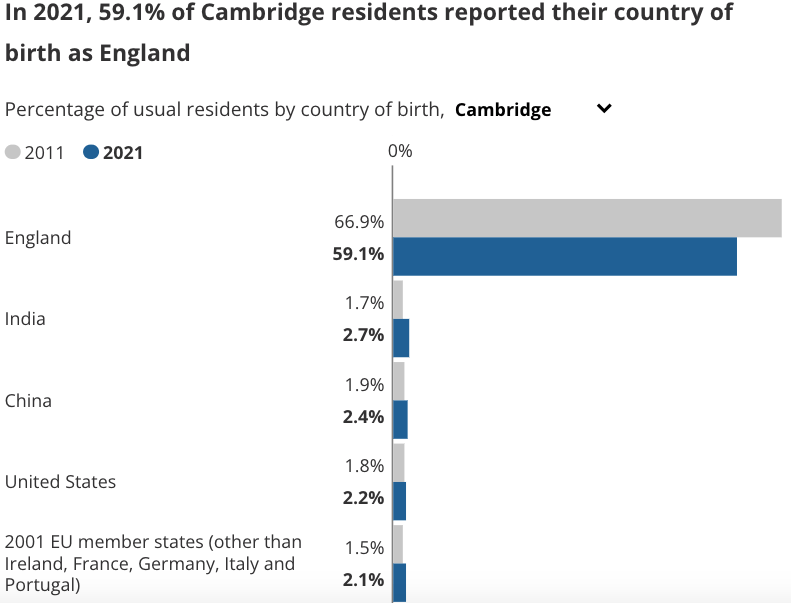
Above – from the Census 2021. I’ll leave it to you to calculate/estimate the percentage of citizens of foreign countries permanently resident in Cambridge unable to vote in local elections.
Remember that the UK lost the American Colonies over related principles – Taxation without representation is a tyranny, attributed to James Otis. So if the promoters of the growth of Cambridge – especially in Westminster and Whitehall, are serious about ‘citizens’, then let’s talk voting rights – and let’s talk governance structures too. Because as I’ve said time and again:
Cambridge will never be greater than the sum of its parts while its local institutions (town and gown) are fragmented, over-complicated governance structures where everyone finds it next to impossible not only to locate where ‘power’ resides, but where accountability and responsibility for decisions taken by big institutions reside.
“5 hospital trusts…”
How many people are familiar with how those hospital trusts are governed and how they and the NHS Trusts co-ordinate their policies and actions with other public services? Only Nick Kirby of the Cambridge Biomedical Campus told a meeting in Cambridge this evening that “No one thinks that Addenbrooke’s having such a small A&E is acceptable”. So why over the past 14 years – despite having a local MP as a health secretary for a number of them, has that A&E unit not being expanded? Noting that the same politician is chair of a local development forum and a member of the House of Lords. Part of finding the solutions to such long term problems has to involve going back through recent history, identifying the decisions that were made (and who took them – and on what evidence base) in order to try and solve them. Because as the transport authorities have found out the hard way, Cambridge has not stood still. The solutions that previous generations came up with in the Cambridge Futures 2 study in the early 2000s have long been overtaken by growth and events.
The future of any town or city is inherently a Political decision – and we all have to work with that irrespective of what we may think of individual politicians or political parties
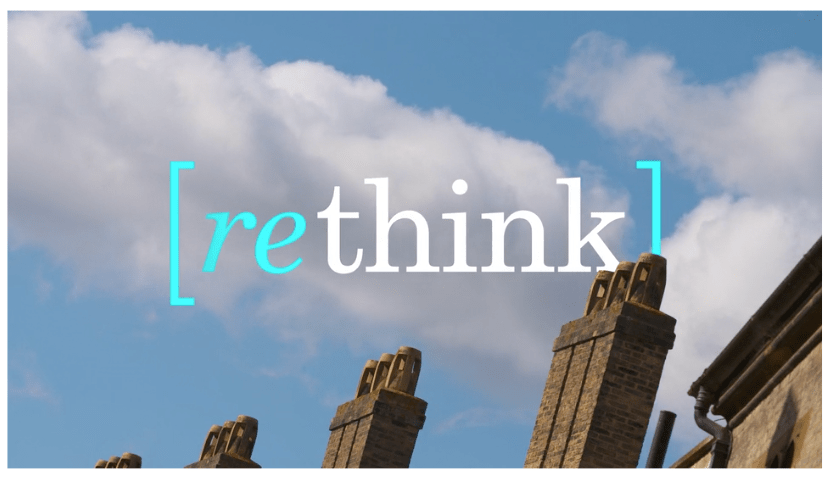
Above – a screengrab from the video. Should they re-think their narrative?
That depends what it is, and what you think of it.
“This is a place where everything is possible”
It really isn’t. Nowhere is. Rather…
One of the biggest challenges is working out what the environmental, ecological, and democratic/sociological limits to growth are.
Innovation within Cambridge has not happened because ‘everything is possible’ – they have happened within a set of boundaries, from the resources made available to the size of the buildings to the size of the workforces to the public services needed to sustain those workforces.
“Everyone has a part to play…”
This video does not show anything like the part that the people of our city and county have to play. If anything, it reflects some of the most excruciating observations made by a former Pro-VC in his 2065 vision for Cambridge back in 2014.
“Top people from around the world will still want to gather together to meet and discuss their research and ideas. The University’s unique selling point — its USP — will be its convening power, bringing key individuals to Cambridge to experience personal interactions and chemistry despite the large carbon, cost of international travel in an energy-deprived world. At every level, from undergraduate via graduate student, postdoc and sabbatical professor to top executive and world leader, Cambridge will be one of the key venues to come and be seen, and to rub shoulders with the global intellectual elite. If it sounds like an exclusive conference venue, then that may be about right.”
Sanders, J (2014) in Cambridge 2065, p48
Ten years later, how does that read? Not just from a moral standpoint but also given what’s happening in the world right now.
Yet in 1962, the Vice-Chancellor of the University of Cambridge, Sir Ivor Jennings QC had a very different message.

“We regard Cambridge as part of our inheritance as members of the University. It is our duty to pass it on to our successors improved and not impoverished. It will not be unchanged, because every generation has to build and rebuild.
“This second aim has no direct advantage to the University, and some people may question why we have included it in as a second aim. We do so to give a recognition to the fact that Cambridge is more than a University, it is a City in its own right, and its significance as a regional centre has grown and will continue to grow.“
Sir Ivor Jennings in the Cambridge Daily News 01 June 1962 in the Cambridgeshire Collection
Sadly last year another pro-VC was not interested in the words of Sir Ivor – instead as I saw it choosing to plead poverty on the University’s finances while combining them with college donations when it suited the headlines for the institutions. That thing about complicated governance structures? Again, Cambridge University’s decision makers don’t get to pick and choose which bits of their history they get to promote and which bits they get to dismiss. Any women members of the University of Cambridge may wish to ask whether the University ever formally apologised to Daisy Hopkins and the women of Cambridge – mindful that Daisy was still alive as recently as the early 1950s.
“What if exclusivity is what Innovate Cambridge wants because it’s more valuable and sell-able financially than ‘inclusivity.”
That for me is the root of where the future of Cambridge is being contested. This is something that the Bennett School of Public Policy at Cambridge is looking into – see Owen Garling’s research here.
“Innovation drives economic growth, but its benefits are not always shared equally, often leaving marginalised groups and economically lagging regions behind.”
Owen Garling, Bennett Institute, Cambridge 23 Oct 2024
Innovate Cambridge’s ‘glass house’ vs Together Culture
You can read about it here. In the grand scheme of things it is the complete opposite of Together Culture near the Grafton Centre as far as financial accessibility is concerned.
With the former, you have hierarchical, financially and socially-exclusive membership criteria that is based in one of the most out-of-place buildings in Cambridge – Botanic House. As ‘Hideous Cambridge’ wrote about the building on 16 September 2013, “In themselves they may be quite good buildings, but they don’t fit in. Botanic House is the most striking example of this.”
Together Culture on the other hand has a much flatter structure and has a membership structure that makes it available to those of us on Universal Credit – which has made it a hive of activity and ideas about the future of our city. Furthermore, it is working constructively with the new landlords and with Anglia Ruskin University about expanding its premises and functions because there are enough decision-makers within that community who understand and value the non-financial benefits that such a community can bring to a part of the city that was once the home to many-a-high-street brand in the 1990s that have long since imploded. If there’s one thing that this part of town has had to do, it’s innovating to breathe new life into The Kite while at the same time bringing back to life its radical past – which goes back beyond the post-war years. Just ask former councillor Henry Thomas Hall who was instrumental in the success of our public libraries.
“So…investors and entrepreneurs can work together with community groups for the good of the city?”
Yes – and CamSkate is another example of this. For any Innovate Cambridge people, pop along to any of the open sessions (see https://cam-skate.co.uk/) and speak to the volunteers there and ask how they did it. Then move away from discrete arms-length charitable handouts where you commission a CSR company to manage your CSR activities and look for community activity groups – especially in those parts of our city and county that need it, and start making long term commitments with them that involve breaking down the social barriers so that we get more partnerships of equals.
Look at where the infrastructure gaps are – something Dr Andy Williams, formerly of Astra Zeneca spoke about when he met residents in Queen Edith’s last year. To his huge credit, he is one of the very few people from the business sector brave enough to engage with residential communities *on their turf*. I had to do similar during my civil service days knowing that on some occasions I was inevitably going to get a kicking. But I learnt lots in the process of listening – even though I didn’t appreciate just how much of a difference this had until many years later.
With business wealth comes civic responsibilities.
One longtime Conservative councillor, Charles Kelsey Kerridge understood this concept and also recognised a huge gap in Cambridge’s sporting facilities – which is why he agreed to become the chair of a fundraising committee for a new sports centre in Cambridge.

Above – Kelsey Kerridge interviewed by Deryck Harvey of the Cambridge Evening News 03 July 1972 (transcribed here)
So successful was he in not only raising the money to get it built (despite the tough economic times of the early 1970s) but also ensuring that the money was spent properly, that we named the centre after him – the Kelsey Kerridge Sports Centre.

Alderman Kelsey Kerridge from the Cambridge Evening News of 1972
That was the 1970s. Can the members of Innovate Cambridge come up with new solutions to Cambridge’s massive inequalities that do not involve short-term unstable charitable funding? Note that MPs in the last parliament concluded council finances are unsustainable. Can they come up with a structure and system of local government that insulates civic finances from the storms that periodically hit Whitehall and Westminster, and can they persuade ministers to implement it? Can they help lobby for a system that *increases* democracy and citizenship participation both in collective problem solving and civic life? Or are they content for the announced cuts to both city and county council budgets to go ahead where our city council has to send out emails asking residents whether they want the axe to fall on public toilets or on the maintenance of car parks?
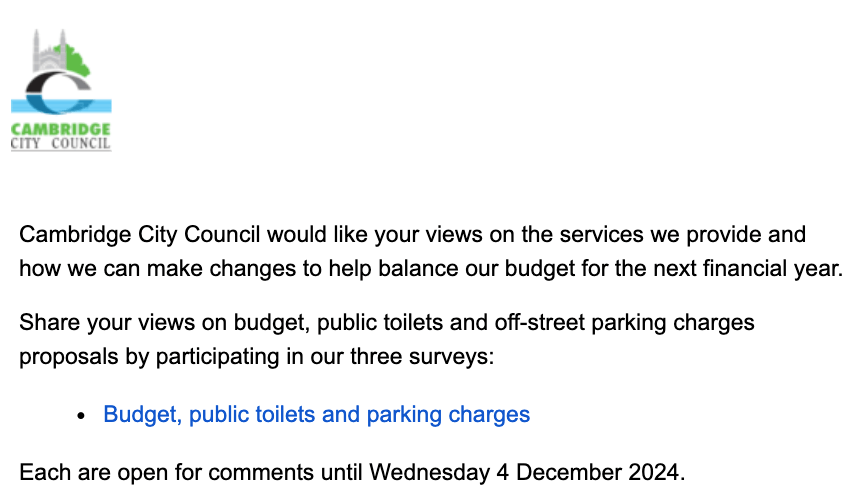
Above – email from Cambridge City Council 23 Oct 2024
Because if we end up with an even more enfeebled local council than we already have, while the Innovate Cambridge community and the sci-tech bubble continue to make its fortunes, that will reflect badly on all of us – just as the potholed roads and the huge need from Cambridge’s food banks – including from people in work, already demonstrates.
If Cambridge is to become greater than the sum of its parts – as I believe it can become, then it involves all of us. Not just the wealthy few protected by college and corporate walls
And as for that corporate video? I’d have gone with a different message. And soundtrack.
Furthermore, I’d get a magnificent new large concert hall built worthy of such a sound track – whether by Parker’s Piece (because the University isn’t using the land for a productive civic purpose) or as an anchor institution for a new urban centre on the Cambridge Airport site.
Food for thought?
If you are interested in the longer term future of Cambridge, and on what happens at the local democracy meetings where decisions are made, feel free to:
- Follow me on BSky <- A critical mass of public policy people seem to have moved here (and we could do with more local Cambridge/Cambs people on there!)
- Like my Facebook page
- Consider a small donation to help fund my continued research and reporting on local democracy in and around Cambridge.

 The Cambridge Town Owl