
The Chair of the Federation of Cambridge Residents’ Associations, Wendy Blythe verbally pinned down the Chair of the Government’s Cambridge Delivery Group at the Greater Cambridge Shared Planning Service’s update on the Cambridge Biomedical Campus
You can watch their exchange here. (Scroll back to the beginning to watch the full meeting)
Note this comes after the Minister for Housing spoke of ‘The Cambridge Model’ – which we still have no idea what that actually means.
Mr Freeman’s response
“I was at the Innovate Cambridge event today at the Town Hall with The Mayor…”
The local historian in me is horrified at the use of such a term given that Cambridge was awarded City Status in 1951 by King George VI, and that there’s a sign on the building that says ‘Guildhall’. And as for the Mayor, which one? The civic one or metro one created by George Osborne? Note the reason why this matters is that previous mayors have told me that visiting politicians from abroad assume that as Mayor of Cambridge they have executive powers – when in reality they are civic mayors. George Osborne went and messed things up by creating Combined Authority Mayors to cover places that have centuries-long traditions of civic mayors.
“All of the growth is ***entirely*** dependent on providing the infrastructure – for water, for transport, for affordable housing, for schools…”
Which sounds great, but the problem is that none of these things are within the gift of a single democratically accountable institutions. We know about the mess of the water sector. Ditto the fun and games of the Greater Cambridge Partnership. Affordable Housing funding ultimately comes from central government grants, permissions, or Section 106 agreements with developers. As for schools, Michael Gove’s academies policy simply created more work for MPs as taking anything out of local council control and putting it within national or regional quangos has this effect in our malfunctioning governance system. And as the last Parliament concluded, that system needs an overhaul.
“I’m absolutely passionate about creating great places – it’s what I’ve spent the last 30 years of my life doing. I believe Cambridge is a wonderful place, and it is over-stressed. We can provide the solutions – and the growth must be dependent on providing that infrastructure. I am on the same side as you [to Wendy]. We can’t answer everything today.
Over such a time period, Mr Freeman must have seen some failures – and big ones at that.
- What are the lessons that he’s learned from previous developments?
- How are those lessons applicable to Cambridge and our surrounding towns and villages
- Have those previous developments had formal post-occupancy evaluations and if so, can they be made available? (And if not, why not and will he urge the Minister for Housing and Planning to make such post-occupancy evaluations a mandatory part of all large developments and make at least the summaries publicly accessible?)
“What about residents?”
Have a listen to this question
“I haven’t heard anything about what makes this area special for residents. We’ve heard a lot about people moving in and coming out. Some of us live in this area 24/7”
Quite!
Note the responses about amenities. The problem is we’ve heard it all before and yet as Dr Andy Williams, formerly of Astra Zeneca told residents in the same neighbourhood (Queen Edith’s ward) in 2023, previous phases of growth and development *did not build those amenities*. Therefore what happens between now and 2040 or 2065 has to cover that gap too.
“What about Haverhill links?”
Paul Holinghurst of Rail Future East raised this here. I concur with his points – noting that the town where most of the employees commute in from was Haverhill. Which makes a nonsense of the GCP’s unwillingness to build a light rail link to the town.
“What are the governance arrangements? Who is in charge?”
Question from Wendy Blythe – noting that Cllr Martin Smart, the Chair of the Planning Committee quite rightly asked where the Master Plan is for the Cambridge Biomedical Campus.
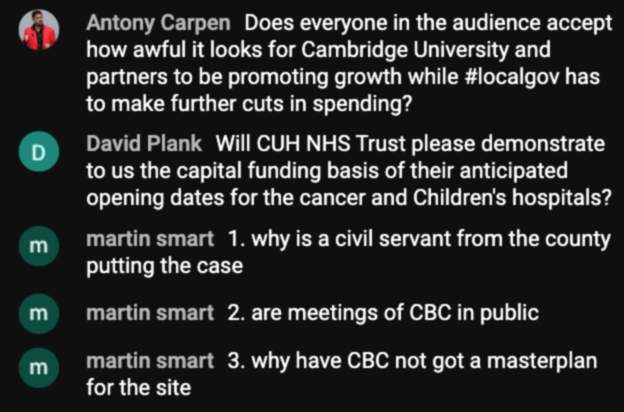
Above – from the chat comments in the video
And as for learning about the processes that all of this involves?
This came up at another gathering I was at earlier this week but in the field of AI and innovations in all things sci-tech, and how it is affecting / undermining democracy. My complaints about adult education provision (and lack of) aside, ministers or the professional institutions should be producing a new generation of civic guides – both online and paper copies on sale in shops. Here’s a relatively short guide from 1968 on Town and Country Planning. Inevitably things will have changed as structures, policies, and politics have moved on.

Above: Town and Country Planning in Britain (1968) HMSO/COI
There’s a huge public interest in a critical mass of the public understanding the system and structures and being able to ask informed questions – and receiving informed answers in response. The behaviour and actions of the GCP over the past decade has hugely undermined that trust that is ever so important for large projects. Yes, there will always be opponents, but if whatever the policy is can be framed as a shared challenge that local people can influence the final result of, so much the better.
Otherwise they developers may as well state from the outset that they are going to impose their designs and dump bland boxes everywhere for maximum profit. And Cambridge deserves better than that. In fact, everywhere deserves better than that. Which is why the reforms to the planning system are ever so important.
Food for thought?
If you are interested in the longer term future of Cambridge, and on what happens at the local democracy meetings where decisions are made, feel free to:
- Follow me on BSky <- A critical mass of public policy people seem to have moved here (and we could do with more local Cambridge/Cambs people on there!)
- Like my Facebook page
- Consider a small donation to help fund my continued research and reporting on local democracy in and around Cambridge.

 The Cambridge Town Owl