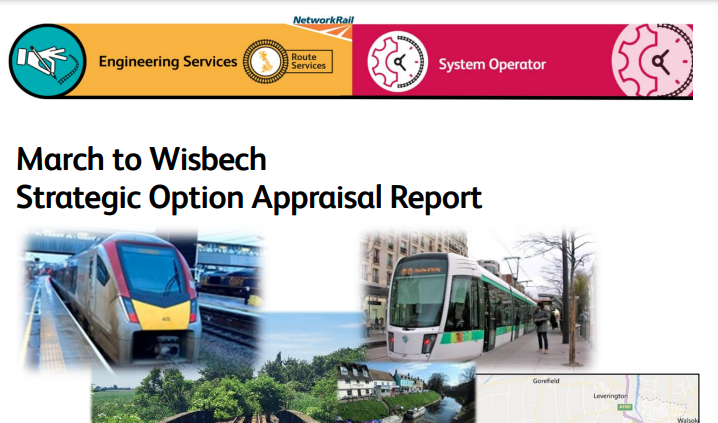
Can Cambridgeshire do better than an A-to-B shuttle service from one Fenland town to another? Noting that Ely-Cambridge has come up again too
You can read the papers at Item 12 of the Combined Authority’s Transport & Infrastructure Committee here. At the same time, you can read my snapshot of the county’s wider infrastructure issues here, which follow in item 13 of the T&I meeting papers.
I already have a PQ tabled for this meeting that was carried over from the Environment Committee because the CPCA said the issues were best addressed there in a report (The Infrastructure Delivery Framework) tabled to both committees.
“What was the question?”
See Item 13 here, in particular Annex A
It’s this bit:

The report on p12 states further:
“The Greater Cambridge Partnership’s (GCP) Making Connections programme was a potential solution to this with the aim of reducing traffic volumes within the city by 15% on a 2017 base, but this is not now progressing. This creates a significant gap, given its potential to alleviate congestion in and around Cambridge and contribute to a significant improvement of the public transport network. The CPCA is leading work with the local authorities and GCP to explore solutions to this via the emerging Greater Cambridge Transport Strategy”
Therefore I’ve asked:
***Please can the CPCA initiate discussions with ministers about building a light rail for Greater Cambridge as envisioned by Connect Cambridge for the years after the GCP funding comes to an end.***
Because as things stand there is nothing substantial that deals with the ‘last mile congestion’ that the GCP was set up to deal with. And as the above quotation shows, the Combined Authority has now taken over in leading on the work previously covered by the Making Connections project – the one that tried to bring in congestion charging without learning the lessons of the attempt back in 2007
“So…basically the senior transport officers have screwed up big time?”
In my opinion, yes – but so did the politicians past and present on the GCP Board. In my opinion they should have been far more searching in their questions to said officers. Not least ensuring that GCP officers had assessed the results of the 2007 Congestion Charge Survey that nearly 5,000 residents had responded to.
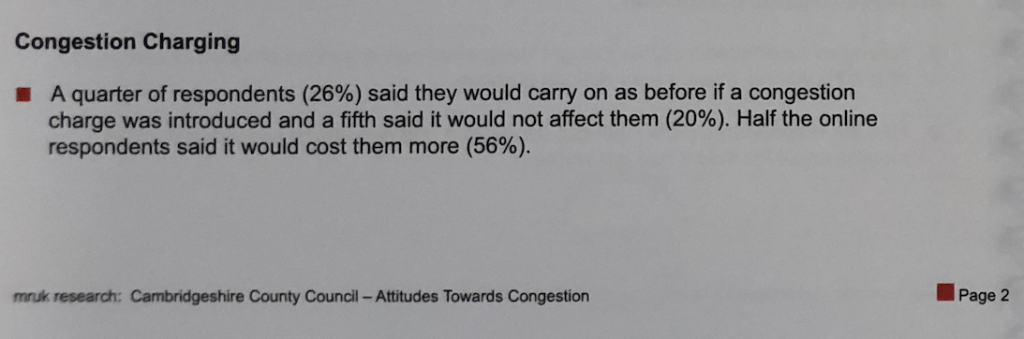
Above – from the Executive Summary of Attitudes Towards Congestion (2008) MRUK for Cambridgeshire County Council.
Finally, they all should have been far more willing to negotiate with neighbouring county councils and ministers over a more radical approach – especially as the climate emergency became and is still becoming ever more pressing. (In other news, why not open an international airport in Greenland?!?) But it’s too late now, hence pitching this as a post-GCP thing.
“Back to Wisbech – how do we reconnect it back into Cambridgeshire’s transport network?”
Not like this:
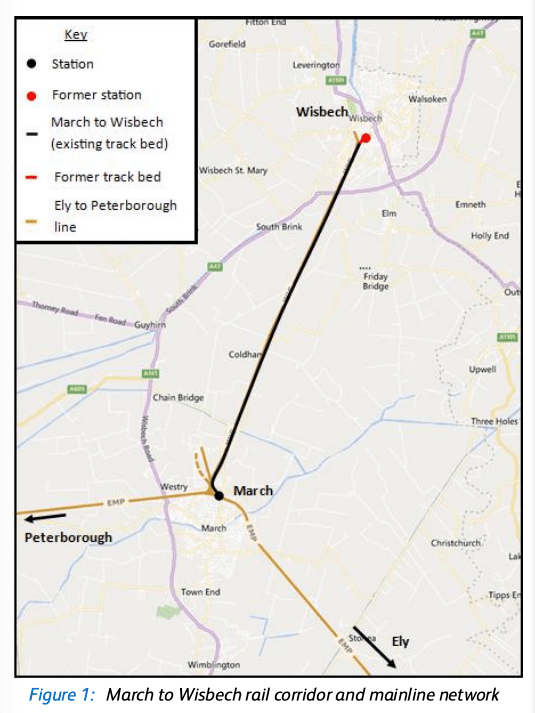
The discussion seems to be on what sort of transport mode the A-2-B, or rather the W-2-M (Wisbech to March) ‘shuttle’ should take.
- Heavy Rail alone
- Tram-Train (i.e. a track suitable for both heavy and light rail)
- Tram
- A Coventry-Style/Airport-Style ‘Very Light Rail’
For those of you who want to know more about the differences between each, get hold of copies of Tramways and Urban Transit Magazine. (Cheaper historical back copies are available second hand)
A point-2-point reconstruction might be the cheapest financially, but…
…would the benefits be far greater if councillors could persuade ministers to build Wisbech Rail into an incorporated and connected rail network?
For example:
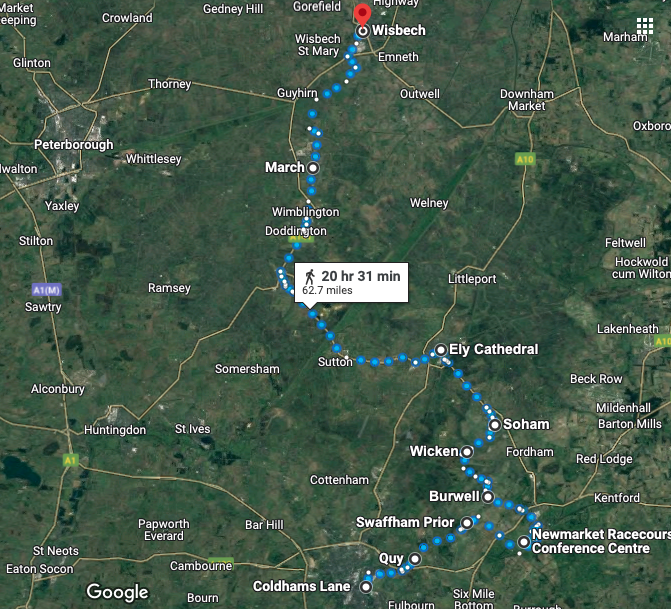
Above – from October 2022 where I pondered how a new route could link up Chatteris (where we know the new reservoir will be built) along with the visitor centres of Wicken Fen and Newmarket Racecourse.
Furthermore, a cheaper version reconstructing the Newmarket Chord would simply mean that a Wisbech-March-Ely service could use the Soham route (the station re-opened at huge expense) to provide the people of the village with additional stopping services en route to Cambridge, while at the same time adding resilience to the network between Cambridge-Ely whenever the Waterbeach section of the line goes down, as every so often it does.
A reminder – The Greater Peterborough Rail Loop concept
This is what I think the Combined Authority should be looking for:

Above – from G-Maps: A conceptual Peterborough and North Cambs light rail loop.
The above was part of a series of concepts I played with in this blogpost. As far as Cambridge is concerned, a North-West-of-Cambridge loop would connect up with Chatteris and Ramsey creating a corridor where both towns shared the same rail line that connects the two loops
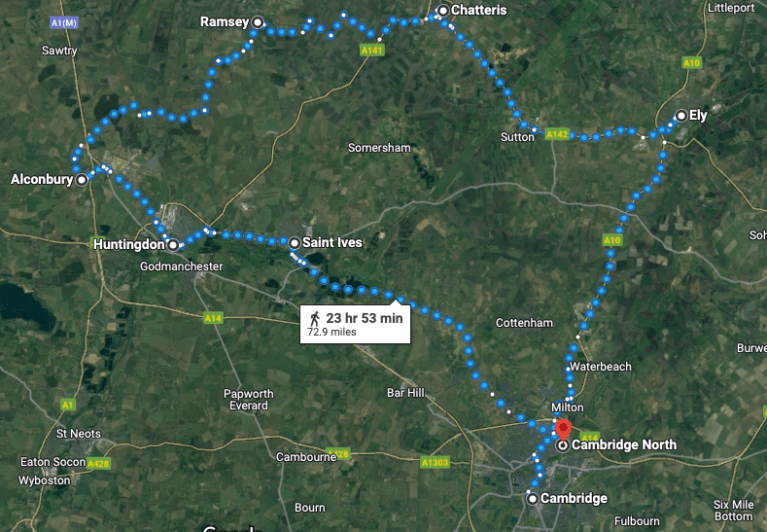
I incorporated the above into a blogpost on the Chatteris Reservoir here.
Incorporating Wisbech into a rail/light rail network treats the historic market town and Fenland port as an integral part of the sub-regional economy rather than a dormitory settlement for those Cambridge workers unable to live closer to the University City may find themselves. And that’s not fair on both residents or workers. I’d like to say that Cambridge needs to resolve its own housing and industrial strategy problems – but it cannot do so while Ministers and others take decisions for the city while withholding the tools, finances, and legal powers needed to administer and govern a city with the consent of the people who make that city. And we don’t have that.
Ely-Cambridge Corridor
I don’t know whether they did this deliberately, but the study area on the consultant’s map conveniently *includes* the A14 dual carriageway between Cambridge-Newmarket but *excludes* the railway line.
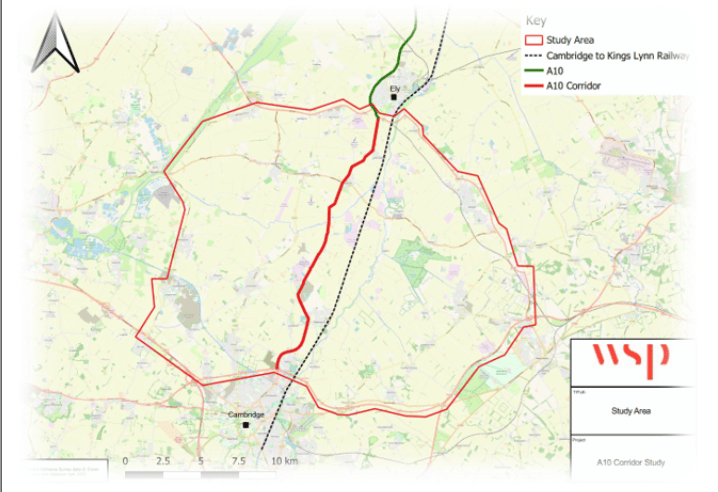
You can see the feint grey line at the foot of the image above which is just outside the area with the thin red border on the map. That makes it perfectly convenient for highways engineers to look at ‘bus only’ solutions – which is what we’ve seen with GCP projects that have made no effort to engage with rail/light rail solutions. Rather, they have spent more time opposing rail and light rail campaigners rather than engaging with neighbouring county councils and with ministers over the possibility of securing additional funding and support for more radical solutions. Which will make the county council election debates that little bit more interesting.
Again, note the original Ely-Cambridge outlines from back in 2018. Little attempt

As the diagram indicates, there is no plan for what happens when the buses hit the city other than the phrase ‘…join the existing bus network’. As we have since seen, the GCP has abandoned its attempts to deal with that problem – the Combined Authority now taking this over.
Do they have a big map anywhere showing them what Cambridge in 2041 might look like with the developments all built out?
If they don’t they should do – here’s what the Greater Cambridge Shared Planning Services shows:

Above – the Cambridge Urban Area as anticipated in 2041 by the GCSP here
This sits within the wider Greater Cambridge area:

Above – Greater Cambridge as anticipated in 2041 prior to any additions from the New Labour Government
Let’s not forget the buses either
Note that the Combined Authority confirmed it would be assessing the growth of private commuter bus networks which are springing up all over the place in face of Cambridge’s chronic transport issues. (See my blogpost here). If anyone wants to table a public question asking for a progress update, feel free to do so.
The levels of growth being discussed are not being matched by the current transport proposals. At the moment there is a massive failure from the private sector – in particular the ones that ministers want to impress, about the problems of traffic congestion as well as the need to treat Cambridge as a city and Cambridgeshire as a county, rather than land assets to be milked for corporate financial gain. Hence also my accusation that generations of pro-growth supporters have failed to take the people who make up our city with them in their plans.
On 30 October 2024 The Chancellor makes her Budget Statement to the Commons. It will be interesting to see what spending commitments or otherwise she has to say about Cambridge – from things like transport infrastructure to new towns. That statement alone could be an historic milestone in the history of our city.
Food for thought?
If you are interested in the longer term future of Cambridge, and on what happens at the local democracy meetings where decisions are made, feel free to:
- Follow me on BSky <- A critical mass of public policy people seem to have moved here (and we could do with more local Cambridge/Cambs people on there!)
- Like my Facebook page
- Consider a small donation to help fund my continued research and reporting on local democracy in and around Cambridge.

 The Cambridge Town Owl