
Housing Minister Matthew Pennycook MP tells Cambridge Growth Company Chair Peter Freeman that “one or more contiguous urban extensions of the city [of Cambridge] must be core components of the vision”
It was Mark Williamson who spotted this earlier and this blogpost looks at the last time around such a massive expansion of Cambridge was proposed in the 1970s by a regional quango. This follows on from the announcement from the Government:
The important paragraph is as follows (from the appointment letter):
“When it comes to the growth strategy, development on a more dispersed geographical footprint is perfectly acceptable, but one or more contiguous urban extensions of the city must be core components of the vision the Growth Company brings forward, in order to maximise the benefits of agglomeration. It must also build on and go further than local plans, in terms of scale, ambition and timescale, and you should work closely with local partners to tackle the constraints that can be difficult to overcome at the local level alone.”
“Who is John Parry Lewis?”
Professor John Parry Lewis was the hunktastic academic employed by the long-since-defunct East Anglian Economic Council. This was the first of a few regional tiers that had a habit of being established or given rocket-boosters by Labour Governments only to be abolished by the Tories – see also the Government Office Network (although Michael Heseltine established that network in 1994).

Above – Hunk: Prof Parry Lewis (JPL) from the Cambridge Evening News 27 Nov 1973 from the Cambridgeshire Collection, in Lost Cambridge here.
“In the 1970s everyone was squabbling over who should have the final say over the future of Cambridge”
Above – me (Antony Carpen) in the Cambridgeshire Collection highlighting archived files of newspaper cuttings on development planning in Cambridge 1950-1990.
I think the Cambridge Growth Company should fund some new archivist posts at the County Archives as well as the Cambridgeshire Collection given that the £10m of new funding is meant to be used to gather an evidence base amongst other things. (How long is that money meant to last for?)
Note Prof Parry-Lewis also called for a new second centre for Cambridge – something that I want to see happen if Ministers get their way with the massive expansion of the city.
John Parry Lewis’s options for Cambridge – 1974
Long-time readers of this blog and of my local history blog Lost Cambridge will be familiar with the diagrams below, but for those of you who are new to this, JPL produced two options: one for the southward expansion of Cambridge, and one for the eastward expansion. (If I recall correctly, his preference was for the southern one.)

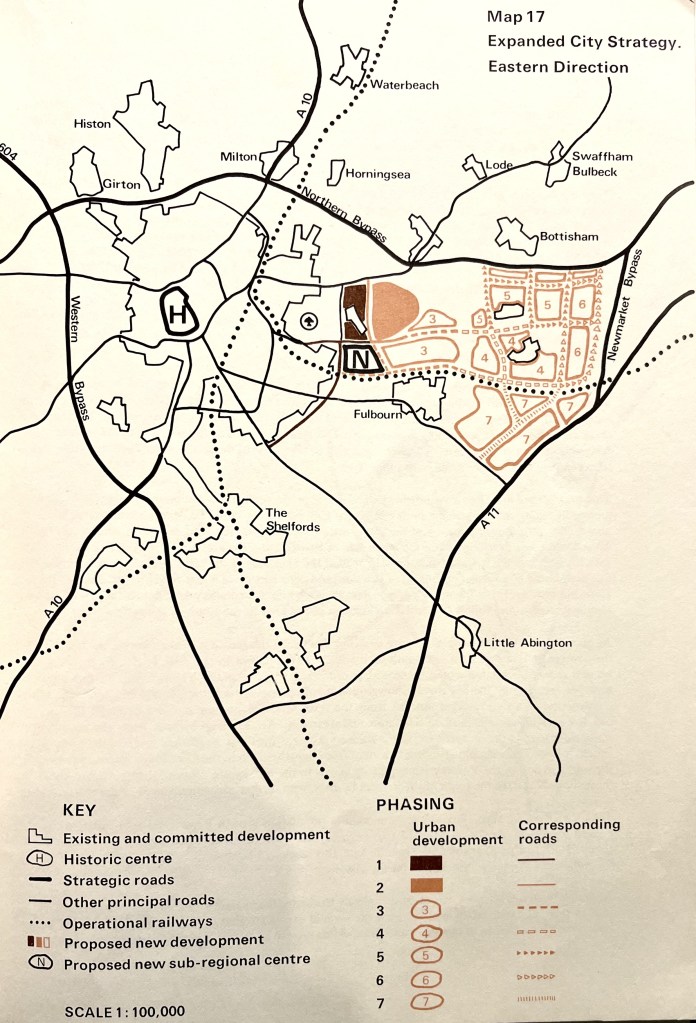
Above – both maps from JPL’s Study of the Cambridge Sub-Region (1974) HMSO digitised here.
You can also browse through the first half of part 2 of his study here
The Housing Minister’s commission to Peter Freeman – October 2024
“To ensure that immediate progress is made, I would like you to lead the Cambridge Growth Company in progressing the following priorities…Developing the evidence base to support development of an infrastructure-first growth plan and a long-term delivery vehicle: work with experts to assess infrastructure requirements, including transport, and lay the foundations for a long-term delivery vehicle”
Above – Press Release HMG Appointment of Peter Freeman 31 Oct 2024
Lessons from Peterborough 1968-88
That ‘Long term delivery vehicle’ is a development corporation. (Not a truck). Is this new to Cambridgeshire? No. Because when Peterborough City Council was a borough-level council in the olden days, Labour Prime Minister Harold Wilson designated it as a 3rd generation new town in 1967 – and thus created the Peterborough Development Corporation 1968-88. You can browse through the Peterborough newspapers of the era that have been digitised by the British Newspaper Archive here. In the mid-1960s Peterborough and Cambridge had broadly similar populations of around 90,000.
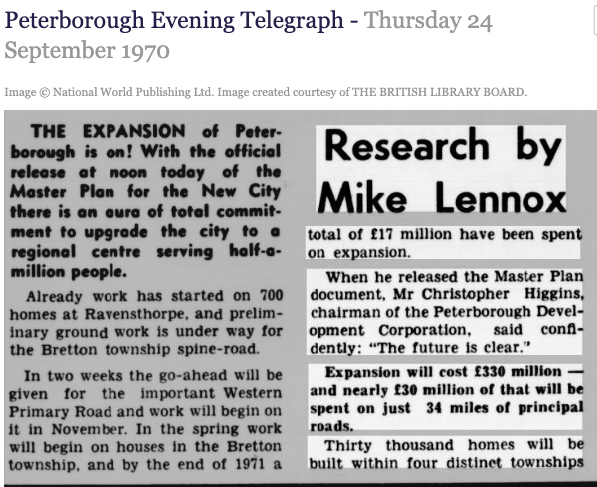
Above – Peterborough Evening Telegraph 24 Sept 1970, in British Newspaper Archive
By 1991, Peterborough’s population had increased to 150,000 (While Cambridge was 101,000), and in 2021 Peterborough’s population had risen to 215,000, with Cambridge at 145,700. You can compare the original plans for Peterborough here with what the city is like today.
Note the estimated expansion cost of £330million quoted in the 1970 article above. In 2024 money that’s around £4.4billion. If Cambridge is to embark on a Peterborough-style expansion, how do we ensure that the wealth created is not syphoned off by speculators into tax havens or climate-chomping status symbols such as yachts and private jets? Because land speculators have already bought up large plots of land that they expect will be released for development. Just look at North Cambourne. Furthermore, growth plans should not be based upon the sites that landowners and developers are offering up.
What a Coordinated Plan for Cambridge Might look like – Andrew Lainton 2024
Have a read here – it’s a longer read but worth it. The reason why I like this is that it gets into the specifics of what goes where. At the moment everything feels to vague and fluid.

Above – Andrew Lainton’s vision for Cambridge post-development (so…2050?)
The green dashed lines are the proposed busways from the Greater Cambridge Partnership, and the green dashed lines indicate opportunities for trams/light rail incorporating some of Cambridge Connect’s proposals. Part of the Cambridge Growth Company’s budget should go on funding a proper feasibility study for Cambridge Connect.
Note the areas coloured in grey are existing built up areas, and the bits in yellow are the parts of the rural villages that should be protected so as to prevent urban sprawl. The bold ‘mouldy pink’ areas are sites already part of the existing and emerging local plans to 2040, while the hazy ‘mouldy pink’ areas are the ones that Mr Lainton proposes.
The growth he proposes is similar to what Gordon Logie proposed in the 1960s – this being picked up in the Cambridge Transportation Study by Travers Morgan and Partners which you can read in the Cambridgeshire Collection.

Above – the proposed Cambridge Cycleway Network as anticipated in 2001, created in the 1960s and as proposed by Cambridge City Council Architect Gordon Logie from the Cambridge Transportation Plan 1966 in the Cambs Collection.
The above diagram shows that Mr Logie was anticipating the growth of Cambridge south-eastwards along Great Shelford Road (one that William Davidge who wrote the 1934 Cambridgeshire Regional Plan thought was an appalling example of ribbon development!), with a ‘green bar’ separating Coleridge Ward from Cherry Hinton Village – that latter village proposed merging with Fulbourn. The S icons indicate secondary schools of the era. The three along the ‘Green Bar’ separating Cambridge from Fulbourn were St Bedes (as is today), Netherhall Secondary Modern (then segregated into Boys and Girls sections), and the Cambridge Grammar School for Boys. (Today, the site of the Secondary Modern on Gunhild Way is now Queen Emma (of Normandy I think) Primary School, with the current Netherhall School being moved onto one single site in the early 2000s.
And finally – note the importance of the wide open green spaces
Part of this is similar to the Cambridge Great Park proposals which I think should be brought back – and also I believe should incorporate a new woodland cemetery/burial site/memory forest. That way you get the benefits of the land serving multiple purposes – including reducing the impact of urban heat islands made worse by architects and developers buildings new homes painted in dark paint. (Northstowe and Clay Farm have examples of this).
Start organising the meetings and events now – because the next six weeks will go by in a flash and the consultations will have started.
If you are interested in the longer term future of Cambridge, and on what happens at the local democracy meetings where decisions are made, feel free to:
- Follow me on BSky <- A critical mass of public policy people seem to have moved here
- Like my Facebook page
- Consider a small donation to help fund my continued research and reporting on local democracy in and around Cambridge.
Below – go and fly The Kite with Together Culture. Much more fun – one place to have some of those meetings?

 The Cambridge Town Owl