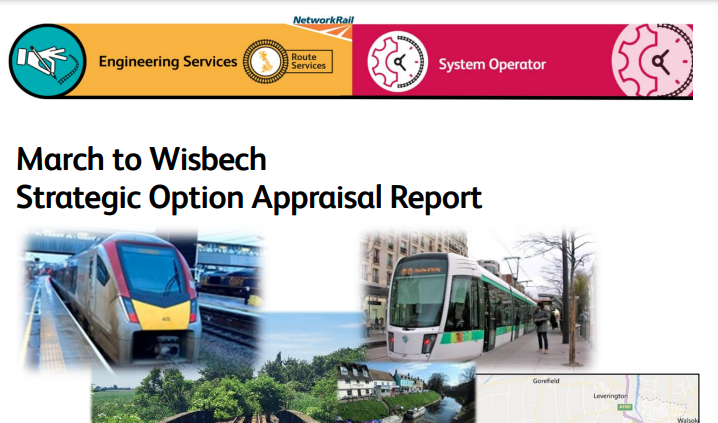
…said Dr Andy Williams, formerly of Astra Zeneca to the Combined Authority’s Transport and Infrastructure Committee
Which sounds great to me because that’s what I have been calling for ***for ages*** (most recently here when the meeting papers were published) …and I only found out about Wisbech Rail because I took Puffles to a meeting of Rail Haverhill *in* Haverhill (the joys of the X13 bus) way back in 2014 and Pete Wakefield of Rail Future East Anglia told me about them.
Which reminds me – Rail Future East’s annual meeting in Cambridge is in a month’s time

- Saturday 7th December 2024 at 14:00
- The Signal Box Community Centre, Glenalmond Avenue, Cambridge CB2 8DB
More details on the venue here which Rail Future use annually for their gatherings. Before you go, please have a browse through their past newsletters as you’ll find ***lots of stuff*** on transport planning and campaigning that are seldom covered in the media…such as the Newmarket Chord that could be incorporated into one of the solutions Dr Andy Williams spoke of.
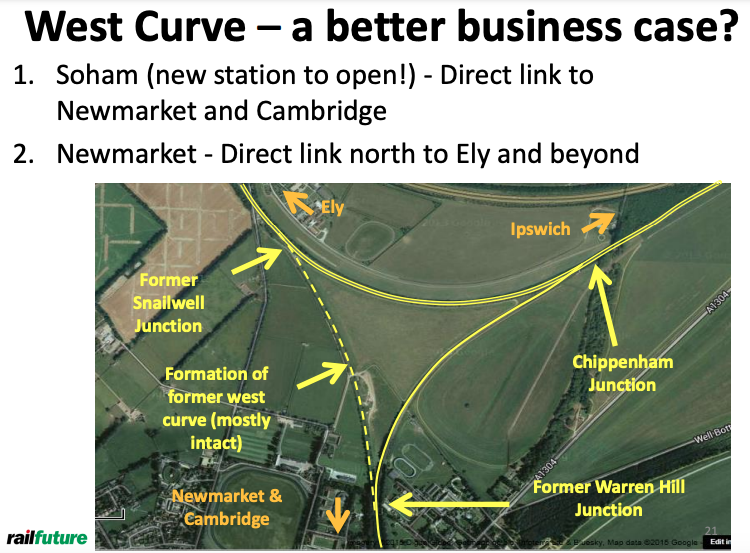
Above – from the Rail Future Newmarket presentation from 2019. If the GCP had not been so parochial and narrow-minded they could have put up some funding to have gotten this link reinstated, providing an alternative route for trains from Cambridge to Ely every time the line through Waterbeach went down.
Wisbech Rail – Dr Williams’ comments.
Prior to Dr Williams’ comments, there were a stackload of public questions. See them listed at item 4 here.
“Please can the CPCA initiate discussions with ministers about building a light rail for Greater Cambridge as envisioned by Connect Cambridge for the years after the GCP funding comes to an end.”
Have a listen to the response from Cllr Anna Smith (Labour – Coleridge, Cambridge City Council here. This is relevant to Dr Williams’ comments later on.
Partnership working – good and bad
In this clip, Dr Williams is addressing Dr Nik Johnson, the Mayor of the Combined Authority. The former was involved at the start of the Greater Cambridge Partnership a decade ago – and spoke about the hostility between the GCP (even with Conservative representation on the board) vs the Conservative-majority Combined Authority.
Then Dr Williams spoke about Wisbech Rail, expressing surprise at how expensive a Wisbech-March link is under ten miles for £200million.
“Just reconnecting Wisbech-March doesn’t make sense – you’re just creating a line between two towns. It needs to be folded into a strategic case – we need to find that case.”
Followed by Cllr Neil Shayler (Labour – Romsey Division, Cambridgeshire County Council)
“I don’t think Network Rail’s thinking is either strategic or forward-looking – but then that’s not their job to plan for future communities or prosperity”
Is that one of the weak links in the chain? Where Network Rail effectively has a veto power on the visions and plans of city regions and economic sub-regions? When put like that, the drive from successive Mayors of London to get suburban rail services incorporated into Transport for London (thus creating London Overground) now makes much more sense. Network Rail and predecessors had no incentive to integrate improved transport planning with economic redevelopment and environmental and social redevelopment.
“Someone said earlier that the Wisbech-Cambridge business case is much, much better”
Cllr Neil Shayler (Labour – Romsey Division, Cambridgeshire County Council)
Which was one of the options in my ‘with all bells and whistles’ proposal for a light or suburban link from Wisbech to Cambridge via Chatteris, Ely, and Soham.
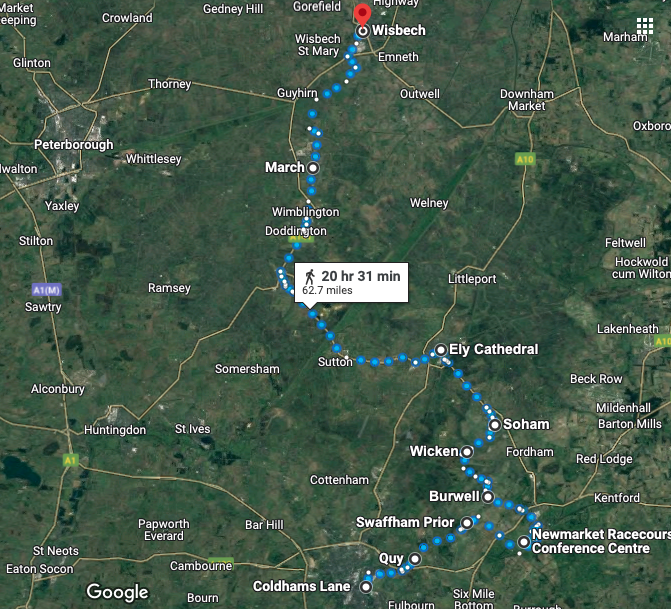
Above – from October 2022 where I pondered how a new route could link up Chatteris (where we know the new reservoir will be built) along with the visitor centres of Wicken Fen and Newmarket Racecourse.
Fast forward to today and we know that the Chatteris Reservoir is all-but-going ahead. The Mayor Dr Nik Johnson mentioned that he had been making the case for extending the Wisbech-March line to Chatteris. Have a listen to his comments here.
Both Drs Nik Johnson and Andy Williams – and Cllr Shayler – expressed strong concerns about the limitations of benefits-costs-ratio (and about the money only).
One of the future visions that Rail Future East Anglia has come up with is the map for new stations across Cambridgeshire (See the list here)
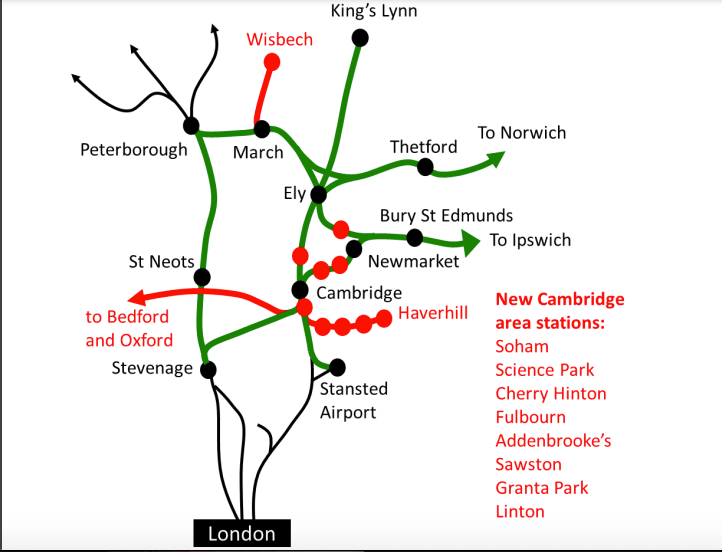
Above – Rail Future East Anglia – Campaign leaflets (scroll to the end)
While I prefer the concept of the rail loops as I wrote here, the improvements to the track and network should enable crawler services from Wisbech all the way through to Haverhill via March, Chatteris, Ely, Soham, and Cambridge. The benefit of this *if* the Cambridge-Newmarket line is properly upgraded is that the science parks being built at Coldham’s Lane, west of Cherry Hinton, and Fulbourn, along with the Biomedical Campus, are all ‘connectable’ with those currently cut-off Fenland towns.
Note the risk is that the Fenland towns get treated as ‘dormitory towns’ by the Sci-tech bubble. This must be avoided – and decision-makers (not just the politicians, but private sector people too) must ensure this is the case
We know this is a risk because back in 2014 Prof Jeremy Sanders told everyone it was a possible outcome for Cambridge in the year 2065.


Above – Cambridge 2065 (published 2014) p40-41
It’s worth reading the Professor’s piece in full, and then coming to your own conclusions.
“Cambridge will be one of the key venues to come and be seen, and to rub shoulders with the global intellectual elite. If it sounds like an exclusive conference venue, then that may be about right.” Sanders (2014)
I expressed my concerns in an earlier article here as it made the future of the city sound like Monaco but where the 1% went to meet sci-tech boffins before being punted down the Cam. It also reflects why I think ministers should be looking at co-ordinated/common ‘landing points’ for Cambridge startups that take off and become too big for our city – hence suggesting both Bedford and Northampton in this blogpost. Both are proud historic county towns, both have extensive riversides presently dominated by bog box retail, and the Create Streets people could explore their architectural dreams without the high land costs. That is assuming they worked with and secured the consent of the residents of the towns. Hence making the case fo the University working with surrounding towns and villages here.
So…the question is:
How can Wisbech Rail be integrated into a wider strategic plan while removing the risk of the historic inland port and market town becoming a dormitory town for a Cambridge economic powerhouse? (Labour’s George Scurfield had some thoughts back in 1969)
Food for thought?
If you are interested in the longer term future of Cambridge, and on what happens at the local democracy meetings where decisions are made, feel free to:
- Follow me on BSky <- A critical mass of public policy people seem to have moved here (and we could do with more local Cambridge/Cambs people on there!)
- Like my Facebook page
- Consider a small donation to help fund my continued research and reporting on local democracy in and around Cambridge.

 The Cambridge Town Owl